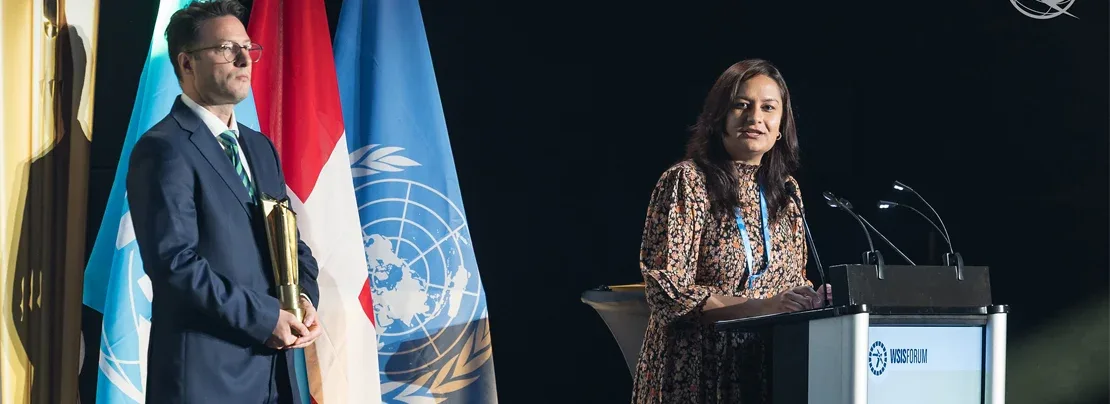
The World Summit on the Information Society (WSIS) Forum 2026, organized jointly by the International Telecommunication Union (ITU) and Switzerland, took place in Geneva from 6 to 10 July. The event ran concurrently with the AI for Good Summit and the inaugural Global Dialogue on AI Governance. As the first WSIS Forum following completion of the WSIS+20 Review in 2025, it signaled the opening of a new chapter in advancing the global digital development agenda.
A dominant message emerged across the week's sessions: the international community is transitioning from compiling pledges to demonstrating tangible, measurable progress. Following the WSIS+20 Review, participating nations reaffirmed backing for the WSIS framework extending through 2035. Throughout the Forum, speakers underscored the continuing relevance of the multistakeholder approach, with governments, technical experts, civil society organizations, academic institutions, and commercial entities all playing roles in advancing digital development.
The WSIS+20 outcome document, finalized in December 2025, establishes the direction for the coming period. A significant decision required all WSIS Action Line facilitators to create results-focused implementation roadmaps that align with pertinent Sustainable Development Goals (SDGs) and Global Digital Compact (GDC) pledges. This signals a fundamental reorientation: whereas WSIS previously concentrated on cataloging initiatives, partnerships, and undertakings, the emphasis now centers on establishing targets, metrics, and measurement frameworks capable of demonstrating actual results.
Building implementation roadmaps
Participants repeatedly identified a persistent challenge: difficulty in monitoring and evaluating WSIS-connected work throughout the UN ecosystem and among broader stakeholder networks. To enhance transparency and synchronization, UN bodies are assembling an integrated platform consolidating data on WSIS Action Lines, encompassing lead agencies, undertakings, deliverables, and stakeholder involvement. This unified resource is anticipated to reflect heightened emphasis on transparency and cooperative coordination.
The UN Commission on Science and Technology for Development (CSTD), responsible for supervising yearly WSIS implementation assessments, indicated that forthcoming reports should prioritize measurable outcomes rather than merely cataloging activities—a notable departure from earlier reporting approaches that stressed activity volume over demonstrated impact.
Constructing implementation roadmaps presents substantial obstacles. Certain Action Lines, including C1 addressing 'The role of governments and all stakeholders in the promotion of ICTs for development', encompass expansive scopes that resist straightforward execution. Multiple speakers at this year's Forum proposed subdividing extensive commitments into narrower, more manageable initiatives with distinct implementation strategies and performance indicators. Action Line facilitators must finalize their roadmaps by 2027, making the coming year pivotal for converting WSIS commitments into concrete undertakings.
From representation to participation
Multistakeholder engagement remained fundamental to discussions. Nevertheless, the conversation increasingly centered on participation quality rather than merely guaranteeing representation from varied constituencies. Speakers stressed that meaningful digital collaboration demands involvement at grassroots and regional tiers, extending beyond attendance at international conferences. Populations experiencing the effects of policy choices require substantive channels for shaping and contributing to their implementation.
This perspective featured prominently in deliberations regarding the Internet Governance Forum (IGF)'s trajectory. Attendees consistently maintained that prospective structures for state participation should remain embedded within the broader multistakeholder framework rather than transforming into a separate governmental mechanism. The São Paulo Multistakeholder Guidelines, formulated during the NetMundial+10 initiative, were regularly cited as a practical model for operationalizing multistakeholder governance. Their inclusion in the WSIS+20 outcome document garnered widespread recognition as a noteworthy accomplishment.
What's next for the IGF?
The IGF's newly established permanent mandate constituted another prominent discussion point. Despite continuing conversations about the Forum's direction, appetite for sweeping changes remained limited. Rather, participants advocated for reinforcing current structures and concentrating on a productive global IGF gathering scheduled for Nairobi this year. Many contributors emphasized national, regional, subregional, and youth IGF initiatives as among the model's most successful components. However, enhanced coordination between National and Regional Initiatives (NRIs) and the global IGF remains necessary to ensure that regional insights more effectively shape worldwide policy conversations. The 2026 WSIS Forum devoted substantial attention to the IGF, reflecting the deepening relationship between these two forums.
From regional success to global recognition
A notable moment occurred when the APNIC Foundation's Building Capabilities in the Asia Pacific (BCAP) initiative received the 2026 WSIS Prize in the Capacity Building category. The recognition reflects the importance of ground-level, community-driven programs that generate concrete benefits and foster digital advancement throughout the region.
Looking ahead
WSIS Forum 2026 inaugurated a fresh implementation phase centered on producing evidence of progress. The task ahead is no longer establishing what stakeholders pledge to accomplish but proving they are accomplishing it. As facilitators construct implementation roadmaps throughout the coming year, the conversation will increasingly center on data-driven reporting, quantifiable achievements, and stakeholder accountability. Whether the subsequent phase of WSIS succeeds hinges on the capacity of the community to transform expansive pledges into concrete measures generating substantive advantages at neighborhood, territorial, and planetary scales. Whereas the initial two decades of WSIS emphasized forging agreement, the approaching decade may be characterized by the community's performance in fulfilling those agreements.