Jelena Cosic, a Community Builder for RIPE NCC, has spent years supporting Internet governance initiatives across Southeast Europe through her work with ISOC and PCH, including hackerspaces, IXPs, and regional meetings.
Researchers studying Internet infrastructure and network operators managing production systems stand to gain from closer collaboration. Yet many valuable partnerships emerge by accident rather than design at RIPE Meetings, where both groups converge around shared concerns about how Internet infrastructure actually behaves.
The challenge lies in converting these chance encounters into sustained working relationships. Researchers gain access to operational experience and real-world technical problems, while operators receive research findings that deepen their understanding of their own networks. However, deliberate mechanisms to help these groups identify each other and pursue questions of mutual interest remain limited.
Obstacles to Working Together
Researchers and operators encounter multiple hurdles when attempting to partner, most of which extend beyond purely technical concerns. Misaligned expectations, legal constraints, and the difficulty of moving research from theory into operational deployment all complicate collaboration.
Accessing operational data ranks among the most significant barriers. Production network data is often essential for research, yet sharing it raises legal and privacy complications. Operators must navigate data protection regulations and establish clear terms governing how information may be used, stored, and disclosed. Even when both parties want to cooperate, negotiating these agreements demands substantial time and effort.
Beyond legal considerations, operators frequently hesitate to share data due to competitive or security concerns. Network topology details, configuration specifics, and operational procedures may be commercially sensitive or expose vulnerabilities. This reluctance can force researchers to depend on indirect measurements or partial observations, limiting their ability to thoroughly test their conclusions.
Converting research findings into deployed systems presents another obstacle. Most research projects end with prototypes, simulations, or proofs of concept rather than production-ready software. Operators typically require maintained products, clear deployment guidance, and ongoing support before investing resources in implementation. Closing this gap often demands additional work involving researchers, operators, and vendors working in concert.
These obstacles are neither unique to RIPE nor insurmountable. They underscore the importance of establishing trust and maintaining dialogue from the start, which can prove as valuable as the research itself.
Testing a Simple Approach at RIPE 92
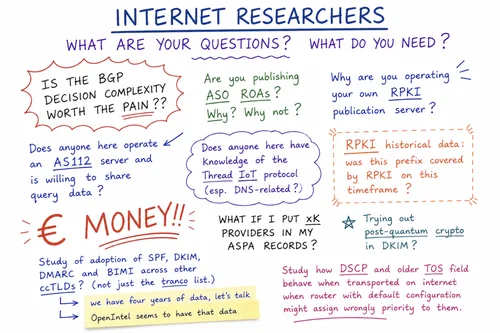
To test whether simple interventions could facilitate connections, organizers conducted a low-key experiment during RIPE 92. A flip chart positioned in the meeting area served as a visible space for researchers to post open questions and collaboration requests throughout the week.
The approach deliberately avoided formal matchmaking. Instead, the flip chart made potential collaboration opportunities visible to all attendees, who could browse questions, contribute their own, and identify contacts for starting conversations. The outcome proved promising: several researchers connected with operators capable of advancing their work.
The trial functioned as an exploratory first step rather than a complete solution. By keeping the mechanism simple, organizers sought to answer two questions: whether visibility of collaboration opportunities would help researchers and operators locate each other, and whether the community valued such a tool at all.
Community Suggestions for Strengthening Collaboration
A dedicated side session on Thursday featured open discussion of the flip chart results. While consensus emerged that easing connections benefits the community, participants proposed several distinct approaches to lowering collaboration barriers, ranging from improved data access mechanisms to expanded meeting opportunities.
Standardizing Data Sharing Agreements
One proposal called for developing a reusable legal framework that organizations could adopt when sharing data for research. Rather than each partnership negotiating from scratch, a standard template could address:
- The specific data being shared
- Anonymisation or aggregation methods applied
- Permitted uses, storage, and publication of the data
- Obligations of both data providers and researchers
Participants also suggested that technical tools automating data extraction and anonymisation could further reduce the operational burden of participating in research.
Establishing a Centralized Data Platform
Discussion also centered on making anonymised operational datasets more discoverable and accessible to researchers through a shared repository.
Beyond the datasets themselves, such a platform could document essential context:
- What was measured and the reason for measurement
- The data provider's identity
- Points of contact for dataset questions
- Known limitations and underlying assumptions
- Rules governing data access and use
This framework could also address trust and access control concerns, particularly for sensitive information.
Scheduling Regular Researcher-Operator Dialogue
Participants emphasized that successful partnerships require more than data exchange. Researchers and operators benefit from recurring forums to discuss challenges, share perspectives, and identify promising research directions.
One suggestion involved establishing periodic matchmaking sessions dedicated to research collaboration. Rather than showcasing finished work, these discussions would center on unsolved questions, operational challenges, available datasets, and early-stage collaboration possibilities. Such forums could supplement existing meeting structures by enabling researchers and operators to connect sooner and build relationships around shared interests.
Moving Forward
The RIPE 92 discussions demonstrated community appetite for mechanisms that facilitate researcher-operator partnerships. The flip chart trial and subsequent conversation revealed that no single solution will suffice; stronger collaboration likely requires a combination of practical tools, standardized processes, and expanded dialogue opportunities.
A Birds of a Feather session scheduled for RIPE 93 in Sofia (26-30 October, 2026) will continue this work, focusing specifically on researcher-operator collaboration. The session aims to identify which support mechanisms the community finds most valuable, which barriers warrant further attention, and what role RIPE could play in advancing these efforts.
The discussion welcomes anyone interested in strengthening ties between researchers and network operators.