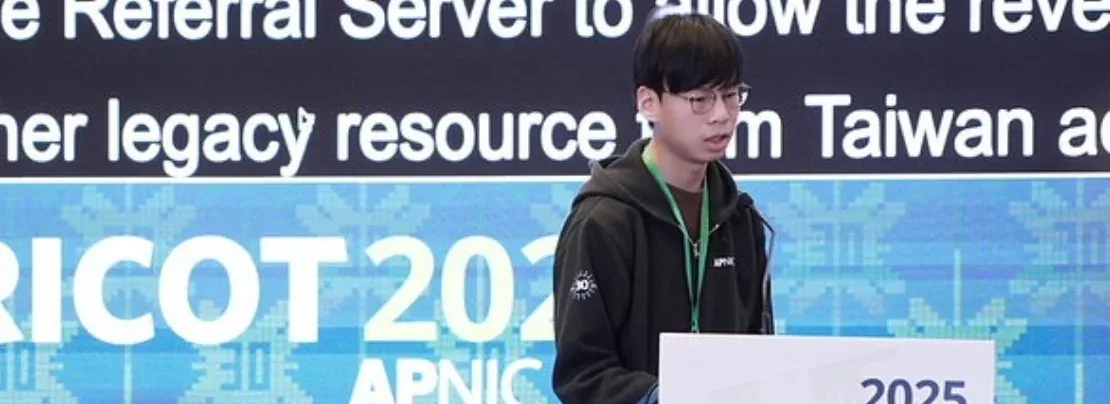
A half-decade ago, an interest in how the Internet actually functions seemed unlikely to reshape a career path. During 2020's pandemic lockdowns, curiosity about networking fundamentals, routing behavior, and the mechanics underlying global connectivity sparked deeper questions about IP address allocation and Autonomous System Numbers. The intersection of technical infrastructure and public policy—particularly how Internet number resources are managed—drew attention toward APNIC. What began as online participation in meetings evolved into selection for the APNIC Fellowship Program in 2022, followed by in-person attendance at APNIC 54 in Singapore.
The conference circuit has since included APNIC 56 in Kyoto, APNIC 59 in Petaling Jaya, APNIC 60 in Da Nang, APNIC 61 in Jakarta, and APNIC 62 in Mumbai. The progression moved from observing Policy Special Interest Group discussions to submitting policy proposals, joining the pilot APNIC Policy Fellowship Program, and mentoring newcomers in Internet policy fundamentals.
1. The Internet is not just about technology: Policy matters too
Early technical studies centered on Border Gateway Protocol, IPv6, and routing mechanisms—the assumption being that Internet operations were primarily a technical challenge. Conversations at APNIC 54 with fellows from various regions, APNIC personnel, network operators, and governance participants revealed a more complex reality.
The Internet comprises independently operated networks with divergent requirements and no single decision-making authority. This decentralized structure makes policy essential. A solution suitable for large operators may burden smaller organizations. A technically sound proposal may prove impractical across a region. Technical expertise alone cannot address these tensions. Technology provides the building blocks; policy establishes how shared resources are governed.
2. You don't need to be an expert to join the conversation
Entering spaces populated by seasoned networking and governance professionals created self-doubt about possessing sufficient knowledge to contribute meaningfully. The Fellowship Program normalized participation and revealed that engagement takes many forms beyond formal presentations.
Community members readily explained technical concepts, shared accumulated experience, and welcomed diverse viewpoints. Asking questions and offering alternative perspectives constitute legitimate participation, particularly in policy discussions. APNIC's Policy Development Process remains open to anyone interested in number resource management. Not every discussion flows easily, but everyone starts somewhere. Meaningful contribution requires willingness to engage and learn, not comprehensive prior knowledge.
3. Good policy is about consensus, not winning an argument
Proposing a policy at APNIC 59 in Petaling Jaya, Malaysia, transformed abstract understanding into practical experience. The submission process demanded rigorous questioning: What underlying problem exists? Why does current policy fall short? Which stakeholders face impact? What consequences might follow?
The pilot APNIC Policy Fellowship in 2025 illuminated the full scope of policy development—preparation, mailing list deliberation, feedback review, operational impact assessment, and potential revision. Success in policy discussions does not require proposal acceptance; it means the community has thoroughly examined the problem and potential solutions.
4. Even small changes to policy have real consequences
Seemingly minor policy adjustments can trigger substantial discussions. The analytical lens shifted from purely technical feasibility—would this work?—to broader questions: Who gains? Who absorbs additional operational burden? Does this address a genuine need? Is policy modification the appropriate solution?
The Open Policy Meeting at APNIC 62 examined a proposal regarding nibble-boundary alignment for IPv6 allocations. Technically, nibble boundaries simplify reverse Domain Name System delegation and address management. Translating this operational consideration into policy requires examining allocation practices and effects on various resource holders. Without participation from those understanding operational realities, critical perspectives vanish from deliberation. Policy language spanning a few lines can affect thousands of networks, warranting thorough examination.
5. Being part of a community means giving something back
Initial attendance as a fellow focused on personal learning and networking opportunities. Perspective gradually shifted over years of participation. At APNIC 61 in Jakarta, an opportunity emerged to facilitate a Policy 101 session at APRICOT 2026 alongside fellow policy fellows, connecting Internet number resource policies to actual network operations and explaining community participation pathways.
Having benefited from patient explanations during early involvement, reciprocating by making policy processes accessible to newcomers became meaningful. Community membership transcends conference attendance counts or presentation tallies. It involves sharing accumulated knowledge, listening to others, and strengthening the community for future participants.
Five years later, I'm still learning
Guidance for those considering APNIC community involvement remains straightforward: avoid waiting for expert status before engaging. Policy proposals need not be the entry point; a thoughtful question can advance discussions. Reading proposals, attending Policy SIG sessions, posing inquiries, or conversing during breaks all constitute participation.
The original motivation—understanding Internet mechanics—has evolved into a broader aspiration: collaborating to strengthen how the Internet functions collectively.
Tsung-Yi, an Internet governance and networking enthusiast from Taiwan, focuses on programmable switches, routing protocols, software-defined networking, and Internet number resource policy. He emphasizes bridging technical and policy perspectives while encouraging newcomers to engage in Internet community participation.