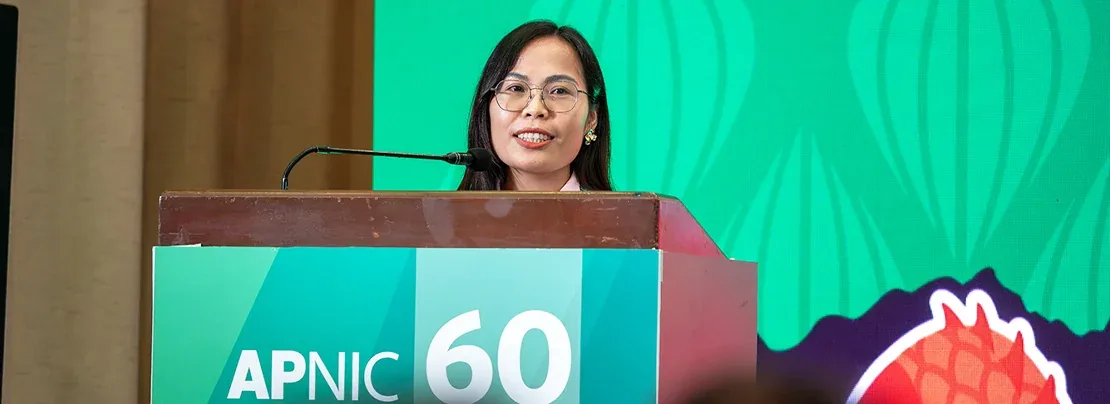
Oanh Nguyen's entry into Internet resource management was unplanned. After completing her education in a different discipline, she joined Vietnam Internet Network Information Center (VNNIC) and found herself navigating an entirely new technical domain. Her path illustrates how commitment to continuous learning can reshape a career trajectory.
"I had to work hard, continuously learn, and improve myself," Oanh recalled. Early training in Internet Protocol (IP) Hostmaster operations through APNIC, combined with mentorship from colleagues at VNNIC and support from the broader National Internet Registry (NIR) community, provided the foundation for her growing expertise.
Her progression moved from IP Hostmaster and resource manager roles into IPv6 and Resource Public Key Infrastructure (RPKI) instruction, policy development, and eventually Deputy Director of VNNIC's Cooperation and Resources Management Department. Today, as chair of the NIR SIG since 2021, she leads discussions affecting more than 15,000 APNIC Members across the region.
"What continues to motivate me today is the opportunity to give back to the community and contribute to a secure, stable, and sustainable Internet, both in Viet Nam and across the APNIC region," she said.
Building connections through participation
Oanh's engagement with APNIC began in 2013, initially drawn by the chance to deepen her understanding of resource management and operational practices. What kept her returning, however, was the collaborative spirit of the gatherings themselves.
"I was impressed by its open and collaborative environment, where different communities can share experiences and learn from one another," she said. Regular attendance at APNIC conferences, APRICOT, Asia Pacific Internet Exchange (APIX), and Asia Pacific Advanced Network (APAN) meetings enabled VNNIC and Vietnam's broader Internet sector to exchange insights with peers across the region.
The professional relationships forged through these interactions became as valuable as the technical knowledge shared. "Beyond the professional aspects, I truly enjoy reconnecting with APNIC friends and catching up with colleagues from other NIRs and across the APNIC community," she said. "These connections are what make every APNIC meeting so meaningful to me."
From learning to leadership
As her expertise matured, Oanh transitioned from absorbing knowledge to creating it. Her contributions have encompassed Internet number resource management, IPv6 rollout and policy frameworks, RPKI implementation, and workforce development. Since 2017, she has led IPv6 training initiatives in Vietnam and collaborated on capacity-building efforts in Laos. She has also participated in regional cooperation through the Association of Southeast Asian Nations (ASEAN) Smart ICT Ecosystem Project.
These experiences shaped her conviction that Internet advancement requires more than technological innovation alone. "It also depends on effective governance, appropriate policies, capacity building, and strong international cooperation," she said.
IPv6 adoption and routing security illustrate this principle. Neither can succeed through isolated national efforts; IPv6 transitions demand coordinated regional action, while RPKI effectiveness relies on participation from resource holders, Internet service providers, and network operators working in concert.
"Ultimately, our shared goal should be to build an Internet that is secure, open, stable, and sustainable for everyone," she said. Capacity building itself follows a similar pattern: knowledge exchange within a single economy can expand through regional frameworks like ASEAN and eventually contribute to broader global cooperation.
Leading the NIR SIG
Oanh's emphasis on connecting disparate communities directly informs her leadership of the NIR SIG. The group functions as a venue where National Internet Registries exchange operational lessons, debate policy questions, and bring their economies' perspectives to APNIC's wider deliberations. Collectively, these registries support more than 15,000 APNIC Members, making their voice essential to the ecosystem.
Uniting communities with divergent priorities, resources, and operational constraints presents distinct challenges for elected leaders. "As SIG Chairs, we need to encourage participation, facilitate balanced discussions, build consensus, and ensure that SIG activities deliver practical value to the community," Oanh said.
She prioritizes keeping discussions grounded in the real operational challenges NIRs and their members encounter. By first understanding those needs, the SIG can surface relevant topics, highlight successful approaches, and integrate emerging technologies and international experience into its work.
"The NIR SIG should serve as a platform for APNIC, NIRs, and the wider NIR community to exchange knowledge, share practical experiences, and work together towards common progress," she said.
Mentoring the next generation
Oanh's own ascent from newcomer to elected leader informs her guidance for those beginning their APNIC involvement. Rather than expecting fresh participants to immediately assume visible roles, she advocates for a measured progression.
For those interested in the NIR space, the starting point involves understanding the NIR SIG Charter and its purpose. Newcomers can then attend sessions, exchange ideas, participate in discussions, and ask questions before advancing to sharing their own knowledge, delivering presentations, or proposing initiatives.
She also urges newcomers to clarify their own objectives. "Most importantly, they should identify their own professional goals and what they hope to learn, understand, or connect with through APNIC activities," she said.
Developing future leaders requires building technical and policy expertise alongside communication abilities and experience working across diverse groups. Active engagement can lead to expanded responsibilities—presenting, contributing substantively to discussions, supporting SIG operations, and eventually seeking elected positions such as SIG Co-Chair or Chair.
"Leadership is not just about holding a position; it is about taking responsibility, bringing people together, and creating value for others," she said.
Priorities for the region's future
Looking ahead, Oanh identifies several areas demanding sustained focus from NIRs and the broader APNIC community. IPv6 deployment and the shift toward IPv6-only infrastructure remain critical, as do RPKI maturation and Autonomous System Provider Authorization (ASPA) adoption. Operational security—encompassing resource monitoring, abuse response, and IP-related threats—will require heightened attention.
Registration data governance, privacy safeguards, and data-sharing frameworks also warrant examination. The long-term effects of the IPv4-to-IPv6 transition on registry operations, resource coordination, and routing stability need consideration, as do the coordination and resource management challenges posed by rapid satellite Internet expansion.
For Oanh, these challenges underscore the importance of convening the Internet community's various constituencies. "I believe the NIR SIG should serve as a platform to identify emerging issues, share practical experiences, and bring APNIC, NIRs, and the wider community together to develop solutions for the future."
This vision extends the trajectory that first drew Oanh into the community—a continuous cycle of learning from peers, sharing accumulated experience, and creating pathways for others to participate and lead.