
A breach of the pCloud Pass password manager allowed attackers to access user accounts and trigger login notifications, according to reports from affected customers and a statement from pCloud. Users worldwide received alerts indicating that an unfamiliar device labeled "pd" had connected to their accounts from IP address 45.131.244.7, located in Luxembourg infrastructure belonging to pCloud itself.

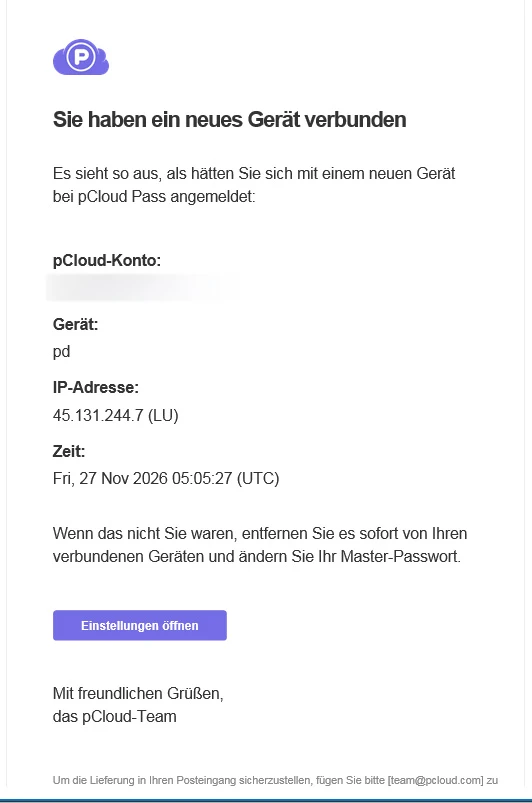
The breach raised immediate concerns because many affected users had two-factor authentication active on their accounts. Some customers who checked their account activity found no record of the suspicious devices, while others reported receiving notifications for accounts they no longer used or had requested deletion of months earlier.
pCloud released a statement acknowledging the incident: "A cyberattack targeting pCloud Pass occurred, which was promptly contained by the pCloud team. Unfortunately, a small number of pCloud Pass user email addresses were exposed and login attempts were made. Our system sends a notification automatically to each of these addresses."
The company stated that the attack was limited to its password manager product and did not affect cloud storage services. pCloud also claimed that passwords, notes, and other sensitive data stored in the service remained secure because they are encrypted on user devices and require the master password to decrypt.
A critical gap in pCloud's disclosure emerged: the company did not confirm whether attackers obtained or accessed encrypted password vaults during the breach. This distinction matters significantly because threat actors holding encrypted vaults can attempt offline cracking without facing login rate limits or two-factor authentication checks that would normally block their efforts.
The 2022 LastPass breach illustrated this risk when attackers stole encrypted password vault backups. Security researchers subsequently traced cryptocurrency thefts to that incident, with evidence suggesting attackers cracked weak or reused master passwords to extract cryptocurrency wallet private keys and seed phrases from the stolen vaults.
Additional technical details raised questions about the breach's scope. A link in the notification emails directing users to "Open settings" pointed to passqa1.pcloud.com, which appears to be a quality assurance testing environment rather than the production password manager website.
In its statement, pCloud referenced how artificial intelligence is accelerating the discovery of software vulnerabilities but stopped short of explicitly stating whether an AI-powered attack was responsible for the breach. The company also issued a reminder that it will never request master passwords or recovery words through email, phone, or chat communications.
The pCloud Pass incident represents the third password manager breach disclosed in November. Earlier in the month, mSeven Software alerted mSecure users to change stored passwords, reset two-factor authentication, and remove passkeys after a hacker obtained an encrypted customer database. On Wednesday, 1Password disclosed a breach after a threat actor compromised an employee's GitHub account and deployed malicious code to backend systems to exfiltrate customer data, though 1Password stated that customer password vaults and their encryption keys remained uncompromised.