
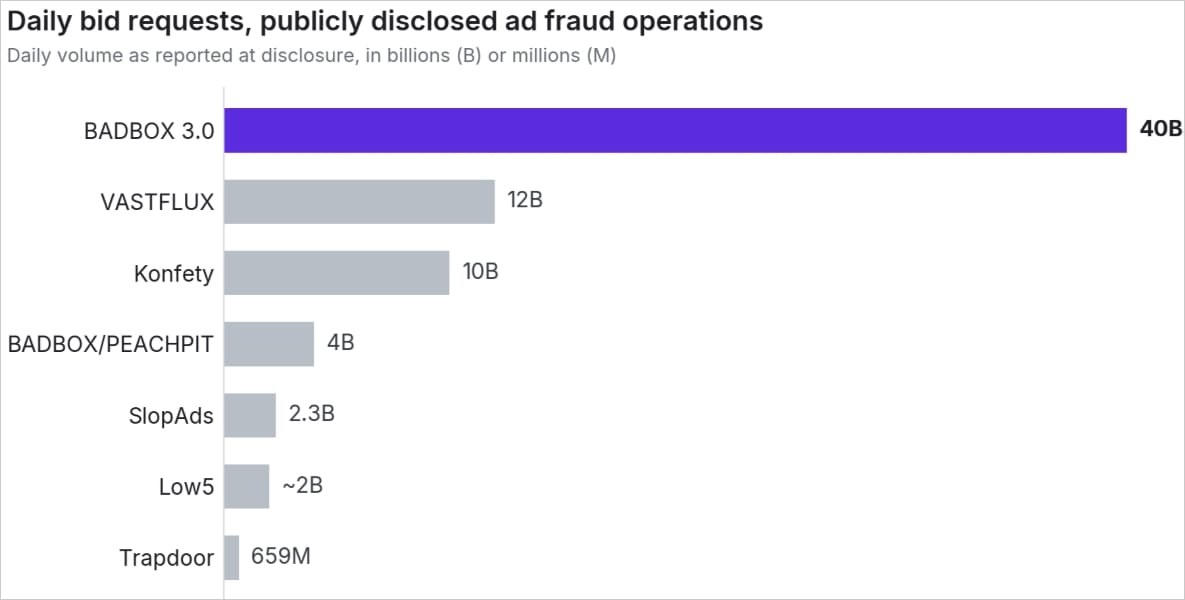
Following disruptions last year, the BADBOX malware botnet has reemerged with unprecedented scale, producing 40 billion fraudulent advertising bid requests daily from infected Android-based devices. Researchers at HUMAN's Satori division, who identified and disrupted this latest iteration, determined that BADBOX 3.0 represents the largest ad-fraud operation ever documented when measured by daily bid request volume.
The botnet first surfaced in early 2023 after researchers discovered it on a T95 Android TV box purchased through Amazon. By December 2024, German cybersecurity authorities reported that tens of thousands of devices had fallen victim to infection. A coordinated takedown effort in March 2025 saw HUMAN and Shadowserver disconnect more than 500,000 BADBOX 2.0 devices from command infrastructure, while Google removed 24 malicious applications from Google Play. Google subsequently filed suit against the botnet operators, revealing that BADBOX 2.0 had compromised over 10 million Android devices by April 2025.

Botnet Rebuilds to New Heights
Despite the disruption campaigns, BADBOX operators reconstructed their infrastructure and achieved new records for fraudulent ad traffic generation.
At its height, BADBOX 3.0 accounted for roughly 40 billion bid requests a day and more than 4% of all CTV traffic observed by the Human Defense Platform
HUMAN
BADBOX 3.0's volume was more than three times the volume of the previous record holder, VASTFLUX, and represents a larger peak than the last five years' worth of published Satori investigations combined.
HUMAN
The operational approach has remained consistent: compromising inexpensive phones, tablets, and streaming TV boxes that run the Android Open Source Project (AOSP) with malware capable of executing ad fraud and traffic proxying schemes.
The malware executes ad fraud by rendering video advertisements within concealed windows while mimicking legitimate streaming applications to make requests appear authentic. Researchers also documented fraudulent server-side ad insertion (SSAI) requests designed to deceive advertisers into believing ads had played on actual streaming devices, despite no genuine device or video ad being involved.
A separate proxying component enrolled compromised devices into one of 11 residential proxy networks without user awareness or authorization. PXYEDGE, one of these networks, emerged as the rebranded continuation of IpMoYu, a residential proxy platform previously connected to BADBOX 2.0. PXYEDGE advertised roughly 200,000 proxy nodes, though monitoring detected unique connections reaching approximately 340,000 at peak times.
Researchers observed that certain ad fraud traffic was channeled through these residential proxies to appear legitimate and circumvent anti-abuse detection systems.
Attribution and Infrastructure
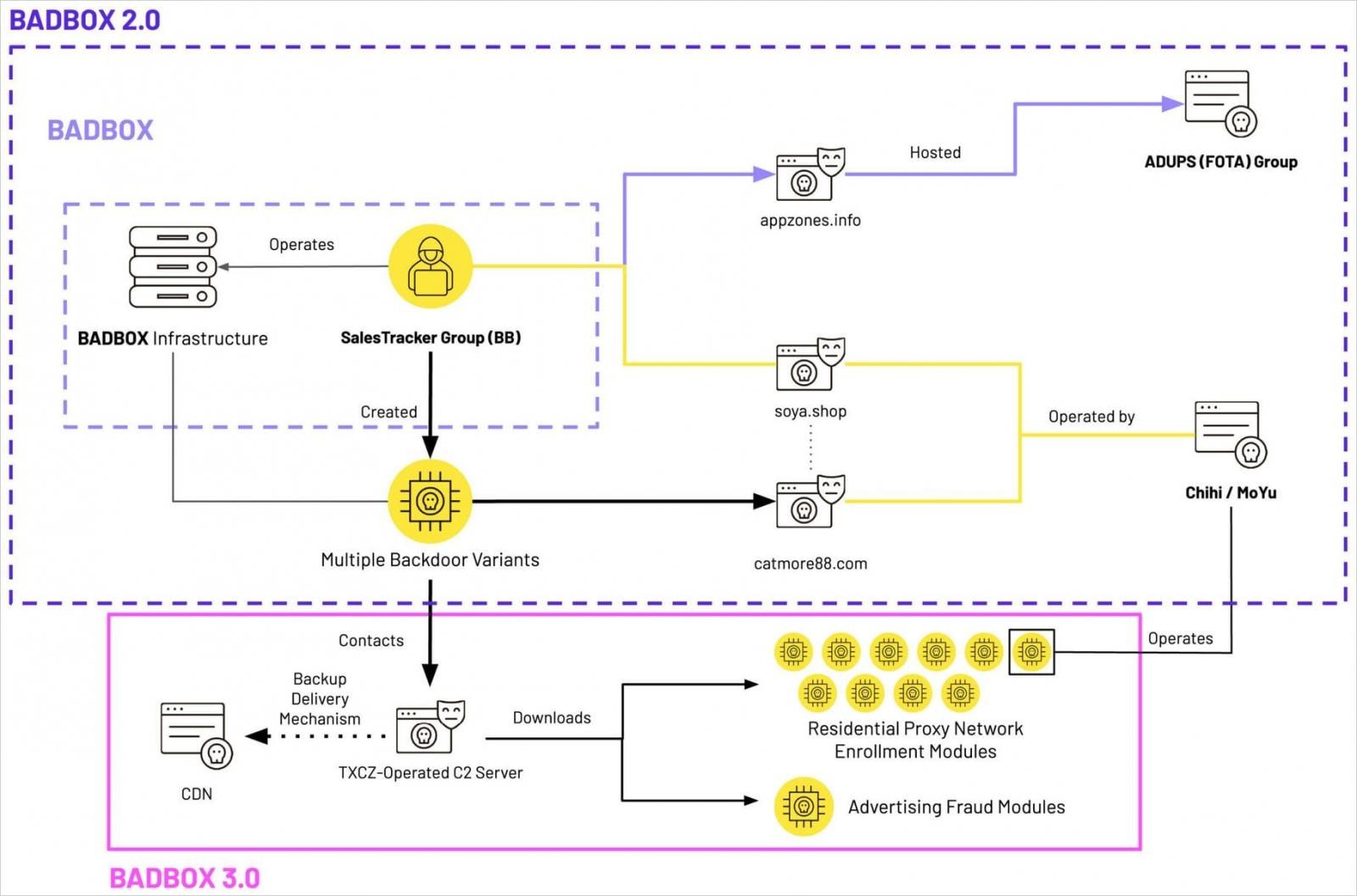
Investigation linked the malware to a particular Chinese electronics manufacturer through domain registrations, device-specific code checks, a factory-installed TV launcher, and repository maintainer information.
Infected devices retrieve malware modules from public code repositories, with identical payloads duplicated across multiple hosting platforms to ensure persistence and withstand removal efforts. HUMAN participated in Google's concurrent disruption of the related XCPE malware campaign earlier this month, which involved eliminating multiple command-and-control domains utilized by BADBOX 3.0. One malware repository was also taken offline, and HUMAN's infrastructure now filters fraudulent advertising traffic connected to BADBOX 3.0.
Nevertheless, HUMAN cautions that botnet operators will probably modify their tactics in response to this disruption, mirroring their adaptive behavior following previous takedowns.
Users are advised to purchase only certified Android devices from established manufacturers and verify that Play Protect is enabled and functioning.