
Open-weight models represented 60% of OpenRouter's US token consumption in August, with Chinese-developed systems making up the bulk of that share. To address data residency concerns, OpenRouter has now rolled out US in-region routing to all business and enterprise customers, providing a guarantee that requests are decrypted, processed and served entirely within the United States—or rejected if domestic processing cannot be assured.
The appeal of open-weight models is well established: organizations can download model weights, adapt them for their needs, deploy them on their own infrastructure, and maintain stricter control over data processing locations, typically at lower costs than proprietary alternatives. Current estimates suggest open-weight models lag leading frontier systems by roughly four to five months. Nvidia, currently the world's most valuable company, is making a significant bet on this trajectory. In early September, the company announced plans to acquire Hugging Face—a major repository hosting over three million models—for $12.9 billion, with commitments to preserve the platform's openness across different models, cloud providers and computing infrastructures. Nvidia also revealed this week how its own open-weight Nemotron model supports its global supply chain operations through a partnership with Palantir.
Yet this expansion brings substantial security implications. OpenAI president Greg Brockman has cautioned that increasingly sophisticated open-weight models—particularly China's GLM-5.3—could "significantly accelerate the threat landscape" given that models with advanced cyber capabilities become freely available for download and modification.
For organizations using these models via third-party platforms, a more immediate concern emerges: data destination when leveraging models originating from China.
Chinese models lead open-weight adoption
Hugging Face data from February indicated that Chinese developers' models accounted for 41% of downloads over the preceding year, surpassing the US at 36.5%. On OpenRouter's platform, open-weight models now represent roughly 60% of tokens consumed by requests originating from the US, with Chinese models constituting the dominant portion.
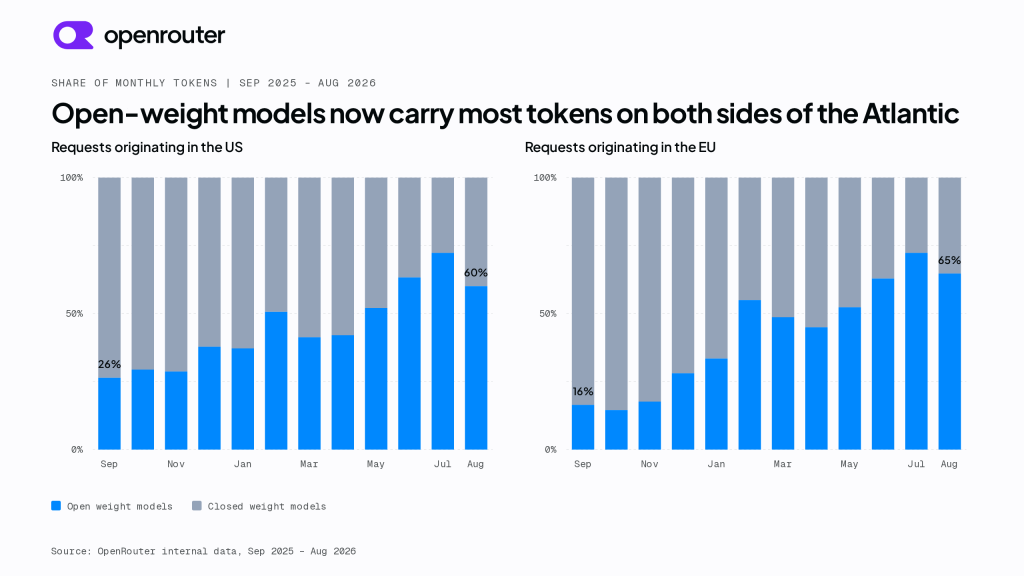
This dynamic prompted OpenRouter to introduce geographic restrictions on traffic. The AI model marketplace has moved US in-region routing from limited availability to general availability for business and enterprise customers, ensuring that requests through its US endpoint remain decrypted, processed and served entirely domestically—or are rejected if compliance cannot be met.
The capability had existed in limited form previously, with OpenRouter updating its documentation in early August to indicate US in-region routing was available to enterprise customers upon request. The company also maintains European in-region routing, which has been available since October 2025.
Founded in early 2023 by Alex Atallah, former OpenSea CTO, OpenRouter functions as an intermediary to the fragmented AI model marketplace, allowing developers to switch between hundreds of models from diverse providers through a single API. Stripe announced recently that it plans to acquire the company in a reported $8 billion transaction. Cursor, Ramp and Meta are among other organizations developing their own model routing solutions.
Model routers have become highly sought after primarily for economic reasons. Developers traditionally embedded applications to route all requests to a single model, whereas a model router can make per-request decisions, directing simpler tasks to cheaper models while reserving expensive frontier systems for work requiring their capabilities.
OpenRouter's residency controls leverage this intermediary position: because the platform already determines which provider handles each request, it can now constrain that selection to US-based provider endpoints.
Managing Chinese models with geographic boundaries
In a Wednesday blog post announcing the feature, Cailee Moberg from OpenRouter's product team acknowledged that while US-developed models from Nvidia and Thinking Machines contribute to the open-weight expansion, Chinese models dominate consumption patterns and create procurement challenges for data-conscious organizations.
Models from Chinese labs are still most of the [open-weight model] volume, and procurement approval for those models can be difficult.
Cailee Moberg, OpenRouter
Deloitte's 2026 State of AI in the Enterprise report found that sovereign AI adoption is accelerating, with 77% of companies now incorporating country of origin into vendor decisions, and nearly 60% constructing their AI stacks "primarily with local vendors."
This context clarifies OpenRouter's push to offer in-region routing for US customers. Moberg highlights DeepSeek V4 Pro, Kimi K3 and GLM 5.2 as concrete examples. All three are accessible through US In-Region Routing because Baseten, Fireworks and Azure host them from US data centers. Organizations could previously maintain these models domestically through self-hosting or direct engagement with US providers; OpenRouter's routing capability now delivers that residency assurance to its own users without requiring them to manage separate deployments.
OpenRouter publishes a current list of models qualifying for US in-region routing, encompassing proprietary frontier systems from OpenAI and Anthropic alongside open-weight offerings from major Chinese laboratories.
In-Region Routing allows teams with data residency requirements to get the price and performance gains from Chinese open-weight models.
Cailee Moberg, OpenRouter
Moberg adds: "When a US or EU provider hosts a model, requests go to that provider and the lab is not involved."
The implementation operates at the routing layer. Through OpenRouter's standard global endpoint, any eligible provider in any region can serve a request, meaning even US-company models offer no guarantee that processing occurs domestically. The us.openrouter.ai endpoint decrypts requests on OpenRouter infrastructure within the US and restricts the provider pool to endpoints OpenRouter has verified as US-based.
When no compliant US provider can handle the requested model, OpenRouter returns a 404 error. Organizations can enforce regional restrictions through OpenRouter's Guardrails at the workspace, team or API-key level, and tools that would transmit prompt data outside the US are deactivated on the regional endpoint.
While in-region routing does not alter where DeepSeek, Kimi or GLM models are developed, it does determine which instances US customers access and where their prompts are processed in the request chain.