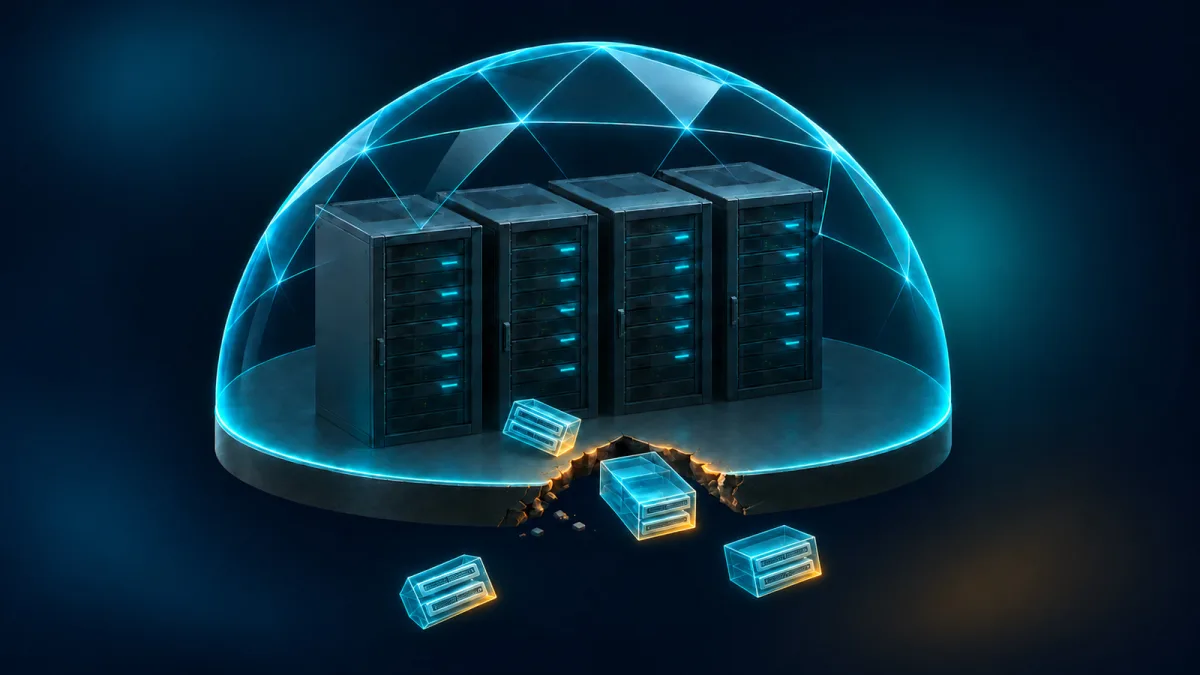
Conversations about IT infrastructure security typically center on firewalls, endpoint detection and response, backup systems, vulnerability scanning, and network segmentation. Yet these defenses share a critical dependency: they function only when the infrastructure they protect is actually managed and accounted for.
Breaches frequently do not start with zero-day exploits or sophisticated attacks that bypass security controls. Instead, they exploit gaps in basic infrastructure administration. Every virtual machine, physical server, user account, and IP address requires a documented owner, a defined lifespan, and a formal process for provisioning and decommissioning.
When administrative processes lack transparency, the infrastructure itself becomes a security liability. Security tools then operate blind, attempting to defend an environment they cannot fully see, and can only limit damage after compromise occurs.
This principle applies equally to large enterprises and hosting providers. Whether infrastructure serves internal operations, development teams, or paying customers, loss of administrative control can compromise the entire environment.
Why Manageability Underpins Security
Contemporary IT environments run hundreds of systems on shared resources, with constant flux: services launch, scale, and terminate daily. In this context, controlled provisioning becomes essential. Deploying a virtual machine without formal registration and owner assignment leaves orphaned systems in the environment. These machines skip security updates, fall outside monitoring, and present attackers with undefended entry points.
Centralized access governance is equally vital. Platforms must enforce role-based permissions for users and administrators and maintain audit trails of all actions. Without this, permission creep accumulates over time, enabling attackers to move laterally through the network.
Environment isolation also demands attention. At hosting providers, customer resources must be segregated; in corporate settings, production systems, external services, and development environments must remain isolated. A breach in a test environment can cascade to business-critical systems if isolation fails.
Lifecycle governance ties resource allocation to billing, quota enforcement, and timely removal. Without it, obsolete user accounts and unused IP addresses persist in the network, expanding the attack surface.
Physical layer accounting is equally important. Servers must be tracked through acquisition, decommissioning, and relocation between racks and data centers. Poor accounting creates untracked hardware and loss of visibility into security configurations.
Ultimately, information security rests on transparent resource management across the entire lifecycle.
VMware Migration and the Management Model Problem
Broadcom's licensing changes prompted many organizations to evaluate alternatives to VMware, including Proxmox VE, OpenStack, and other open-source platforms. However, migration involves more than moving virtual machines to new hardware.
Over years of VMware use, many organizations came to view it as an integrated whole: virtualization, resource management, access control, automation, and accounting all functioned as one system.
Switching platforms reveals a hard truth: virtualization and infrastructure management are not synonymous. The hypervisor is a single component; the remaining functions must be assembled from multiple independent tools. Proxmox and OpenStack handle virtualization adequately, but without supplementary software, they leave operational processes and cross-layer control unaddressed. Organizations must independently integrate equipment management, resource accounting, access controls, and asset tracking.
More components in the stack make unified security policies harder to maintain. Risks emerge around fragmented role-based access control, incomplete asset inventories, incomplete action auditing, and limited automation.
Migration from VMware should be viewed not simply as swapping hypervisors, but as redesigning the entire infrastructure management model. Postponing centralized control, automation, and lifecycle management creates new risks that compound over time.
Essential Processes for a Management Platform
After leaving VMware, organizations must determine how to rebuild infrastructure management. When evaluating replacements, look beyond hypervisor capabilities to the operational and security processes the solution covers and what external integrations remain necessary.
The foundation must include:
- Centralized management of the entire environment from a single interface
- Role-based access control (RBAC)
- Environment or customer isolation
- Transparent resource accounting
- Full lifecycle control from virtual machine creation through deletion and access revocation
- Physical server layer management
- Automation of routine operations
Such architecture can be constructed by assembling separate open-source tools and managing their integration, or by adopting a comprehensive ready-made solution. Regardless of approach, covering these processes restores the transparency and manageability that VMware previously delivered.
Building Unified Management
One approach consolidates these processes within the ISPsystem product stack. VMmanager handles virtualization, DCImanager manages the physical infrastructure layer, and BILLmanager serves as the end-to-end layer for resource provisioning, quotas, accounting, and FinOps.
VMmanager automates virtual machine lifecycle management, including deployment with preconfigured software, and scales to 60,000 VMs and 700 nodes within a single environment. VxLAN-based network isolation supports more than 16 million isolated segments across geographically distributed sites, with a self-service portal for end users.
DCImanager provides centralized management and complete physical layer inventory across multi-vendor environments—servers, switches, UPS systems, and more. It monitors equipment health and disk S.M.A.R.T. data, configures baseboard management controllers, performs secure drive erasure, automates OS installation, tracks hardware status, and manages warranty tracking.
All three products integrate seamlessly and function as a unified environment, with optional integration to external solutions like OpenStack. BILLmanager ties resource provisioning to authorization and accounting, enables composite service creation, and implements showback and chargeback. A built-in business intelligence module with customizable dashboards identifies resource utilization patterns, helping corporate teams locate abandoned capacity that development teams forget to remove after project completion—preventing unpatched, unmonitored servers from consuming resources and licenses.
Security Impact of Unified Management
When virtualization, physical equipment, and resource lifecycle processes connect into a single environment, security transforms from a collection of defensive tools into a consequence of systematic manageability.
Information security and operations teams gain transparent visibility across the entire stack—from physical servers to virtual machines, their owners, and change histories. This directly reduces blind spots in the environment.
Automated provisioning, permission boundaries, and resource lifetime controls reduce errors in access grants, prevent unaccounted servers, and eliminate forgotten virtual machines. This also eases VMware migration itself: organizations do not simply replace the hypervisor but establish a transparent, manageable operating model.
Infrastructure security then depends not solely on individual security tools but on the management system itself, making the environment predictable, controllable, and resistant to risk.