A developer spinning up two containers for a quick test faces entirely different demands than a platform engineer orchestrating workloads across multiple Kubernetes clusters. Yet both groups need infrastructure provisioned promptly, without waiting for requests to languish in a backlog. Broadcom positions VMware Cloud Foundation as a unified private cloud that accommodates developers, operators, and teams still relying on traditional virtual machines.
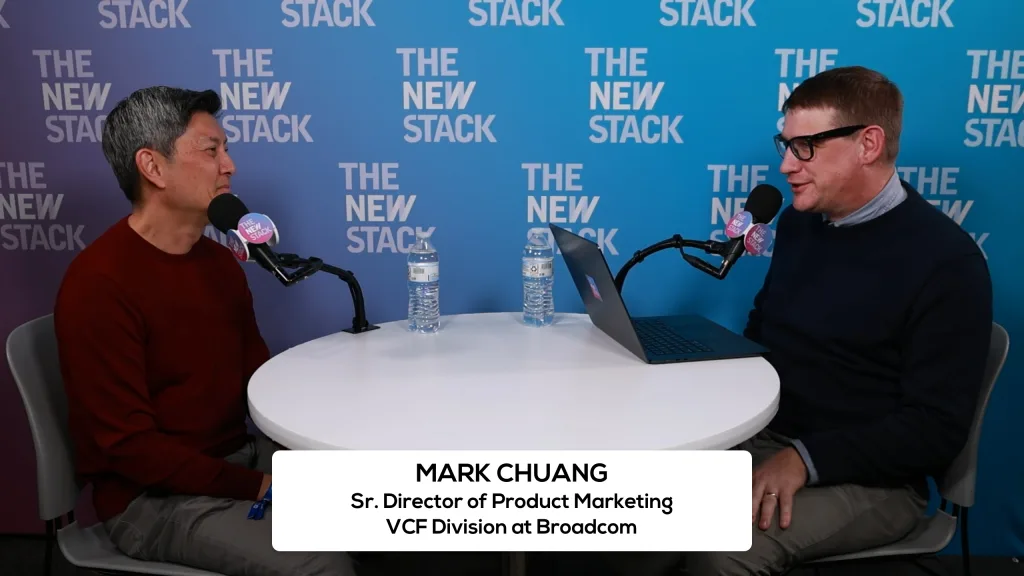
During a recent conversation at KubeCon + CloudNativeCon 2026 in Salt Lake City, Mark Chuang, senior director of product marketing for VMware Cloud Foundation at Broadcom, discussed with The New Stack's Nick Lucchesi how organizations manage the complexity of running VMs, containers, and AI workloads on a single platform.
They get a public cloud-like experience when it comes to self-service.
Mark Chuang, Broadcom
According to Chuang, developers requesting resources experience the convenience of public cloud self-service, while platform teams retain control over the policies governing those resources. This matters particularly when AI applications depend on services distributed across both container and VM environments. Operators can enforce consistent security policies, manage workload lifecycles, and control placement decisions. Developers gain self-service access to infrastructure and can continue using their existing CI/CD tools.
Choosing the right level of orchestration
Chuang distinguishes between direct container deployment, suitable for lightweight edge applications or rapid developer validation, and Kubernetes, which becomes necessary when applications require automated orchestration across multiple clusters. A team testing a minor change might deploy a handful of containers directly to avoid setup overhead, while a platform team can accommodate both approaches within the same operational framework.
The conversation also addressed what Broadcom means by validating partner applications for vSphere Kubernetes Service (VKS). Broadcom supplies test environments and automation tooling, while software vendors determine the appropriate tests for their own applications. Validation checks can encompass initial deployment, failure recovery, security posture, and clean uninstallation procedures. Broadcom reviews results, which partners then use to develop reference architectures and technical documentation.
We're just trying to lighten some of the load that's on the plate of our customers.
Mark Chuang, Broadcom
If an update causes a partner application to fail, customers can reach out to either Broadcom or the software vendor. When contacting Broadcom support, the team first determines whether the issue originates from the platform or the application update—a practical distinction for developers who can pinpoint exactly when functionality broke and have multiple potential causes to investigate.
Bundling tools developers already use
Broadcom packages commonly deployed tools including Prometheus, Argo CD, and Harbor as VKS add-ons. Chuang notes that the company bases inclusion decisions on usage patterns and customer feedback. Managing installation and updates through VKS eliminates the burden of teams maintaining these integrations independently.
Chuang has observed a shift in customer preferences: some organizations increasingly favor a curated tool set if it accelerates their path to a functional environment. When asked which operational burden a private cloud might eliminate within a year, Chuang pointed to a common scenario: diagnosing why an application runs slowly.
Is it a storage issue? Is it a network issue? Is it a CPU contention issue?
Mark Chuang, Broadcom
Chuang expects AI to handle more of this diagnostic work across infrastructure layers over the next year. The full interview, available on The New Stack's YouTube channel, explores what AI-driven troubleshooting could look like in practice, the tangible benefits of partner validation for developers, and why testing a container sometimes begins with a smaller initial deployment.