
After two years operating in stealth mode, TypeSafe announced its debut model, Jev, backed by $40 million in seed funding led by DCVC. The company positions Jev as a fundamentally different class of AI—what it calls a "System One" model—designed specifically for machines to make decisions within software applications rather than generate conversational text.
Jev operates as a text-only model that accepts structured queries and returns typed decisions accompanied by calibrated probability scores, enabling applications to handle uncertainty programmatically. The architecture incorporates novel components: a custom sampler algorithm that controls token selection from probability distributions, and a training methodology called Reinforcement Learning for Calibrated Decisions (RLCD).
Sequential generation fundamentally mismatches machine requirements
Diogo Almeida, TypeSafe's co-founder and CEO, previously worked at OpenAI where he contributed to RLHF and InstructGPT—the foundational techniques powering ChatGPT and GPT-4. On September 15, Almeida articulated the core distinction between Jev and conventional language models on X.
Look at how LLMs generate sequentially, which is great for a natural conversation, but totally useless for computers.
Diogo Almeida, co-founder and CEO of TypeSafe
Almeida explained that Jev emerged from questioning why advanced conversational models have not accelerated progress toward artificial general intelligence. He attributed this gap to RLHF-optimized chat systems that prioritize human preferences while introducing problems including mode dropping, overconfidence, and insufficient reliability for production use.
https://x.com/CompleteSkeptic/status/2099925682726002904?ref_src=twsrc%5Etfw
Performance claims and hallucination immunity
Almeida's announcement highlighted performance metrics: Jev operates 20-200x faster than conventional models, costs 40-400x less (with output tokens provided at no charge), and delivers what TypeSafe terms "frontier composable intelligence" optimized for decision-making. The company asserts that System One models cannot hallucinate because they function more like code—deterministic, rapid, self-consistent, and type-safe—outputting decisions with associated probabilities and confidence levels rather than prose.
Vercel, the frontend cloud platform, reported adoption metrics within 24 hours of Jev's launch on its AI Gateway. The model reached more than twice as many paid teams as any prior model launch, establishing what Vercel called the fastest adoption rate in gateway history. Within the first twelve hours, Jev surpassed all comparison models and continued expanding its lead. By the 24-hour mark, approximately 13% of paid teams had adopted it—double the GPT-5.6 family's share and more than six times Fable 5.1's penetration.
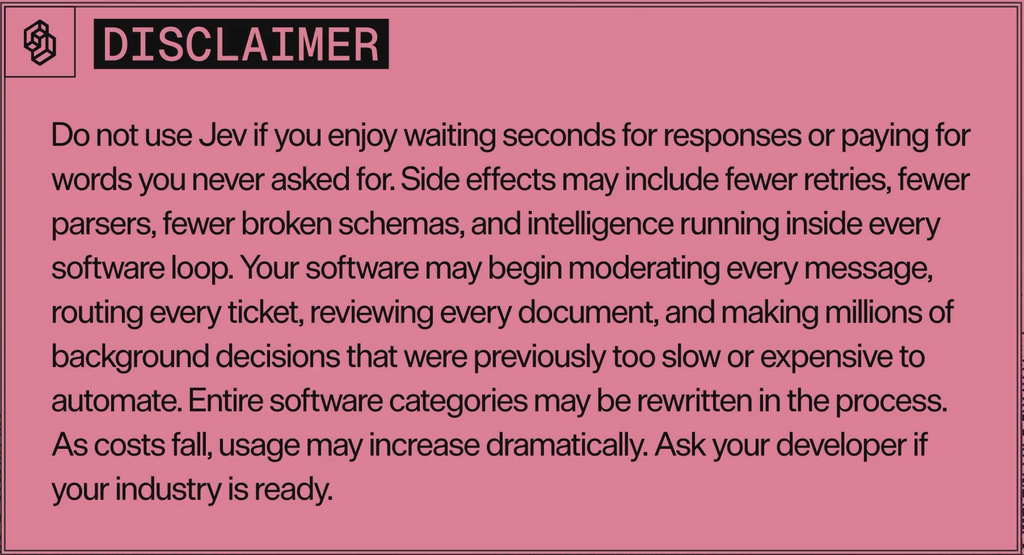
Developers can configure thresholds determining when Jev operates autonomously versus when it escalates decisions for human review. These decisions can be composed within code to construct larger workflows with explicit control over intelligence deployment. Engineers can direct Jev to select an agent's subsequent tool or subagent, validate model outputs, and enforce safety guardrails.
Jev as a decision component, not a chatbot
Independent software developer Flavio Copes characterized Jev as fundamentally distinct from ChatGPT and code generation models. It neither produces replies, explanations, nor code.
The simplest way to describe it: Jev is a smart if statement.
Flavio Copes, independent software developer
Copes emphasized the architectural difference: with ChatGPT or coding agents, AI functions as the primary interface or executor, whereas Jev operates as a discrete component embedded within conventional applications. It addresses specific decision points while the surrounding product remains built on standard code.
You add it where code needs one judgment, while the rest of the product stays ordinary code.
Flavio Copes
Copes documented the stated performance characteristics: most Jev calls complete within approximately 100 milliseconds, input tokens cost $0.042 per million, and output tokens incur no charge. Users supply data and a list of typed questions; Jev returns one answer per question—a yes/no probability, a selected option from a predefined list, or a position on a defined scale—with accompanying probability distributions.
Testing the boundaries of a text-only model
AI engineer Bartosz Mikulski conducted an experiment to evaluate Jev's limitations. Given that TypeSafe markets Jev as text-only, Mikulski deliberately tested its weakest area: images. He converted 400 hand-drawn sketches into Scalable Vector Graphics (SVG) coordinates and queried the model for identification.
The model achieved approximately 35% accuracy—substantially above the 10% baseline of random guessing—though it exhibited a pronounced bias, labeling more than half the drawings as "airplane," inflating the apparent success rate. Mikulski acknowledged that TypeSafe's documentation explicitly states Jev processes text only and performs better with words than numbers.
I fed it numbers that encode pictures, which is close to the least fair test anyone could design, and it still beat chance by a wide margin. I mean that as a compliment, not as a benchmark.
Bartosz Mikulski, AI engineer
Mikulski clarified that his test revealed nothing meaningful about Jev's performance on the text classification tasks it was engineered to handle, but rather demonstrated robustness when pushed far outside its intended scope.
The Jevons Paradox connection
TypeSafe named its model after 19th-century economist William Stanley Jevons and his Jevons Paradox—the economic principle stating that as technology increases resource efficiency, total consumption of that resource typically rises rather than falls. When steam engines improved coal efficiency, coal consumption increased; LED lighting cost reductions led to expanded lighting usage; video compression algorithms that reduced bandwidth requirements resulted in greater overall web traffic growth.
Almeida concluded his announcement video with a reference to developer productivity, stating, "As we say at TypeSafe, we're building prod, not God."