
During its Ignite conference in San Francisco on Tuesday, Microsoft revealed several new AI models, with particular emphasis on two purpose-built coding variants.
The two new offerings—Code 2 and Code 2 Flash—are engineered to approach the capabilities of leading models like GPT-6.1 Sol and Claude Opus 5.5 while operating at significantly reduced expense.
MAI Code 2 is at the frontier of price-performance for enterprise coding tasks. It does all of this while also delivering changes code maintainers would merge, at a fraction of frontier cost.
Microsoft
Code 2 performance metrics
According to Microsoft's benchmarking, Code 2 achieves 98% of GPT-6.1 Sol's performance at 40% of the cost, and reaches 96% of Claude Opus 5.5's capability at just 5% of the expense—a figure that underscores the current operational costs associated with Anthropic's models.
Microsoft indicates the model has been optimized for generating "great dashboards and visualizations" and demonstrates particular strength in visual coding tasks.
It bears noting that OpenAI released GPT-6.2 Astra and Sol on the same day with enhanced capabilities, which somewhat tempers Microsoft's positioning. However, OpenAI similarly claims that GPT-6.2 Astra outperforms Claude Fable 5.2 by 5.5 points on Agents' Last Exam while costing just 5% as much, further illustrating Anthropic's current cost structure.
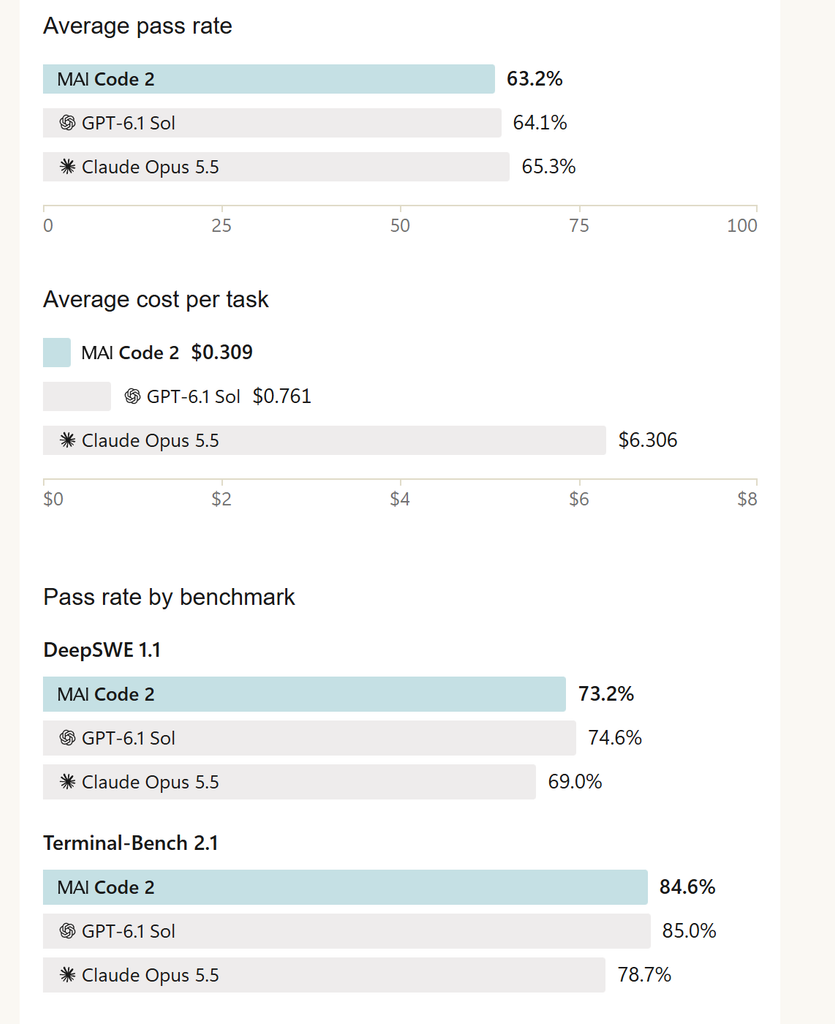
Code 2 Flash performance metrics
Regarding Code 2 Flash, Microsoft contends the model matches Anthropic's Claude Haiku 5.5 and GPT-6 Luna across benchmarks including DeepSWE 1.1, Terminal-Bench 2.1, and SWE Atlas, while consuming 20% and 65% of their respective costs.
Specialist approach versus general-purpose models
A notable distinction in Microsoft's strategy involves deliberately constraining these models to specific enterprise coding workflows. Microsoft states the models are "explicitly not yet tuned for harder problems, like fundamental science research and very long horizon agentic work."
The comparison models Microsoft references are general-purpose systems. OpenAI previously pursued a similar specialist path with Codex but has since shifted toward broader capability models.
Microsoft, which does not maintain proprietary frontier models internally, appears to be prioritizing smaller specialized variants optimized for efficient execution. While these models may not match frontier offerings across all benchmarks, concentrating on particular use cases provides practical advantages in this context.
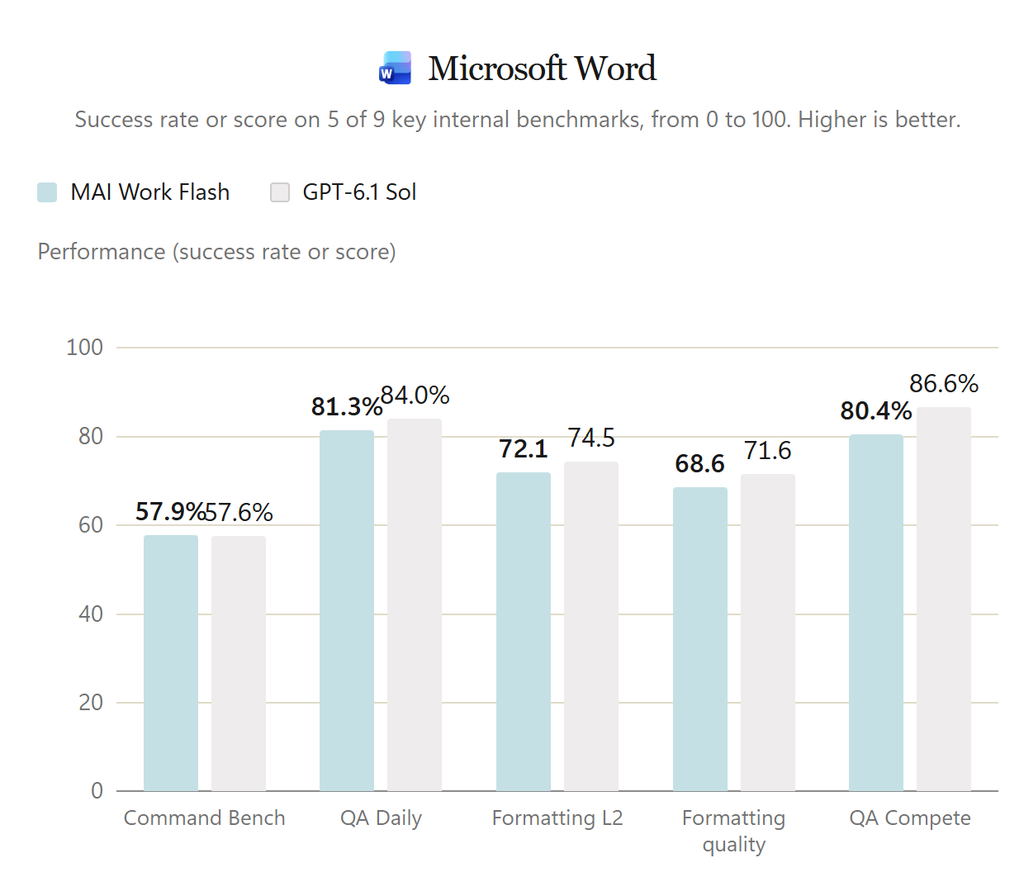
Microsoft is extending this philosophy with offerings like MAI Work Flash, a model trained specifically for integration across Microsoft 365 and Fabric IQ.
Availability
Code 2 and Code 2 Flash are accessible immediately through GitHub Copilot, with Code 2 Flash also entering limited preview on Microsoft Foundry. OpenRouter, Vercel, Hermes, Open Code, and Kilo will receive support in the coming period.