
OpenAI has demonstrated that its most recent language models exhibit markedly improved capabilities in generating and refactoring code written in older programming languages. The organization highlighted COBOL, Fortran, and Visual Basic as languages where the newer models have achieved particularly notable performance gains.
The significance of these improvements becomes clear when considering the scale of legacy systems still in operation. COBOL underpins over 40% of online banking infrastructure, handles 80% of in-person credit card transactions, and processes 95% of ATM transactions globally. Fortran remains essential in specialized domains including meteorological modeling and nuclear reactor safety systems.
These languages have less code and documentation available for models to learn from than languages like Python and JavaScript, yet support critical infrastructure and essential services around the world
OpenAI
To evaluate progress systematically, OpenAI developed MultiLangBench, a benchmark that requires models to construct a SQLite-compatible database engine from the ground up across 20 different programming languages.
The results demonstrate substantial advancement. GPT-6 Astra achieved an average pass rate of 87.4% on the benchmark, compared to 26.8% for GPT-5.6 Sol. Language-specific improvements were even more dramatic: COBOL performance jumped from 10.9% to 72.1%, while Fortran climbed from 21.4% to 83.5%.
OpenAI documented gains across the entire test suite: "Improvements extend to every language tested, including COBOL (10.9% to 72.1%), OCaml (25.6% to 85.8%), Fortran (21.4% to 83.5%), and Visual Basic (27.5% to 89.4%)."
COBOL Migration Performance Reaches Near-Saturation
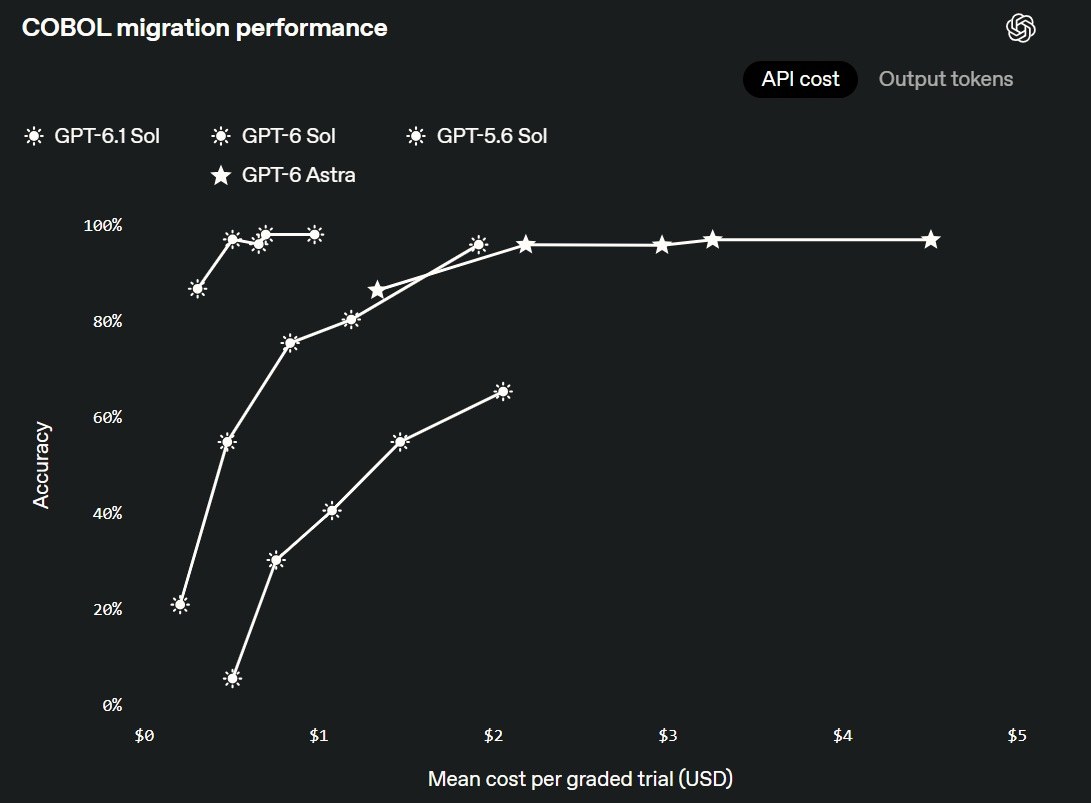
OpenAI also evaluated whether its models could successfully convert COBOL applications to C++, Java, Kotlin, Python, or Rust while preserving original functionality.
GPT-6.1 Sol achieves 86.6% accuracy at low reasoning effort, compared with GPT-5.6 Sol's 5.4% at the same setting at just 61% of the API cost. At higher reasoning effort, accuracy reaches 97.9%, bringing the evaluation close to saturation.
OpenAI
While these results suggest potential pathways for enterprises to modernize aging codebases, real-world migration projects would still demand thorough validation and human expert oversight before deployment to production systems.