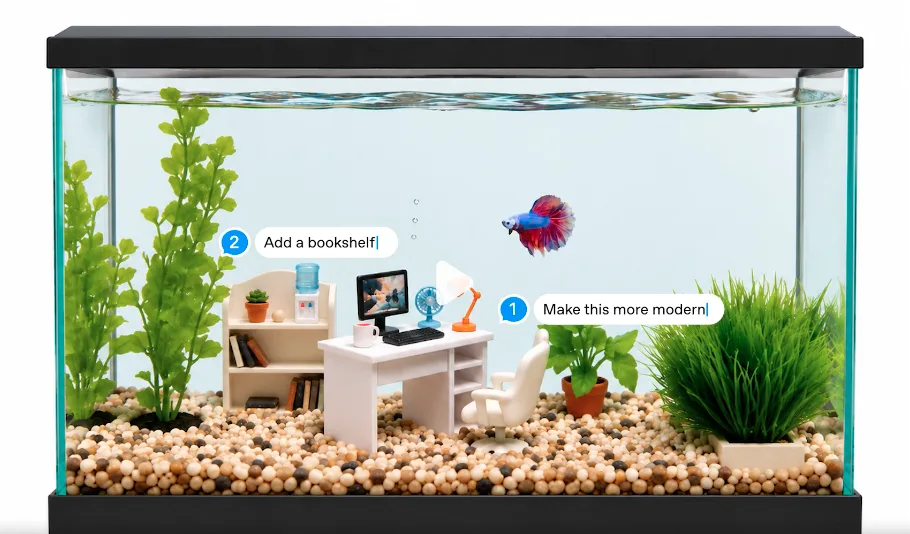
The rollout of GPT Images 2.5 brings a pair of distinct models designed to address different priorities in image creation workflows. Flare targets speed and general-purpose tasks, while Sunburst emphasizes precision and control. Yet OpenAI has provided limited transparency regarding how these differences will manifest in production environments, particularly when it comes to execution time and per-image expenses.
The core promise behind this release centers on a persistent challenge in image editing: modifying specific elements within a composition without degrading the surrounding content. OpenAI claims its new models deliver measurable improvements in this area, but developers evaluating the two options face incomplete information for making informed decisions.
Flare vs Sunburst
Flare serves as the baseline offering, positioned by OpenAI as "the default choice for most applications." The model targets everyday use cases including social media content generation, rapid prototyping, visual search functionality, and standard image synthesis. According to the company, Flare surpasses its predecessor GPT-Image-2 in output quality while cutting latency by half.
Sunburst occupies the premium tier, engineered for scenarios demanding exacting control over modifications. OpenAI characterizes it as "built for premium visual workflows that benefit from tighter control across edits." The company suggests Sunburst better suits high-stakes applications such as finalized marketing campaigns or commercial product photography. However, the tradeoff involves extended generation times, and OpenAI provides no specifics about the magnitude of this delay.
Identical token rates mask uncertain real-world economics
On the surface, both models carry identical pricing structures: $5 per million text input tokens, $8 per million image input tokens, and $30 per million image output tokens. This apparent parity, however, obscures a fundamental uncertainty about actual expenses.
On paper, OpenAI says Flare and Sunburst have the same token rates: $5 per million text input tokens, $8 per million image input tokens, and $30 per million image output tokens. But this doesn't necessarily mean using either model will run up the same bill for the same kind of image.
The fundamental issue is that OpenAI has not disclosed how token consumption differs between the two models for identical image generation tasks. Developers cannot rely on the company's existing GPT Image 2 cost calculator for projections, as OpenAI explicitly states: "Token rates match GPT Image 2. The GPT Image 2 calculator does not estimate GPT Image 2.5 token consumption." Without published token consumption estimates, there is no way to compare the actual cost of generating the same image using Flare versus Sunburst before committing resources.
The latency comparison between the two models remains similarly opaque. While OpenAI confirms that Flare achieves 50% lower latency than GPT-Image-2, the company has not specified how Flare's speed compares to Sunburst's. The launch documentation only notes that Sunburst's enhanced precision involves "longer generation times," leaving the actual performance gap undefined.
Improved editing capabilities across the board

Beyond the model variants, GPT Images 2.5 introduces refinements to the underlying image generation and editing pipeline. The system demonstrates enhanced fidelity in reference-based workflows, maintaining closer alignment between generated variations and source imagery.
The editing capabilities represent a notable advancement. Developers can now isolate modifications to specific image components—such as a product, background, or text element—while leaving adjacent areas untouched. The model also responds more accurately to sequential editing instructions, reducing the need to regenerate entire assets when minor adjustments are required. OpenAI notes the system is "better at understanding complex visual instructions and translating them into coherent results."
These improvements in image quality, editing precision, and generation speed should streamline image-intensive workflows. However, determining whether Sunburst's superior control justifies its longer processing times and potentially higher costs will require hands-on evaluation by individual development teams.