
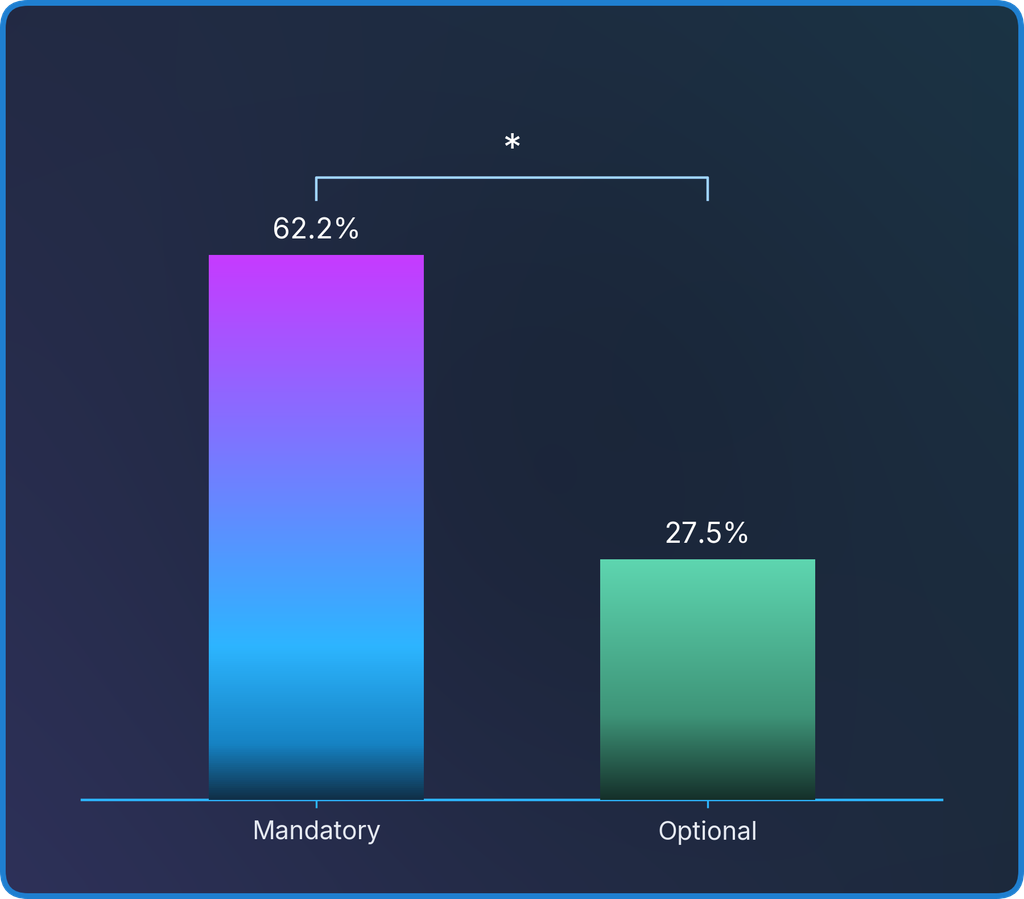
Internal platforms that enforced mandatory adoption succeeded at delivering their stated objectives far more often than those that left adoption to developer choice. Teams running mandatory platforms reported achieving most or all of their goals at a rate of 62.2%, versus just 27.5% for optional platforms. Yet this performance advantage has not stopped the industry from moving in the opposite direction: mandatory platforms have declined from 63.0% to 45.9% of the market in a single year, while optional platforms now represent the majority at 54.1%.
This reversal contradicts conventional wisdom in platform engineering. Team Topologies, the CNCF's Platform Engineering maturity model, and recent literature reviews all advocate for platforms that earn adoption through self-service rather than compulsion. Evan Bottcher's frequently cited 2018 definition stated that a platform "cannot stand on a mandate alone." Researchers expected optional adoption to dominate the data. Instead, the numbers told a different story.
The emergence of AI coding agents is reframing the mandate question entirely. These agents do not make platform choices the way developers do. According to the research, "An agent never chooses a platform. It works within whatever access someone configures for it." This shift moves the critical question away from whether to mandate platform adoption and toward which policies the platform should enforce.
Mandatory adoption delivers, even as optional takes over
The performance gap between adoption models remains stark. Teams with mandatory platforms report 62.2% success in delivering their intended benefits, compared to 27.5% for optional platforms. Yet the industry continues to recommend and adopt optional models, suggesting that success metrics alone do not drive strategy.
Two distinct questions produce two distinct answers. Mandatory adoption predicts whether a platform achieves its goals more reliably. Optional adoption, however, measures something different: whether developers embrace a platform because they prefer it, not because they must. This distinction represents a different kind of success.
What comes bundled with mandatory platforms
Mandatory adoption does not operate in isolation. Network analysis of survey responses reveals that mandatory adoption clusters with stronger leadership direction, higher job satisfaction, and greater confidence in budget security. These factors correlate with one another and with successful goal delivery.
Leadership support likely explains much of this pattern. Executives who mandate a platform typically secure its funding and champion its adoption. In this sense, mandatory adoption is one element of a larger package that includes sustained budget allocation and clear strategic direction.
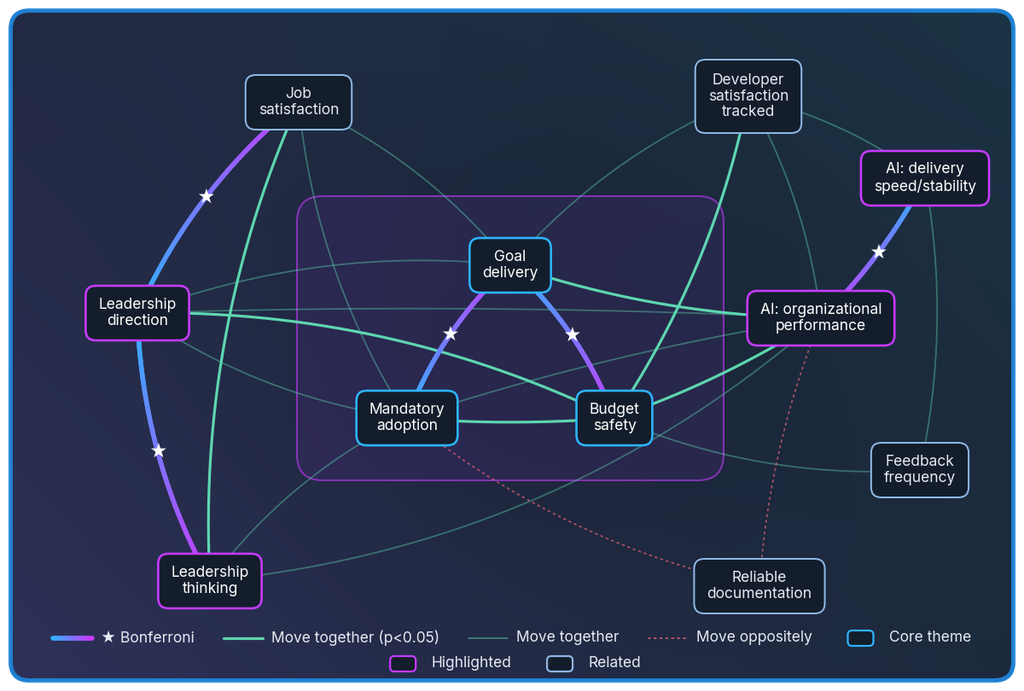
AI adoption follows a similar pattern. Respondents reporting the strongest positive impact from AI also reported higher budget confidence, clearer leadership direction, and greater job satisfaction. AI adoption showed association with mandatory platform adoption, though less strongly than other factors.
Because this data is cross-sectional, causation cannot be determined. Regardless of which factor influences which, the conclusion remains consistent: without leadership engagement and the budget commitment that typically accompanies it, a mandate alone is unlikely to produce the same results.
Where mandatory adoption matters most
Mandatory platforms generate considerably higher confidence in budget renewal: 78.9% versus 50.0% for optional platforms. When examining adoption strategy, budget confidence, and goal delivery together, budget confidence emerges as more critical for optional platforms than for mandatory ones.
For optional platforms, moving from low to high budget confidence produces a dramatic shift in goal delivery, rising from 9.5% to 52.4%. Mandatory platforms show similar movement in budget confidence, but the impact on performance is less pronounced, ranging from 37.5% to 70.0%.
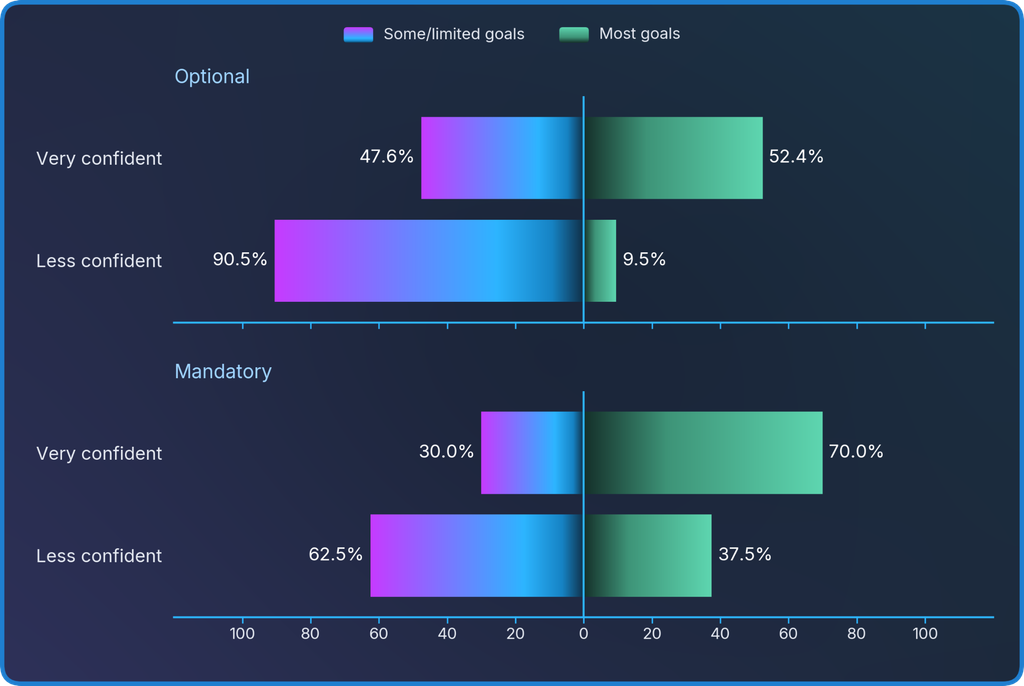
This distinction has practical implications. Mandating platforms reduces performance dependence on budget security. Optional platforms succeed or fail largely based on funding stability, whereas mandatory platforms maintain more consistent results regardless of budget conditions. For platform leaders with limited advocacy capacity, this insight matters: mandatory adoption proves most valuable when funding is uncertain and less critical once budgets stabilize.
Mandatory adoption also promotes standardization, working alongside budget confidence. It can eliminate decision fatigue and tool proliferation that emerge when every team selects its own solutions, allowing the platform to manage security, compliance, and governance centrally rather than distributing these responsibilities across teams.
This advantage grows as agents assume more delivery responsibilities. Where developers might choose to deviate from standard processes, agents follow the routes the system provides. Standardization makes those routes safer and more predictable.
What a mandate can't do on its own
Mandatory adoption carries no guarantee of success and can mask underlying problems. The data reveals a concerning pattern: less reliable documentation correlates more closely with mandatory adoption than with optional adoption. When developers lack choice, maintaining documentation quality becomes less urgent, since the mandate itself prevents users from leaving.
Mandatory platform adoption shows only weak association with higher overall job satisfaction. More significantly, mandatory platforms are no more likely to track developer satisfaction. Under mandatory adoption, this gap matters because adoption metrics no longer signal whether the platform functions well.
A more measured approach separates policy from platform choice: mandate the policies—security, cost control, business-critical standards—while keeping platform adoption itself optional. A platform that becomes the easiest path to meeting those policies will attract developers on its merits. This approach preserves the benefits of mandatory adoption, including scale and standardization, while retaining the signal value of developer preference. A meaningful test of any platform is whether developers would continue choosing it if they were not required to.
This reasoning strengthens as agents take on more delivery work. Documentation and manual reviews only work when people engage with them. Agents require the same policies, but these must be embedded in the delivery process itself, making the platform that enforces them the most practical option for both developers and agents.
The strongest platforms probably need both: a reason people have to use them, and a reason they would want to.
Bottcher's 2018 observation holds true: forcing developers onto a platform is insufficient. Yet the data suggests that relying solely on developer choice may also fall short. The most effective platforms likely require both a compulsory reason to use them and a voluntary reason to prefer them. For agents, which make no choices at all, the platform itself must embed the safe path.