Rapid prototyping via AI coding agents has reshaped how product teams work. A working prototype can materialize before the next planning cycle concludes—a genuine advantage. Yet the responsibility for validation remains: someone must assess whether interactions are sensible, whether new capabilities address real problems, and crucially, whether the organization can deploy the change without risk.
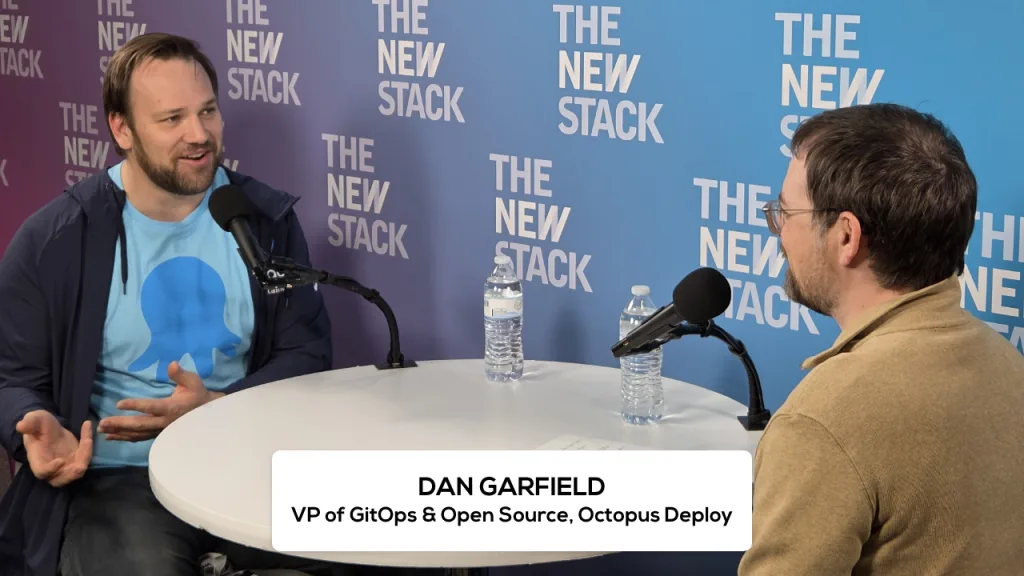
At Octopus Deploy, this reality is reshaping how product managers present ideas. Rather than submitting written specifications, they now arrive with functional prototypes and continue iterating on behavior. Developers then shepherd the work through to live systems. "The ultimate differentiator now seems to be care, attention to detail, and taste," Dan Garfield, the company's VP of Open Source, told The New Stack's Matt Burns during KubeCon + CloudNativeCon this month in Salt Lake City. The conversation spanned from a newly announced open-source utility designed to flag problematic Argo CD setups to a fundamental challenge: what occurs when teams generate modifications faster than they can validate and release them?
Catching risky Argo CD configurations
Garfield maintains Argo CD and recalls an incident where a community user's deployment suddenly removed 100 applications. Recovery happened swiftly, but investigation revealed the root cause required substantial effort. Two configuration parameters, each harmless independently, combined to allow a network disruption to trigger the mass deletion.
Octo Doctor, unveiled at ArgoCon as a free open-source offering, targets precisely these scenarios. The tool examines Argo CD configurations using a deterministic ruleset built from years of platform stewardship and production experience. Its output describes what each flagged setting might accomplish and suggests remediation paths. Teams can execute it via command line, integrate it as a Claude skill, or embed it within CI pipelines to intercept dangerous modifications in pull requests.
"It's a tool that you can run using AI, but it gives you a deterministic output," Garfield explained to TNS.
The recommendations preserve human judgment. Organizations may have legitimate reasons to retain a flagged configuration. The report equips developers to make that decision with full awareness of potential consequences. The goal is enabling that deliberation before 100 applications force the decision themselves.
Delivery becomes the new constraint
According to Garfield's perspective, expanded AI-assisted development creates mounting strain on version control systems and continuous integration infrastructure as teams generate and refine more pull requests. After changes clear CI checks, teams require confirmation that software operates as intended in production-like conditions. Octopus Deploy's continuous delivery platform, which integrates with Argo CD, manages phases including testing, approvals, and transitions from staging through production.
Garfield outlines how these phases interconnect. Ephemeral environments allow code to run its test suite. Staging environments offer another validation checkpoint. Incremental rollouts introduce modifications to a subset of users initially, permitting teams to identify issues and roll back before widespread impact. Defined policies establish which verifications and sign-offs a production service demands, giving developers a consistent release pathway even as modification frequency accelerates.
A comparable principle guides Garfield's thinking around GitOps. When contributing to its foundational principles, the group emphasized versioned, immutable storage. This approach allows flexibility in how OCI or versioned databases might manage higher concurrency while sustaining an auditable record.
"There are things that we're going to have to continue to evolve to handle the scale and change rate," Garfield said.
The complete conversation is available on The New Stack's YouTube channel, where Garfield elaborates on how Argo maintainers employ AI for pull request triage and review, his continued emphasis on reproducible builds, and an unconventional approach one developer took to GitOps using Google Sheets—dubbed "SheetOps."