Waiting eight minutes for a fresh model replica to begin handling traffic feels interminable when requests are already arriving. Kubernetes can trigger autoscaling and schedule the new replica, yet the actual time to readiness involves multiple sequential steps: provisioning hardware, fetching the container image, loading model weights, and compiling GPU code.
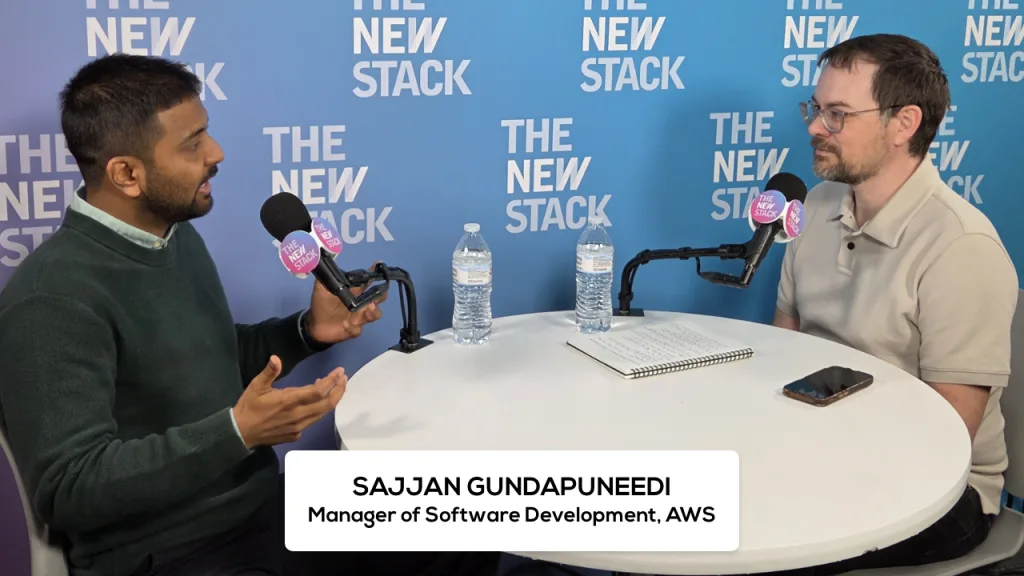
At KubeCon + CloudNativeCon in Salt Lake City this month, Matt Burns from The New Stack spoke with Sajjan Gundapunnedi, senior engineering manager for Amazon Elastic Kubernetes Service (EKS), about strategies developers can employ to compress those startup delays. The conversation examined both the challenge of locating available GPUs and the architectural choices that determine how efficiently those GPUs operate.
Demand for GPU capacity or any accelerated capacity is outpacing supply everywhere
Sajjan Gundapunnedi
Expanding Kubernetes' scheduling capabilities
Gundapunnedi outlined two pathways for reserving accelerated capacity through EKS Auto Mode and Karpenter, the Kubernetes node provisioner. On-Demand Capacity Reservations lock in capacity within a specific Availability Zone, contingent on availability. Capacity Blocks enable teams to reserve capacity for a predetermined time window, allowing them to align training or fine-tuning jobs with their reservations.
Once hardware is secured, the physical placement of devices becomes critical. EKS Auto Mode now supports Dynamic Resource Allocation for NVIDIA GPUs and Elastic Fabric Adapters, permitting developers to declare which devices a workload requires and request a GPU alongside an adapter on the same PCIe path.
What this lets you do is faster communication for your job
Sajjan Gundapunnedi
Training and fine-tuning operations involve repeated data transfers between components. Idle time during these exchanges wastes GPU cycles while costs accumulate. Enabling Kubernetes to make placement decisions based on hardware topology can substantially reduce these communication delays.
Dissecting the eight-minute delay
Inference workloads present distinct scheduling challenges. Demand arrives in waves, and newly launched replicas must become productive before the traffic spike subsides.
Gundapunnedi detailed the approaches his team experimented with, starting with capacity buffers in Karpenter that allow replicas to land on already-running nodes during traffic surges. The team also adopted seekable OCI to download and decompress container images concurrently, and integrated vLLM with Run:ai Model Streamer to fetch model weights in parallel.
For smaller models, GPU code compilation emerged as a significant expense. Every replica launching on a node was performing identical compilation work. The solution involved storing compiled artifacts locally on the node, enabling subsequent replicas to reuse them rather than recompiling.
It was the cheapest configuration tuning for us, which gave the largest benefits
Sajjan Gundapunnedi
The conversation also addressed the trade-off between managed and self-managed infrastructure. In Auto Mode, AWS handles worker-node images, bundled add-ons and their update cycles, and operates the Karpenter controller. Standalone Karpenter remains available for teams requiring configurations that Auto Mode does not yet support.
For application developers, this distinction becomes significant when responsibilities transition from deploying a model to operating the underlying infrastructure that sustains it.