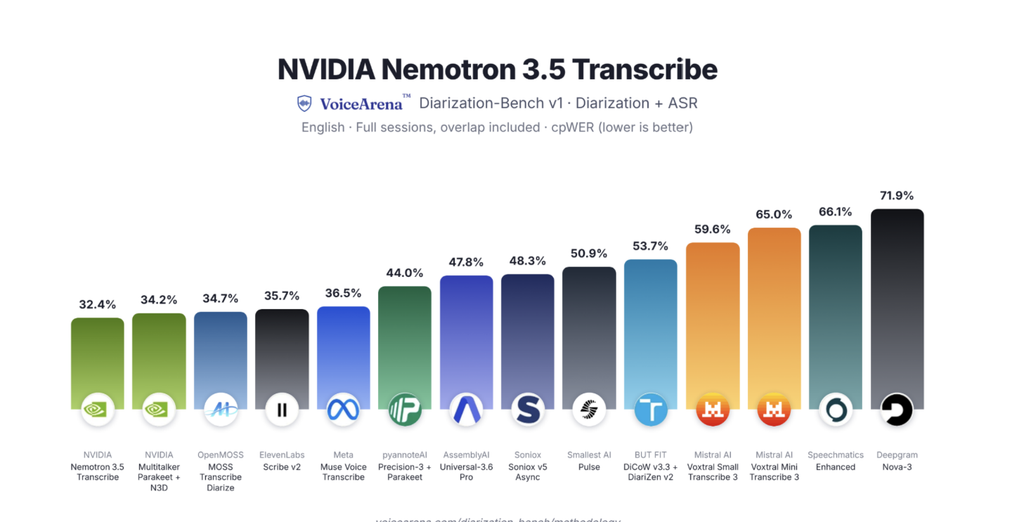
Nvidia unveiled Nemotron 3.5 Transcribe on Wednesday, a multilingual transcription model designed to accept instructions from users before analyzing audio. The open-weight release claims the top position on Hugging Face's Open ASR leaderboard for English-language models, achieving a word error rate of 5.33%, and also ranks first across two speaker-attribution benchmarks.
Promptable transcription with context setting
The model's distinguishing feature is its ability to accept prompts—users can provide specific instructions that shape how the model processes audio. This typically involves establishing context for the transcription, such as informing the model that an audio file contains a medical conversation in English and supplying relevant medical terminology.
Beyond domain-specific context, the model supports additional capabilities. Users can instruct it to identify and label individual speakers, pose questions about the audio content, request either verbatim or edited transcripts, and specify formatting preferences for numbers and other elements. Nvidia consolidates these features—along with translation functionality—into a single model checkpoint, potentially streamlining application development.
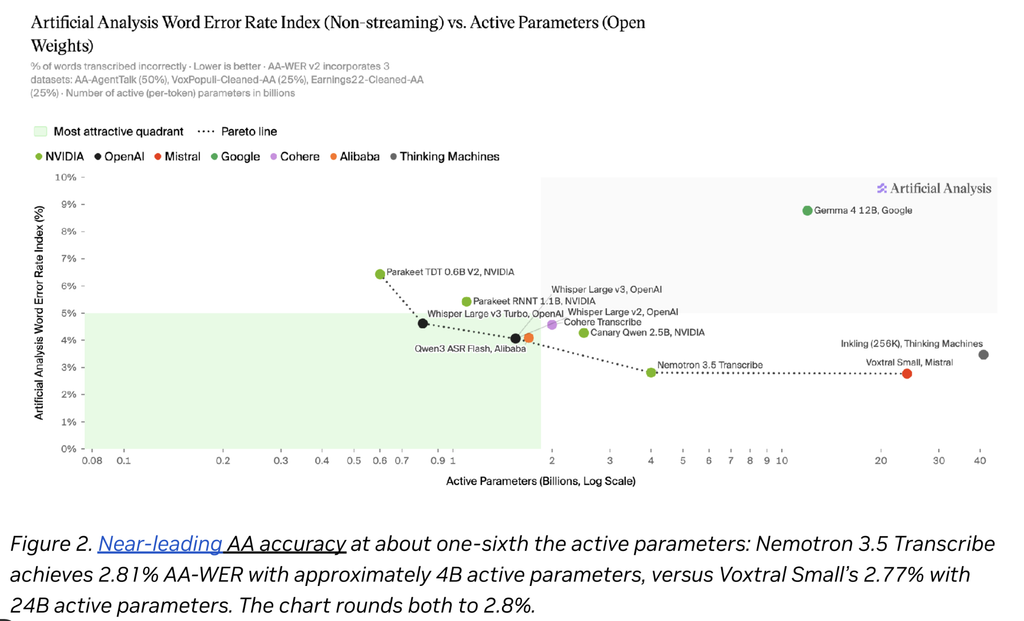
Providing this contextual guidance generally improves accuracy, though the trade-off involves substantially larger model sizes compared to conventional transcription systems. Traditional models typically remain under one billion parameters, whereas Nemotron 3.5 Transcribe operates as a 30-billion-parameter mixture-of-experts architecture with 4 billion active parameters.
Competitive performance with parameter efficiency
While promptable speech-to-text models have emerged recently—including Mistral's Voxtral offerings and AssemblyAI's Universal 3 Pro—Nvidia's approach achieves comparable accuracy with substantially fewer active parameters. On Artificial Analysis's benchmark, Nemotron achieves a 2.81% word error rate against Voxtral Small's 2.77%, while consuming approximately 4 billion active parameters versus Voxtral Small's 24 billion. This comparison reflects accuracy relative to active parameter counts rather than runtime or memory usage.
Language support and technical specifications
The model supports transcription across 40 languages, with translation capabilities for 31 of those languages to and from English. Speaker attribution functionality operates across 13 languages and can differentiate up to eight distinct voices. Audio question-and-answer capabilities were trained exclusively in English.
Nemotron 3.5 Transcribe can process recordings extending to one hour in length. The model is optimized for pre-recorded audio and does not support live streaming. Developers can deploy it using vLLM or execute it locally via NeMo-Speech.cpp, with Nvidia indicating single-GPU operation across hardware ranging from Jetson AGX Thor and DGX Spark to Blackwell data-center processors.
Fine-tuning and customization
Released under the OpenMDW-1.1 license as an open-weight model, Nemotron 3.5 Transcribe permits users to fine-tune the system for their specific requirements using NeMo Speech's fine-tuning capabilities and comparable tools. In a medical transcription case study, Nvidia demonstrated that fine-tuning reduced word error rate on previously unseen speakers from 22.44% using optimal prompting to 12.17%—a 45.8% relative improvement. The complete adaptation process required approximately 14 GPU-hours on a single GB300 processor.
Alongside the model release, Nvidia is distributing Granary v2, a reusable data curation pipeline constructed with NeMo Curator. The release includes public manifests encompassing roughly 463,062 hours of audio spanning 48 languages and 16 source corpora. Developers can execute this pipeline on their own recordings to prepare datasets for customization, though these figures represent the dataset release rather than Transcribe's complete training mixture or its sampling distribution.