Underutilized Macs and PCs can now handle inference requests from AI agents. Nvidia's PAIR distributes these requests through Ollama or LM Studio, with each model executing on a single machine.
Nvidia has been steadily building out its strategy around open-source models and edge AI execution. The company's planned acquisition of Hugging Face signals deeper commitment to this direction, and recent product launches demonstrate tangible progress in lowering barriers for users wanting to deploy AI locally.
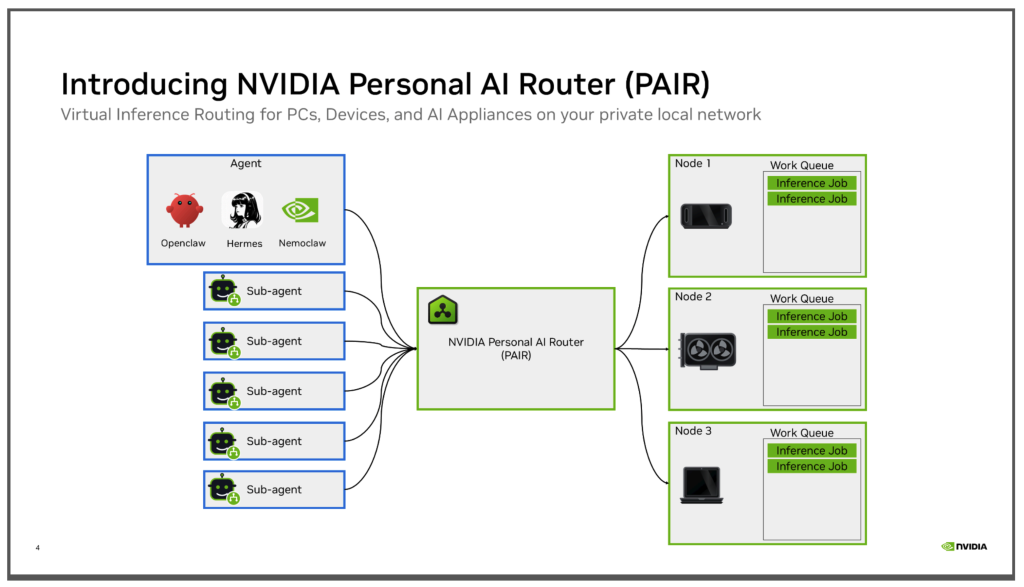
On Thursday, Nvidia unveiled the Nvidia Personal AI Router (PAIR), an open-source network router designed for residential environments that harnesses idle computing resources to run smaller models on-demand and enhance agentic workflows through parallel subagent execution.
PAIR targets performance improvements for agents such as NemoClaw, OpenClaw, and Hermes by enabling them to deploy additional subagents concurrently. The architecture allows a primary agent to distribute tasks among subagents, whose model inference requests then execute across these idle systems.
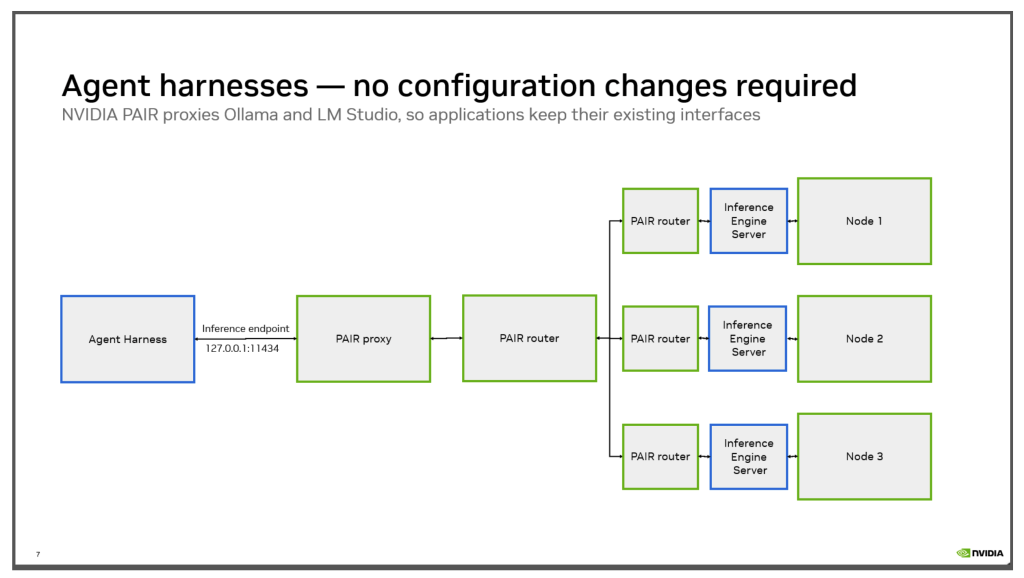
Nvidia describes the tool as a "virtual inference router" and emphasizes it functions as a routing layer rather than a new inference engine. The software leverages existing Ollama or LM Studio installations on networked machines and coordinates model execution across them. After deployment on each machine, PAIR automatically discovers available systems on the local network using mDNS and assesses their capability to handle requests.
An important limitation: PAIR cannot fragment a single inference operation across multiple machines. Nvidia clarifies that the system neither consolidates GPUs nor combines VRAM into a unified resource and cannot distribute individual inference requests to multiple nodes.
Agents can send a request through the familiar local interface it expects. PAIR receives the request through its proxy, identifies its engine and model requirements, and selects one eligible node. That node executes the request from start to finish and sends the response back through PAIR. The agent continues to see one connection while PAIR handles placement behind it.
Nvidia
Hardware compatibility spans Windows, macOS, and Linux systems equipped with suitable GPUs. Specifically, Nvidia GeForce RTX 20 series cards and later represent the minimum threshold, alongside Macs running M4 silicon or newer, plus Nvidia DGX Spark units and forthcoming RTX Spark PCs and laptops launching later this year.
The inclusion of Mac support deserves note, given their widespread adoption for local model deployment and agents like OpenClaw, despite lacking Nvidia GPU acceleration.
Different machines within the network can host distinct models, though PAIR only directs requests to machines with the appropriate engine active and the specific requested model present. Deploying identical models across multiple machines expands routing flexibility for distributing simultaneous requests.
PAIR monitors machine availability and automatically halts local inference when a user resumes active work or gaming on a system and reclaims GPU resources.
In Nvidia's demonstration, PAIR running on two PCs equipped with high-end RTX 5090 GPUs containing 32 GB of RAM (currently priced at $5,000 despite initial $2,000 MSRPs) and the Qwen3.6 35B A3B model achieved approximately 1.6x speedup when coordinating five subagents.
Most households lack multiple RTX 5090 cards or DGX Spark desktops, so practical performance in scenarios combining a Mac Studio, several Mac minis, and perhaps a gaming PC remains to be demonstrated, though even such configurations should yield measurable improvements for local agent operations.
Availability
Nvidia PAIR entered beta availability immediately. Setup requires installing the software on each networked machine, configuring system discovery and pairing, and ensuring Ollama or LM Studio runs on each with downloaded models.
PAIR streamlines initial configuration by automating Ollama or LM Studio installation and model downloads on paired machines.
Source: The New Stack