Nvidia and Palantir revealed Thursday a joint initiative to deploy what they call "sovereign AI to critical supply chains," beginning with Nvidia's own operations. The collaboration extends their partnership that began last October, when the two companies announced plans to combine Nvidia's AI computing capabilities and models with Palantir's software platform to enable organizations to make complex operational decisions using AI. The June expansion introduced sovereign AI functionality, permitting enterprises to operate and customize Nvidia's models within isolated environments while maintaining control over sensitive data and model parameters.
A proving ground for sovereign AI
The partnership has fine-tuned Nvidia's 30-billion-parameter Nemotron 3.5 Lightning model using decisions from Nvidia's supply-chain operations team. Palantir's Foundry and Artificial Intelligence Platform (AIP) consolidate the operational data underlying those decisions, while its Ontology functions as a dynamic reference system linking components, factories, capacity levels and production obligations. Nvidia's cuOpt software determines optimal distribution of constrained parts, with Nemotron providing broader context analysis and operational recommendations for planners.
The companies intend to "extend the learnings from Nvidia's deployment" across sectors including manufacturing, energy, healthcare, automotive and aerospace. Palantir's customer base will have the ability to construct customized versions for their own supply chains by training Nemotron on their proprietary information through Foundry and AIP, then executing the resulting system on-premises or via cloud and colocation infrastructure.
In essence, Nvidia and Palantir are operationalizing the sovereign AI framework they outlined in June within Nvidia's own environment, simultaneously using that implementation as a reference architecture that other organizations can modify for their specific requirements.
Nvidia as a test case
With a $5.4 trillion market capitalization making it the world's most valuable public company, Nvidia has compelling reasons to pilot the technology internally. The company's supply chain encompasses millions of components, thousands of suppliers, and a worldwide manufacturing ecosystem. A single Vera Rubin rack contains approximately 1.3 million parts, and each component must reach the correct location at the precise moment—any shortage can halt assembly while other arrived materials remain idle.
Nvidia founder and CEO Jensen Huang contends that this complexity makes supply chains an obvious candidate for AI intervention. He emphasizes that contemporary AI system development increasingly requires orchestrating an extensive network of companies and components, spanning semiconductors and memory through manufacturing, networking, power and thermal management.
Supply chains are the operating system of the physical economy, and AI factories are among the most complex systems ever built.
Jensen Huang
Palantir co-founder and CEO Alex Karp extends this assessment, suggesting that Nvidia's operations represent an exceptionally demanding environment for validating the companies' methodology.
Nvidia has arguably the most valuable, intricate, and complex supply chain in the world.
Alex Karp
The sovereignty selling point
Nvidia has positioned itself prominently in discussions surrounding open-model approaches. In July, Huang published his inaugural X post promoting an industry letter urging U.S. policymakers to support frontier open-weight models, contending they grant companies and nations greater autonomy over their AI infrastructure.
Nvidia subsequently announced a $12.9 billion acquisition of Hugging Face in early September, the platform known as the "GitHub for AI models." Amid questions about whether ownership by the world's leading AI chipmaker might compromise Hugging Face's independence, Huang committed that the platform would maintain its open character, continue distributing models from across the sector and extend support for non-Nvidia hardware.
Nemotron occupies a central position in Nvidia's open-model strategy. The designation traces to 2023, when Nvidia introduced its first Nemotron-3 8B models designed for enterprise customization and fine-tuning. These initial models were accessible through Hugging Face and Nvidia's NGC catalog, though access was restricted and governed by Nvidia's proprietary community license. While customizable with available weights, the broader "open model" framing Nvidia employs presently emerged subsequently.
The Nemotron 3 series launched in December, initially encompassing Nano, Super and Ultra variants targeting different agentic AI applications. Nvidia currently releases model weights and, for numerous models, training data and recipes enabling developer customization. Nemotron 3.5 Lightning, made available in August, represents the 30B model that Nvidia and Palantir have adapted for this supply-chain application.
This openness underpins the sovereignty proposition: organizations can modify Nemotron leveraging proprietary information while maintaining that information, model weights, and inference execution within their controlled infrastructure.
Specialization over size
Nvidia's internal deployment furnishes measurable evidence for external evaluation. The fine-tuned 30B Lightning variant achieved 86.7% accuracy on the supply-allocation assignment, compared to 55.5% for the 550B Nemotron 3 Ultra—a model approximately 18 times larger.
In a technical blog post released Thursday alongside the primary announcement, Nvidia solutions architects Nell Barber, Rana Haber, and Aastha Jhunjhunwala highlight how substantially specialization can enhance performance. On a narrowly scoped allocation task, the 30B model surpassed a general-purpose model more than an order of magnitude larger.
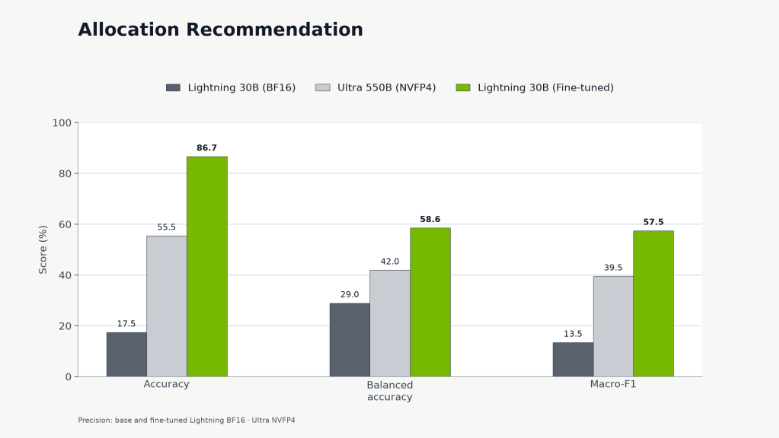
This doesn't mean the smaller model is more capable overall. Its gains are concentrated in the domain it was post-trained on.
Nell Barber, Rana Haber, and Aastha Jhunjhunwala
The architects note that future production risk forecasting remained challenging despite fine-tuning, and specialization enhanced the decision task while failing to address every prediction challenge associated with it.
For organizations evaluating Nvidia's methodology, the significant insight may be that a smaller open model trained on business-specific data can frequently deliver greater practical value than selecting the largest available model.