
Anthropic's recent AI-Native SDLC Playbook makes a compelling observation: "code is no longer the bottleneck." When AI agents can generate working implementations in minutes, the real challenge shifts upstream and downstream—to planning, code review, testing, deployment, and compliance oversight. Yet this insight reveals a deeper problem that existing tools have not solved.
The danger lies in scale without control. If organizations can now produce ten times more changes while maintaining the same quality per change—or worse—they face an impossible task: identifying which changes are problematic when manual review becomes the bottleneck. As the playbook itself suggests, "The risk… is producing ten times the changes at the same quality per change or worse, with no way to identify which changes are the bad ones." Traditional approaches, where a human examines every change, collapse under this volume.
The playbook establishes solid principles: written specifications drive work, policies are enforced through deterministic mechanisms rather than prompt instructions, and agents validate their own output before humans review it. Yet it—along with similar tools like Amazon's Kiro and GitHub's Spec Kit—prescribes a single, fixed workflow that every change must follow. This one-size-fits-all model creates a critical gap.
The Problem with Uniform Processes
No organization actually operates under a single process. A documentation update, a library version bump, and a database schema change in a payments system carry vastly different risks and require different levels of scrutiny. Each demands distinct approvers, verification methods, and audit records. In regulated industries, the process itself is a compliance requirement—auditors need to see who approved each change and what evidence informed that decision.
When tools enforce one rigid workflow, teams inevitably work around it. They route changes through unofficial channels when the prescribed path doesn't fit, making the actual process invisible and unauditable. Alternatively, vendors add configuration layers until the tool becomes an incomprehensible workflow engine. "When a tool prescribes one process, teams route around it for changes that don't fit, which is the worst outcome because the real process becomes invisible."
Processes as State Machines
A better approach treats each process as a state machine—a set of rules that react to observable facts about a change. These facts live in systems the organization already owns: the repository, CI pipeline, production cluster, and issue tracker. Rather than a program that executes sequential steps, the process becomes a collection of rules, each specifying:
- The conditions that must be true before the rule can activate
- Whether the rule fires automatically or requires human approval
- What permission it grants when it fires—such as the ability to merge or deploy
These rules are stored as data and reviewed like code. An organization maintains multiple state machines, each tailored to a different risk category. At runtime, the system does not track progress through numbered steps. Instead, when a fact appears in the system that owns it, relevant rules react. Late-arriving events, duplicate events, or events that arrive after a restart are handled consistently because rules only examine current state. A gate can be held during an incident or release freeze without modifying any definition.
Enforcement matters. A gate implemented as a prompt instruction relies on the model's compliance. Instead, the agent harness can provide the determinism needed to run the state machine, pausing the agent between actions until a gate receives approval, while infrastructure enforces the remaining conditions.
Routing Changes by Risk, Not by Author
A single process definition per repository still forces every change down the same path, regardless of its actual risk. Instead, the path should be determined by classifying the change based on signals already available: which files it modifies, which repository it targets, labels on its tracking issue, and similar metadata.
Process definitions themselves must evolve safely. Since a process definition is data, changing it is itself a change that travels through its own gated workflow. Relaxing an approval requirement on the release process receives the same scrutiny as a schema migration—not the casual treatment of editing a configuration file.
Consider three changes to the same service:
- A documentation fix, identified by the paths it touches, follows a two-state process: build passes, then merge. No human involvement required.
- A dependency upgrade skips design review but demands compatibility evidence—the upgraded service must pass integration tests against real dependencies. A major version change adds an approval gate that a patch version does not.
- A schema migration in the payments service is routed by the component it affects, regardless of how the change is labeled. Its process includes states the others never reach: review by a payments domain owner, validation against production-scale data, and release approval from an accountable stakeholder.
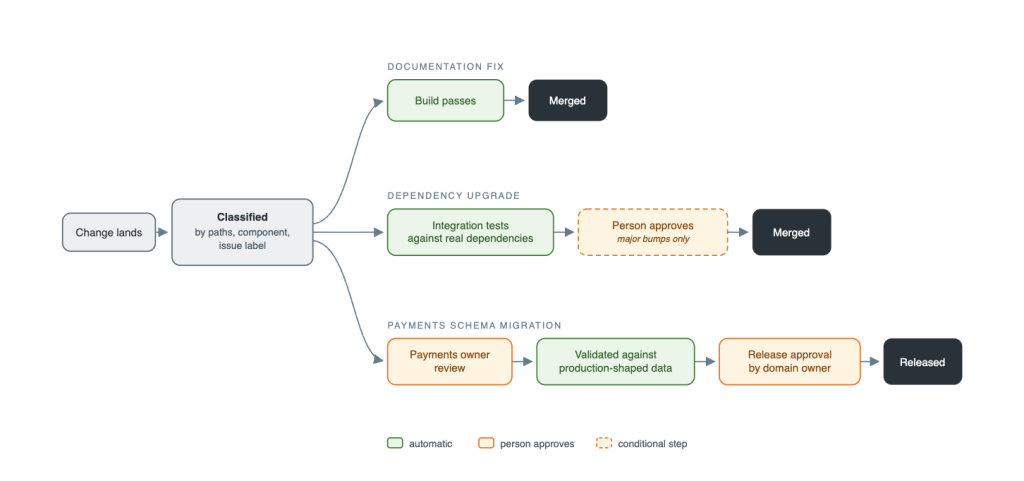
Every transition is logged with the approver's identity and the evidence supporting the decision.
Core Principles
Effective adaptive processes should follow these tenets:
- Autonomy grows with demonstrated reliability. Each transition is configured to fire automatically, require approval, or hold. As agents prove trustworthy on a category of changes, that setting loosens, allowing the process to benefit from agent improvements without redesign.
- Human effort concentrates where judgment matters. Agent work becomes cheaper over time; human supervision does not. People enter the loop only when the decision requires human judgment, and they receive the context needed to decide quickly.
- Evidence originates outside the agent. An agent's self-report never advances a change. Transitions fire on facts from systems the agent cannot modify—test results, validation in production-like environments, and external checks.
- The process log is the audit trail. The written definition serves as policy, and the transition log documents who approved each step, what evidence they considered, and which version of the policy was in effect.
Scaling Quality Through Adaptive Workflows
The playbook and comparable tools establish the right foundations. What remains missing is the ability for organizations to define their own processes, adjust them based on the risk profile of each change, and evolve them safely over time. The objective is not to remove humans from the loop—it is to deploy human judgment precisely where it is needed, supported by evidence that agents cannot generate about themselves. This approach maintains quality while multiplying throughput.