Meta unveiled Muse Ember on Monday as a streamlined, multimodal addition to its Muse model lineup. The model targets the same efficiency-focused segment that Anthropic and OpenAI serve with Claude Haiku 5.5 and GPT-6 Luna respectively, following the industry pattern of offering scaled model families from specialized inference tasks through frontier-class systems.
The model is positioned for agentic subtasks such as file reading, test execution, and localized code modifications, with larger models like Muse Wonder handling higher-level planning. Muse Ember is accessible via Muse Code and the Meta Model API under the identifier muse-ember-1.0, with model weights remaining proprietary. Availability on third-party platforms like OpenRouter and alternative cloud providers is expected, consistent with Meta's distribution strategy for prior Muse releases.
Pricing and performance metrics
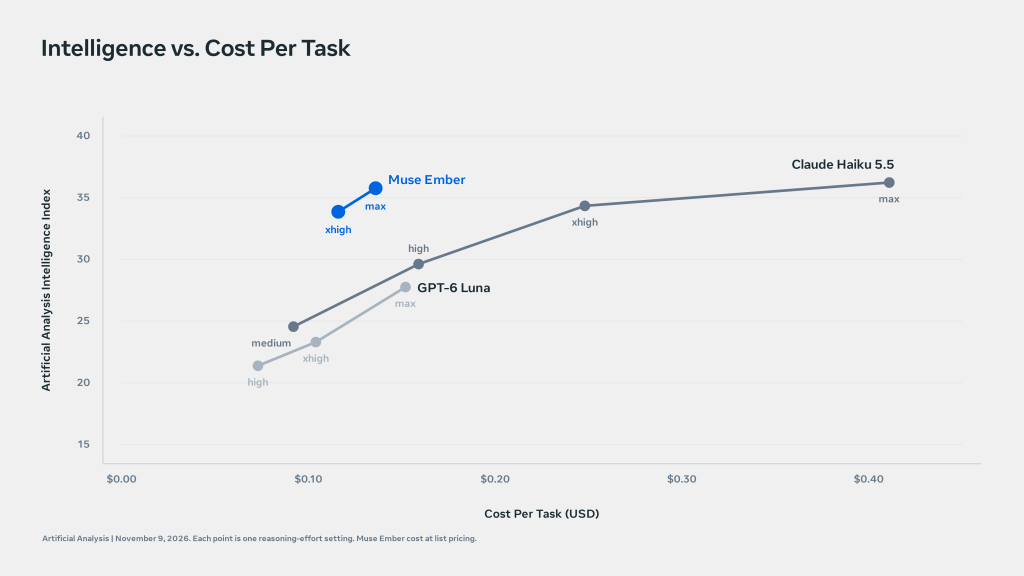
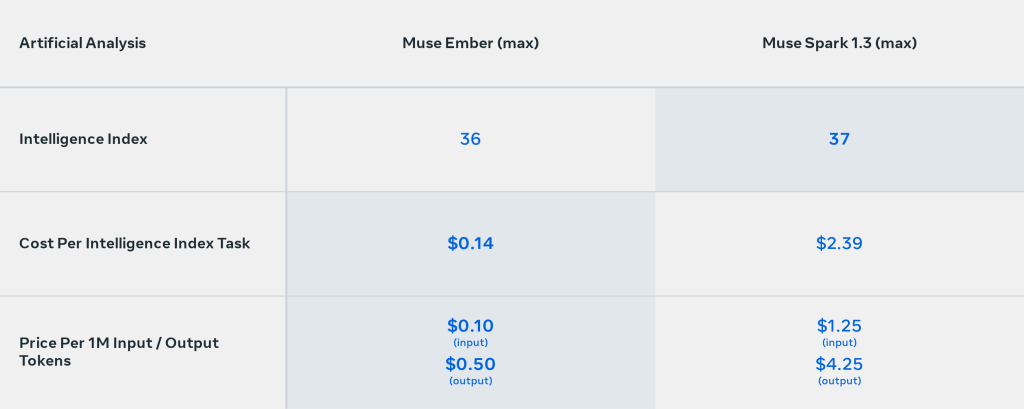
Muse Ember demonstrates competitive cost efficiency in Meta's benchmark analysis. At maximum reasoning settings, the model costs approximately $0.14 per task on the Artificial Analysis Intelligence Index, compared to $0.41 for Haiku and $0.15 for Luna. The model achieves Haiku's rounded benchmark score at roughly one-third the expense and exceeds Luna's performance for approximately one cent less per task. Under the xhigh configuration, Ember scores around 34 at approximately $0.12 per task.
The model features a 1M-token context window with support for up to 512K output tokens. Pricing is set at $0.10 per million input tokens, $0.004 per million cached input tokens, and $0.50 per million output tokens. These rates align with the standard short-context pricing of both GPT-6 Luna and Claude Haiku 5.5, though those competitors charge $0.01 per million cached input tokens at their standard rates, with increased pricing for extended contexts.
Comparison with Chinese models
While Meta's published benchmarks do not directly include Chinese competitors such as DeepSeek V4.1 Flash 1017, Z.ai's GLM-5.3 Flash, and MiniMax M3.1 Flash, Muse Ember undercuts the listed uncached input rates for all three. The model also beats DeepSeek's direct off-peak pricing and MiniMax's output costs, matching GLM's rates. DeepSeek maintains a marginally lower off-peak cache-hit rate of $0.003 per million tokens.
On the Artificial Analysis Intelligence Index, Muse Ember scores 36 at maximum reasoning, outpacing DeepSeek V4.1 Flash 1017 at 33, MiniMax at 29, and GLM at 28. OpenAI's GPT-6 Luna scores 28 on the same benchmark at maximum reasoning, while Haiku reaches 36, both under identical test conditions.
Positioning against Muse Spark
Meta's larger Muse Spark 1.3 scores 37 at maximum reasoning and costs $2.39 per task using standard API rates in the comparison methodology. The company provides a Spark Contributor tier that leverages user requests to enhance its products, matching Ember's uncached input pricing while charging $0.20 per million output tokens. Meta reports performance advantages over both Haiku and Luna on its Personal Superintelligence Index, which measures personal and knowledge work capabilities.
Performance diverges on FrontierCode 2.0, which assesses whether a repository maintainer would accept an agent's code modifications. Ember achieves 27.2 percent on this metric, trailing Haiku's 34.9 percent and DeepSeek's 28.5 percent, while Spark 1.3 scores 23.1 percent.
Computer use capabilities
Muse Ember accepts text, images, audio, and video inputs and can interact with desktop applications through screenshot analysis. On OSWorld 2.1, the model achieved a partial-credit score of 69.5 percent compared to Haiku's 68.9 percent, while completing more tasks outright at 33.8 percent versus Haiku's 27.8 percent and Luna's 17 percent. In a separate OSWorld 2.1 evaluation, Spark 1.3 earned nearly identical partial credit to Ember and completed 39.25 percent of tasks.
Meta trained Muse Ember using the larger Muse Wonder Full model, mirroring the approach used to develop specialized models deployed across Meta's Muse personal agent and Meta AI platforms.