
JetBrains has unveiled Mellum2.1 Instruct, a new iteration of its open source coding model designed to handle the routine operations that AI coding agents perform as part of larger problem-solving workflows. The model targets quick code modifications, tool invocations and other lightweight tasks that do not require deep reasoning.
Mellum2.1 Instruct extends the repository-level training that JetBrains introduced with Mellum2.1 Thinking last month to a non-reasoning variant. Unlike its Thinking counterpart, which generates explicit chain-of-thought reasoning, this model produces answers directly. JetBrains trained both variants using Nvidia's open source NeMo RL and NeMo Megatron-Bridge libraries on infrastructure capable of running 10,000 sandboxes at once.
The lineage traces back to the original Mellum, a proprietary model released in 2024 for low-latency code completion in JetBrains IDEs. In June, JetBrains introduced Mellum2, a 12-billion-parameter mixture-of-experts model available under Apache 2.0 license in both reasoning and non-reasoning forms. Mellum2.1 Thinking arrived last month with additional reinforcement learning to teach the model how to navigate codebases, use shell and file tools, and make changes that pass hidden tests.
Token efficiency through streamlined inference
Gleb Ingman, a member of the Mellum model team at JetBrains, explained that Mellum2.1 Instruct was engineered specifically for "sub-agents, tool loops, and chat." The model targets tasks where reasoning overhead provides no benefit—modifying a few lines of code or extracting information from a repository. In these scenarios, the added computation of chain-of-thought processing wastes resources without improving output quality.
Every extra thinking token adds to the time you're waiting.
Gleb Ingman, JetBrains
Ingman noted that following the Thinking model's release, JetBrains received repeated requests from developers running models locally for a less verbose alternative capable of tackling "moderately hard tasks." The concern was particularly acute for local execution, where each additional token directly increases user-facing latency.
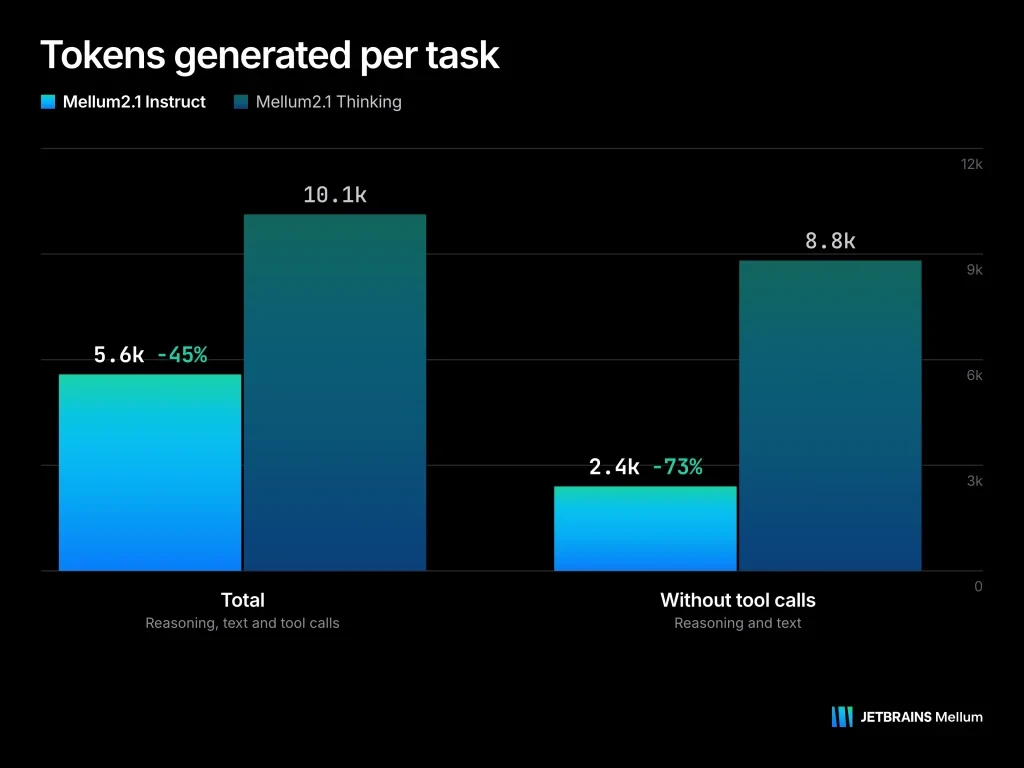
In agentic coding tests conducted by JetBrains, Mellum2.1 Instruct generated an average of 5,600 tokens per task compared to 10,100 for the Thinking variant—a 45% reduction. When tokens tied to tool calls were excluded from the calculation, the reduction climbed to 73%.
Benchmark performance and architectural advantages
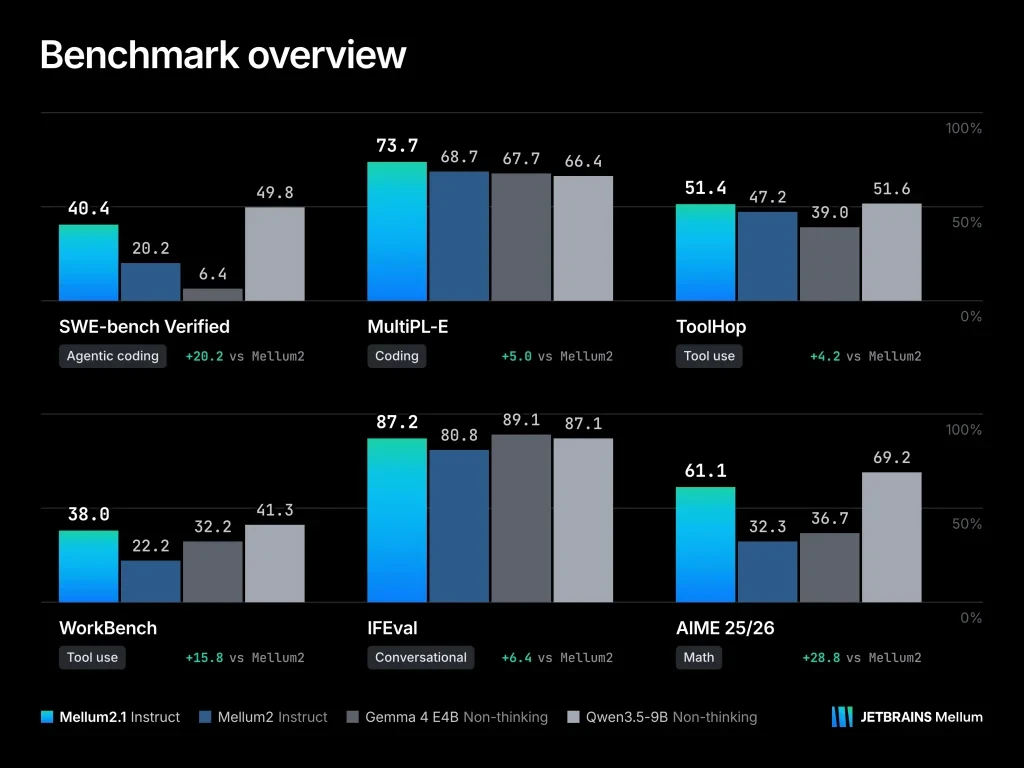
JetBrains benchmarked Mellum2.1 Instruct against its predecessor Mellum2 Instruct, Alibaba's Qwen3.5 9B and Google's Gemma 4 E4B (with reasoning disabled in the competing models). Testing covered six dimensions: agentic coding, multilingual code generation, tool use, instruction following and mathematical problem-solving.
On SWE-bench Verified, which measures real-world software issue resolution, Mellum2.1 Instruct doubled the previous Mellum2 Instruct score, rising from 20.2% to 40.4%. The model outperformed all three competitors on the MultiPL-E code generation benchmark and matched Qwen3.5 9B on ToolHop, which evaluates multi-step tool use. Qwen3.5 9B still led on SWE-bench Verified with 49.8%.
JetBrains attributes performance gains partly to Mellum's mixture-of-experts design, which activates only 2.5 billion of its 12 billion parameters per token. This architecture allows Mellum2.1 to generate tokens approximately 1.4 times faster than Qwen3.5 9B on individual requests and 1.8 times faster under concurrent load.
Trade-offs emerge on harder problems. While both Mellum2.1 variants perform nearly identically on SWE-bench Verified, performance gaps widen on benchmarks drawing from competitive programming and mathematics competitions. Ingman stated that "On hard algorithmic and math problems, such as those in LiveCodeBench and AIME, thinking is crucial, and so Mellum2.1 Thinking remains the better choice."
Deployment and multi-agent orchestration
Mellum2.1 Instruct is available on Hugging Face under Apache 2.0 license, including a GGUF version for local execution on memory-constrained hardware. JetBrains is also releasing a multi-token prediction head alongside the model, which forecasts multiple tokens ahead to accelerate generation by up to 1.8 times.
The release aligns with JetBrains' broader shift toward agent orchestration in its developer tools. In September, the company unveiled a redesigned version of Air, its environment for coordinating multiple coding agents. JetBrains has also been enhancing Junie, the coding agent launched last year, with increased emphasis on local operation.
As developers assign more work to agents, and those agents delegate tasks to other agents, the case for deploying different models based on task complexity strengthens. A token-efficient model like Mellum2.1 Instruct could help manage inference costs and latency across such hierarchical agent systems. Whether JetBrains will integrate Mellum2.1 Instruct into its own products such as Air or Junie has not been disclosed.