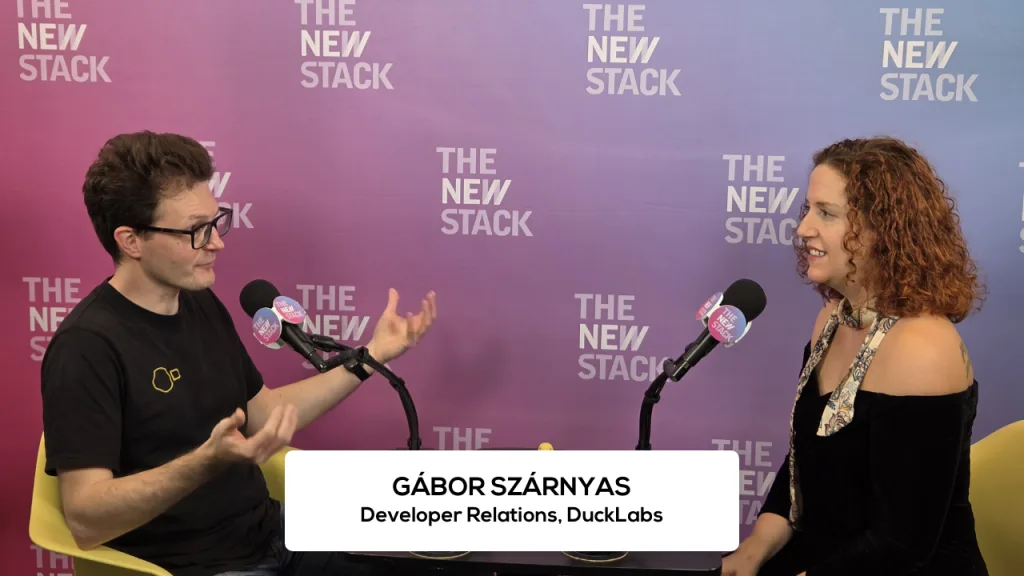
Substantial modifications to how DuckDB manages data storage have prompted the team to mark October's release as version 2.0, a major version bump that reflects backward incompatibility with files created by earlier releases. Development is already underway on version 2.0.1 as the team addresses early feedback. Gábor Szárnyas, head of developer relations at DuckLabs, discussed the reasoning behind the changes and the team's cautious approach during an appearance on The New Stack podcast.
Branded as Cinnamon Teal, DuckDB 2.0 represents the analytical database's most significant feature release since version 1.0.0 arrived more than two years ago. The release enables DuckDB to operate as a server and process queries with improved speed. Szárnyas spoke with The New Stack at DuckLabs' Amsterdam office about the technical decisions driving the update.
Parser extensibility and networking as core features
Among the headline additions is an extensible SQL parser that transitions from experimental status to enabled by default. According to Szárnyas, "The other features are an extensible SQL parser, which was experimental earlier this year, but now is something that we turn on by default. That ideally doesn't break anything, but it might." The release also prioritizes networked operations through the Quack remote protocol, now treated as a first-class component of the database rather than an afterthought.
Production caution and rapid stabilization efforts
The DuckLabs team is explicit about the risks of deploying a major version release in production environments. Szárnyas emphasized, "Advice from database folks is that you should never migrate a .0 release in production. So I would like to repeat this warning." Despite this counsel, the Amsterdam headquarters is actively working toward a more stable 2.0.1 release, which will focus on resolving bugs, making performance improvements, and integrating lessons learned from early 2.0 users.
Szárnyas referenced the open-source principle that "In the eyes of many, all bugs are shallow," suggesting that community involvement will help identify and fix issues quickly.
Agent Mode for AI-driven query execution
Version 2.0.0 introduces Agent Mode, a feature designed to simplify how artificial intelligence coding agents interact with the database. The mode helps agents interpret error messages and self-correct SQL queries, reducing token consumption and accelerating query refinement. Szárnyas explained the approach: "For AI agents, we just print simple Markdown tables in compact mode with no spacing. The AI doesn't really care. The large language models don't mind if a text is formatted badly or the punctuation isn't perfect." This optimization can reduce table output to roughly 60 to 70 percent of its original size while remaining intelligible to language models.
Agent Mode includes machine-readable errors in JSON format, safeguards to prevent runaway queries, and compatibility with coding agents including Claude Code, Codex, and Cursor. The feature avoids hidden truncation of results.
AWS integration and broader adoption
Following Amazon's acquisition of DuckLabs announced in August, AWS has disclosed its internal reliance on DuckDB as an in-process analytical engine. Mai-Lan Tomsen Bukovec, technology VP at AWS, reported that the company has executed more than 2.5 billion queries using a custom Quick query engine that incorporates DuckDB integrations and optimizations. AWS credits DuckDB with reducing average query latency in Quick by 30 percent.
Amazon plans to establish DuckDB as the standard SQL dialect across AWS storage and analytics services. During Amazon's Q3 earnings call in October, CEO Andy Jassy outlined the vision: customers will be able to "write SQL queries once and then execute using any AWS analytics service," eliminating migration friction and simplifying data processing through "a modern analytics engine that is fast, simple to use and ubiquitous." Jassy noted that this standardization will also enable AI agents to query data across AWS services without additional complexity.