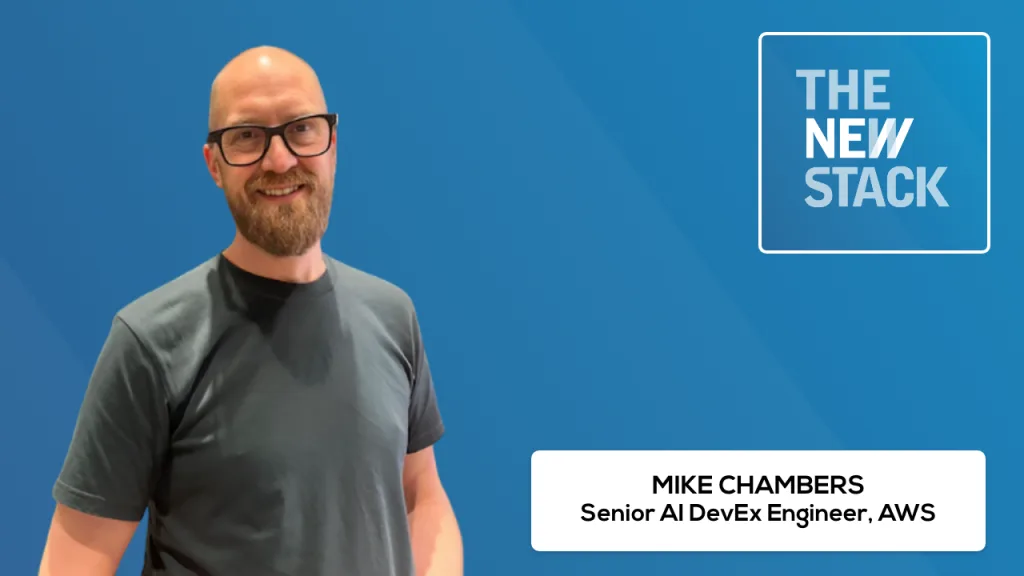
When an AI agent receives a simple greeting, it might still invoke semantic search across long-term memory, retrieve beverage preferences, and process the exchange through a full language model—a substantial amount of computational work for two words. Mike Chambers, a senior AI DevEx engineer at AWS, identifies this inefficiency as a design problem that decider models can solve.
At AGNTCon + MCPCon North America 2026 in San Jose, California, Chambers discussed with The New Stack Editor-in-Chief Nick Lucchesi how developers can deploy specialized decision models to handle the frequent small judgments that accumulate within agentic systems. Decider models—also referred to as decision models or System One models—are trained to select from a constrained set of options or score inputs along a scale, returning calibrated probabilities without producing open-ended text. TypeSafe AI's Jev popularized this approach, enabling software and agentic workflows to make rapid, low-latency determinations with explicit confidence scores. AWS's Strands Labs contributed an open-source option by releasing the 2-billion-parameter Strands Decider 2B on October 1.
An if statement with a feel for language
Chambers characterizes the technique as "a little bit like having an agentic-powered 'if' statement inside of your code." Classification systems have existed in software for years, but the current generation of decider models brings a new capability: general-purpose pretraining allows developers to apply them to novel classification tasks without building and training a custom model. A developer can supply context in natural language, pose a question about it, and receive a numeric score that the application can use to direct execution.
The score emerges in a single forward pass, with no token generation required. This characteristic makes deciders valuable for decisions on the critical path of every request. A model router, for instance, can use the score to direct routine queries to a smaller model while preserving a more powerful one for complex tasks. Cost reduction comes both from the routing decision itself and from the downstream inference it prevents.
When an agent can skip the memory search
Chambers tested the approach using the open-source Strands framework alongside Amazon Bedrock AgentCore Memory. He positioned Strands Decider before the memory lookup to assess whether an incoming message warranted retrieving prior conversation history. A simple greeting could pass through without triggering a search, while a query referencing earlier context could still initiate one.
He also experimented with placing a decider after retrieval. Memory services typically return top matches to a query, but not all results bear relevance to the current task. A decider can rate each result for pertinence before the agent incorporates it into the context sent to the model. One decision can eliminate a service call; the other can reduce irrelevant material the model must process.
A predictable output still needs testing
A numeric value in a predictable JSON field simplifies integration of a decider into an application. Whether that value proves reliable enough to act on demands rigorous testing. "Will the number be correct? That's for your testing to be able to go and figure out whether that's the case or not," Chambers said.
Chambers characterizes his memory experiment as exploratory work. The discussion also addresses scenarios where consequences escalate. A missed preference might yield a suboptimal coffee suggestion, but an agent about to execute a financial transaction represents a different risk category. Chambers advocates for validation mechanisms outside the agent's control and human sign-off for decisions that are difficult or costly to reverse.
The full interview is available on The New Stack's YouTube channel, featuring Chambers' detailed walkthrough of the memory experiment and exploration of how developers are advancing open-source deciders across domains including document processing and robotics.