Picture this scenario: an AI model reaches production for a limited audience, and errors start appearing. The compiled artifact is identical across all deployments, making deployment history alone insufficient for diagnosis. Which users received the new model? What other activity was occurring in the application when failures began? How quickly can the feature be disabled before incident discussions spiral out of control?
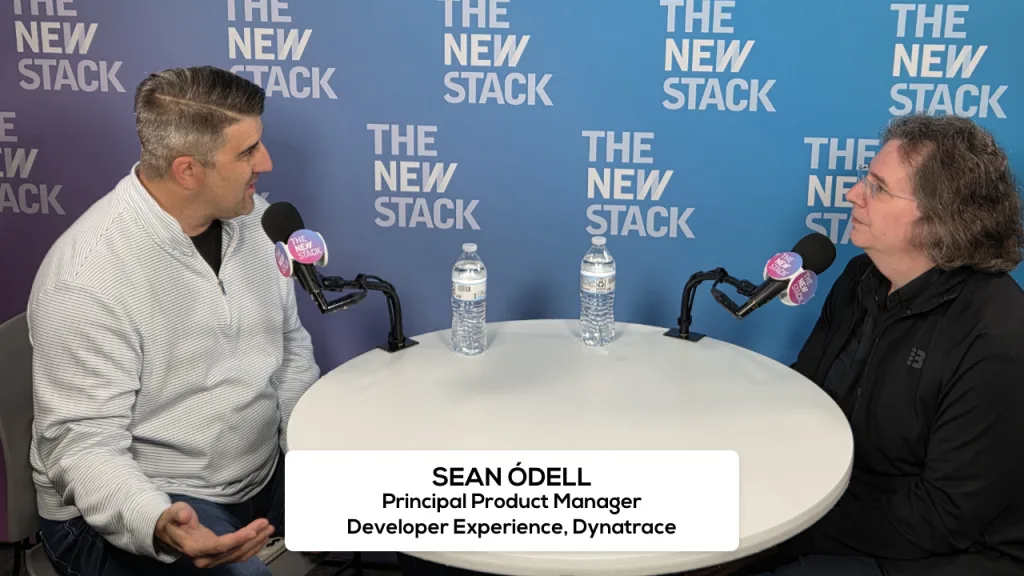
Sean O'Dell, developer experience lead at Dynatrace, is focused on streamlining exactly this kind of troubleshooting. During a discussion with The New Stack's Frederic Lardinois at KubeCon + CloudNativeCon in Salt Lake City, O'Dell detailed how Dynatrace consolidates signals from application layers, infrastructure components, and AI systems, enabling developers to understand what occurred and determine appropriate responses.
Isolating rollout signals
According to O'Dell, the approach begins with feature flags. Once a build ships, teams can gate a feature or model to reach only a portion of users. When flag state is visible alongside observability data, teams can establish whether errors cluster among users receiving the new capability.
O'Dell outlined the insight a developer might reach: "It would be something like, 'Hey, I saw some issues, but it wasn't a build; it was actually a feature,'" he said.
This reasoning explains Dynatrace's focus on OpenFeature. O'Dell envisions feature flagging and observability as complementary during staged rollouts, when teams must track both who received a change and how the system responded. Should a rollout introduce problems, the flag provides a way to turn off the feature while investigation proceeds. The code review can be addressed later.
Building on existing instrumentation
When Lardinois asked whether AI agents demand separate observability infrastructure, O'Dell grounded his response in what developers may already have deployed. "OpenTelemetry allows me a starting point to build upon," he said.
O'Dell highlighted OpenTelemetry's generative AI conventions and OpenInference, which extends OpenTelemetry with AI-specific instrumentation. The practical challenge for developers involves tracing a request as it moves through an application, database and model invocation.
An odd answer in the UI may send a team straight to the model, even when the evidence it needs is elsewhere in the stack.
Sean O'Dell
Dynatrace positions its Grail data lakehouse and Smartscape as capabilities that help teams correlate evidence across their systems. A developer investigating a performance issue can examine relationships between services and identify what shifted in code or infrastructure. An agent supporting a site reliability engineer can leverage the same context.
We want agents to make the right decision at the right time
Sean O'Dell
O'Dell explained how telemetry informs these decisions. The challenge lies in the diversity of needs: a frontend engineer understanding user experience may require real-user monitoring, while a platform engineer investigating latency needs backend visibility. An agent requires evidence tailored to its specific task. This means determining what information to present becomes part of the engineering effort, alongside the collection process itself.
The complete conversation between O'Dell and Lardinois covers where open standards provide value versus what an observability platform must add, how token economics affect engineering choices, and which safeguards become necessary as agents assume greater operational responsibility. The full interview is available on The New Stack's YouTube channel.