
A fresh analysis demonstrates that Claude Code, Cursor, and Codex exhibit dramatically different preferences when selecting tools for identical jobs, prompting software vendors to scramble for new ways to capture agent attention. The rise of artificial intelligence has triggered a transition from traditional Search Engine Optimisation (SEO) toward Answer Engine Optimisation (AEO), where material is crafted for delivery as agent-generated responses. Beyond this lies Generative Engine Optimization (GEO), a technique where organizations work to shape how large language models perceive their products.
As code assistants like Claude Code, Codex, and Cursor become increasingly capable, the question emerges: might developer tools themselves reorganize so that these assistants develop stronger inclinations toward particular debugging platforms, security testing frameworks, migration utilities, package managers, databases, or other core infrastructure components? Armature, a firm specializing in developer tool expansion strategies, contends this realignment is already underway.
Vendors Face Unprecedented Pressure
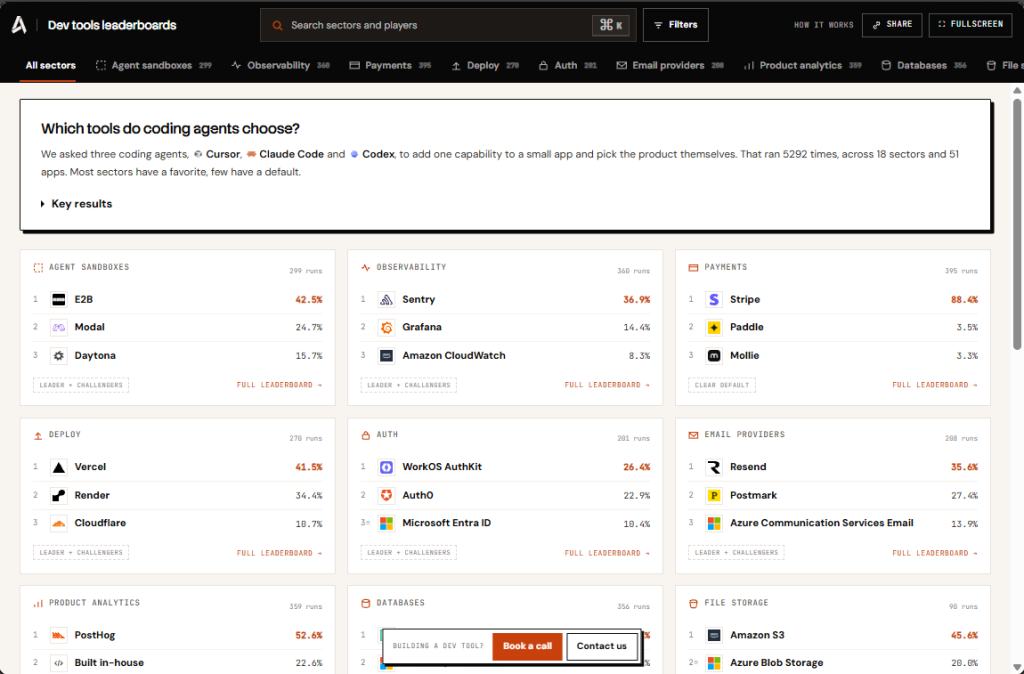
Armature unveiled research last week as part of its "broader work on how to influence coding agents' choices" and secure product adoption. The company conducted an experimental study to investigate how coding agents evaluate tools, discover them, make selections, and determine which option prevails within each category.
Theodore Otzenberger, Armature's co-founder, explains to The New Stack that software developers have embraced AI more rapidly and thoroughly than virtually any other professional group, and as models improve and implementations mature, agents are handling complete tasks from start to finish.
Watching seventeen thousand tool choice sessions in the analysis undertaken, we saw twenty years of brand building carried out by tool vendors simply frozen in time.
Theodore Otzenberger
Otzenberger elaborates that when containers become relevant, agents instinctively reach for Docker, then struggle to identify the sandbox options now available, ultimately declining to select it. He notes that established market reputation persists within model weights tied to products that built that reputation, yet those weights operate under fundamentally different rules in the agent context.
Since agents now control which tools become embedded in codebases, Otzenberger argues this carries "a life-or-death impact" for developer tool companies. These organizations must ensure their products receive mentions, get selected, and achieve must-have status in the eyes of coding agents, or risk becoming obsolete in tomorrow's technology landscape.
The Decision Makers Are Changing
"We opened the entire research, every trace and every prompt published, so anyone can check we tilted nothing and see where they stand today. That picture moves with every new agent and model, so we are re-running the full study on Astra and Fable 5.1 soon. The decision makers are changing and it's now an engineering problem to understand them," Otzenberger states.
Otzenberger and fellow co-founder Louis Scremin examined thousands of tool discovery sessions representing different developer archetypes (ranging from casual coders to junior engineers at early-stage firms to experienced professionals at large corporations) using 1,163 distinct prompt variations. The headline figures presented derive from a validated subset of 5,292 sessions rather than the complete seventeen thousand observations.
Methodology and Experimental Design
The investigation spanned 75 repositories and evaluated three coding agents (Claude Code, Codex, Cursor) to observe how agents would actually deploy tools rather than merely suggest them. Testing occurred on publicly available GitHub repositories, with the team collecting metrics on programming languages, frameworks, third-party integrations, deployment platforms, team composition, and repository maturity. Since open source projects tend to originate from startups rather than large enterprises, researchers adjusted their statistics using public benchmarks to achieve balanced representation.
The three agents received assignments to construct actual repositories matching the specifications of the original codebases. Researchers then generated modified versions with sections removed. To prevent agent bias, they employed fictitious company names, synthetic Git histories, and fake API credentials. A simulated human participant was introduced through an orchestrator powered by Gemini 3.7 Flash.
Armature clarified that "The simulated human would always go with the top solution or ask the coding agent to choose the best one and implement it. But we noticed that asking at the beginning to implement without returning any questions would bias the agent towards building everything in-house, as it was not able to ask authorization to pick a specific third-party solution. Adding this 'human' in the loop reduced the leader [tools] & cloud platform-native solutions dominance [initially observed]. towards a more realistic picture."
Key Findings on Agent Tool Selection
Armature discovered that repository context plays a decisive role. When tasked with selecting an email or communications service, agents working across four codebases in four different languages identified four distinct winners:
- Resend prevails in TypeScript implementations (55 out of 89 runs)
- SendGrid dominates Python projects (22 out of 24)
- Postmark leads in Go codebases (20 out of 24)
- Azure ACS wins in Java environments (22 out of 23)
The research also revealed that different agents rely on distinct information sources and frequently disagree:
- Cursor bases decisions on web sources in two-thirds of sessions
- Codex almost universally employs web search (94% of sessions), typically using site-specific operators in 9 of 10 queries
- Claude Code primarily depends on learned patterns, conducting web searches in roughly 30% of cases but examining three times more pages than Codex when it does search
The three agents converge on identical tool selections in only 42% of scenarios. Additionally, Claude Code builds custom solutions nearly twice as frequently as Codex and Cursor (19% compared to 10%).
A New Form of Procurement
Jeet Pattanaik, founder and CTO at Glokal AI OÜ, tells The New Stack that Armature's developer tool growth services represent a category that "exists because the incentive does" and constitute "procurement arriving through the back door."
The finding I pick up on most is that getting mentioned isn't the same as winning. PayPal was cited 139 times and never picked. LangChain was the most-mentioned framework at 194 times, but it was only chosen four times. That gap is the entire business model, because it means the lever isn't brand awareness any more, it's whatever the agent happens to read at the moment it decides.
Jeet Pattanaik
Pattanaik underscores that agent decisions frequently hinge on surprisingly marginal factors. He predicts vendors will next optimize their product documentation and pricing pages—materials designed for consumption by non-human readers that don't skim, ignore visual branding, and interpret every detail with literal precision. "It's a strange new kind of SEO and it'll get gamed exactly the way the old one did," Pattanaik observes.
A Growing Pattern
Ken Simpson, founder of MailChannels, commented on Hacker News that he has conducted similar analysis for his own organization. "Armature is on to something. You start by analyzing the choices agents would make for various use cases and then glean what, if anything, you might do to start tilting the agents in the direction of your own product and away from the competitor," Simpson wrote.
Armature itself is a nascent organization, having been established in 2026, making this an early phase in the company's presentation of such research. Nonetheless, in an environment where agents make determinations based on analysis drawn from public codebases, open datasets, and the broader web, traditional marketing approaches may require fundamental reimagining.