
Cloudflare unveiled a new capability enabling website operators to make their content directly queryable by AI agents through a simple toggle in the dashboard. The feature aims to streamline how AI systems discover and retrieve information from websites, but the financial responsibility for search infrastructure falls to site owners themselves.
The initiative builds on Cloudflare's existing AI-focused offerings. The company launched AI Search last month as a managed service for developers to index data and integrate search into applications and agents, which now serves as the underlying infrastructure for Search for Agents. Earlier, in February, Cloudflare rolled out Markdown for Agents, which transforms HTML into a lightweight text format that AI systems can process more efficiently.
Search for Agents goes further by providing websites with their own agent-discoverable search API. Rather than crawling through individual pages to locate information, agents can query a site's content directly through this dedicated endpoint.
The agent retrieval problem
Developer documentation platform Mintlify identified a significant challenge in September: the llms.txt file format that guides AI agents through website content was hitting a 100,000-character ceiling on larger documentation sites, causing some pages to be excluded. Mintlify addressed this by introducing a tiered structure of smaller index files, enabling agents to discover all available pages without loading a single massive index.
The problem proved especially relevant for Mintlify, which disclosed in April that AI coding agents represented 45.3% of all requests across its platform's documentation sites—nearly matching traditional browser traffic. Cloudflare separately reported last year that AI crawling activity triggered by user queries had grown more than twentyfold through 2025.
Even with such improvements, agents must still navigate a website's content index to locate what they need. Search for Agents circumvents this requirement by allowing agents to query the website directly.
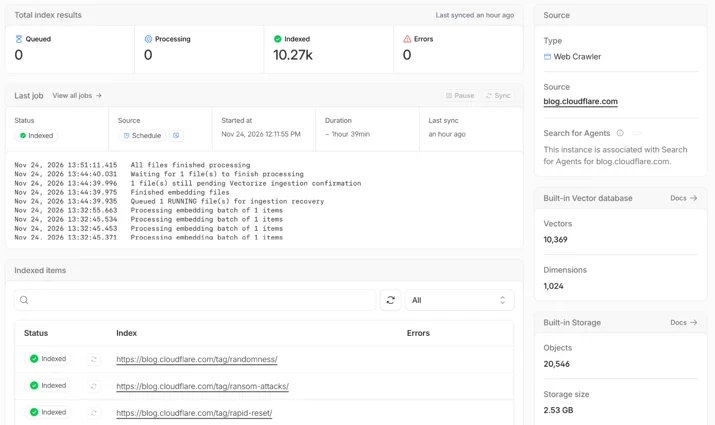
Website operators can activate the feature, currently in beta, through the Quick Actions section of their Cloudflare dashboard or via API, as detailed in a Wednesday blog post. Once enabled, Cloudflare provisions a dedicated AI Search instance and starts crawling and indexing the site's content. Operators can then manage the instance from their AI Search dashboard, tuning settings like caching and enabling reranking to boost result relevance.
Cloudflare embeds instructions into page metadata directing visiting agents to the search API and its usage. For sites running Markdown for Agents, these instructions also appear in the Markdown document's YAML front matter.

Agents can submit keywords or natural-language questions to the website's /.well-known/search endpoint and receive relevant content excerpts in Markdown format. The agent then uses this to generate its own response to the user.
Who pays for agent search?
Search for Agents is available across all Cloudflare plans, including the free tier. However, with AI Search billing commencing December 1, website owners face cost implications when enabling agent-accessible content.
Each account receives a monthly allotment of 5 million ingestion tokens, 10 GB-months of storage, and 1,000 queries each for semantic and full-text search. Beyond these allowances, Cloudflare charges $0.75 per million ingestion tokens, $2 per GB-month of storage, $0.75 per 1,000 semantic, vector or hybrid queries, and $0.10 per 1,000 full-text queries.
Crawl limits also apply. Free plan customers on Workers are restricted to 500 pages per day, while paid customers have no daily limit. Both face a 100,000-page ceiling per discovery crawl.
This pricing structure raises questions given Cloudflare's recent push to help site owners monetize AI traffic. The company introduced pay-per-crawl last July, letting website owners charge AI companies for page fetches. This July, it expanded to pay-per-use, compensating publishers when their content appears in AI-generated answers. In September, Cloudflare launched its Monetization Gateway in closed beta, enabling domain owners to charge AI agents for accessing websites, APIs, MCP tools and datasets via the x402 payment protocol.
Against this backdrop, Search for Agents presents a striking reversal. After spending 18 months building revenue streams for site owners from AI traffic, Cloudflare now asks those same operators to absorb the costs of making content more accessible to AI agents.
What incentive exists for site owners to accept these costs? According to Celso Martinho, VP of engineering at Cloudflare, the answer centers on AI agents' growing significance as an audience segment.
Our data shows that agents have now surpassed humans using the Internet and are an important audience for any website owner.
Celso Martinho, VP of engineering at Cloudflare
Cloudflare reported in June that bots, including AI agents, accounted for 57% of HTML page requests across its network. Martinho also highlights existing tools such as AI Crawl Control and the x402 payment protocol, which site operators can deploy to manage and monetize content access.
Additionally, Cloudflare plans to extend its Monetization Gateway to cover the new search endpoints, potentially allowing website owners to charge agents directly for search queries.
We are working on adding first-class support for Search for Agents and other agentic content APIs to Monetization Gateway.
Celso Martinho
Martinho provided no timeline for this expansion. For the present, search infrastructure costs remain the responsibility of website owners.
A common language for agent search?
While organizations can build and expose their own search APIs, Search for Agents delivers an off-the-shelf solution for Cloudflare customers. According to Martinho, existing agents with web browsing capabilities should be able to discover and use these endpoints without developers needing to create custom integrations.
Cloudflare has validated the approach extensively on its own blog and developer documentation properties, Martinho notes.
Using a search API is more efficient for agents than crawling individual pages to find answers.
Celso Martinho
Broader industry efforts have emerged to standardize AI agent interactions. Last December, the Linux Foundation announced the Agentic AI Foundation (AAIF), with Cloudflare as a founding member, consolidating projects including the Model Context Protocol (MCP), AGENTS.md and Goose under one umbrella.
For now, Cloudflare is pursuing its own path for search endpoint discovery. Martinho notes that agents adapt well to different instructions and web protocols, and that Cloudflare's research into agent behavior through initiatives like Radar's AI Insights and its Agent Readiness project informed the technology choices for Search for Agents.
The approach leverages established web conventions such as well-known URIs and HTTP GET, along with the newer HTTP QUERY method, an Internet Engineering Task Force (IETF) proposed standard co-authored by Cloudflare engineer James Snell.
Martinho acknowledges the value of coordinated industry action in this space.
Interoperability absolutely matters. A common approach to discovering search endpoints across providers would also make sense.
Celso Martinho