
Following its debut in August and subsequent enhancements in September, Cloudflare has delivered on its pledge to make Kitesurf publicly available. The stateless browser designed for AI agents, which operates entirely within Cloudflare Workers, is now accessible on GitHub under the Apache 2.0 license. Developers can examine the source code, execute it on their machines, modify it as needed, and run their own instance on Cloudflare Workers.
A browser built for agents
Kitesurf operates exclusively on Cloudflare Workers, handling HTML parsing, CSS application, JavaScript execution, and screenshot rendering without requiring a traditional browser container. The system implements support for the Chrome DevTools Protocol (CDP), enabling integration with tools like Puppeteer.
The primary objective behind Kitesurf is to furnish AI agents with a lean, performant browser capable of loading websites, running JavaScript, and engaging with page content while consuming substantially less CPU and memory compared to full-featured browsers such as Chromium. The architecture leverages Cloudflare's global Workers network for on-demand scaling.
What is inside the repository?
Kitesurf leverages Cloudflare's Developer Platform and APIs alongside a collection of open-source Rust packages compiled to WebAssembly:
- Blitz handles HTML parsing, DOM construction, layout computation, and rendering.
- Stylo manages CSS parsing, style cascading, and style computation.
- Boa executes JavaScript within WebAssembly as a fallback when Dynamic Workers cannot run JavaScript natively.
- Linebender libraries support text layout and 2D graphics, while Krilla produces PDF output.
Each of these projects maintains its own licensing terms, with third-party attributions documented in the repository's NOTICE file.
The codebase comprises three primary components: the Engine oversees browser sessions and client interactions, PageScript manages page execution and JavaScript processing, and PageRenderer handles visual output.
All components—packages, the engine, its Rust implementation, DOM shims, renderer, and the Kitesurf CLI—are organized in separate directories within the repository's packages folder, making it straightforward to understand how each element integrates.
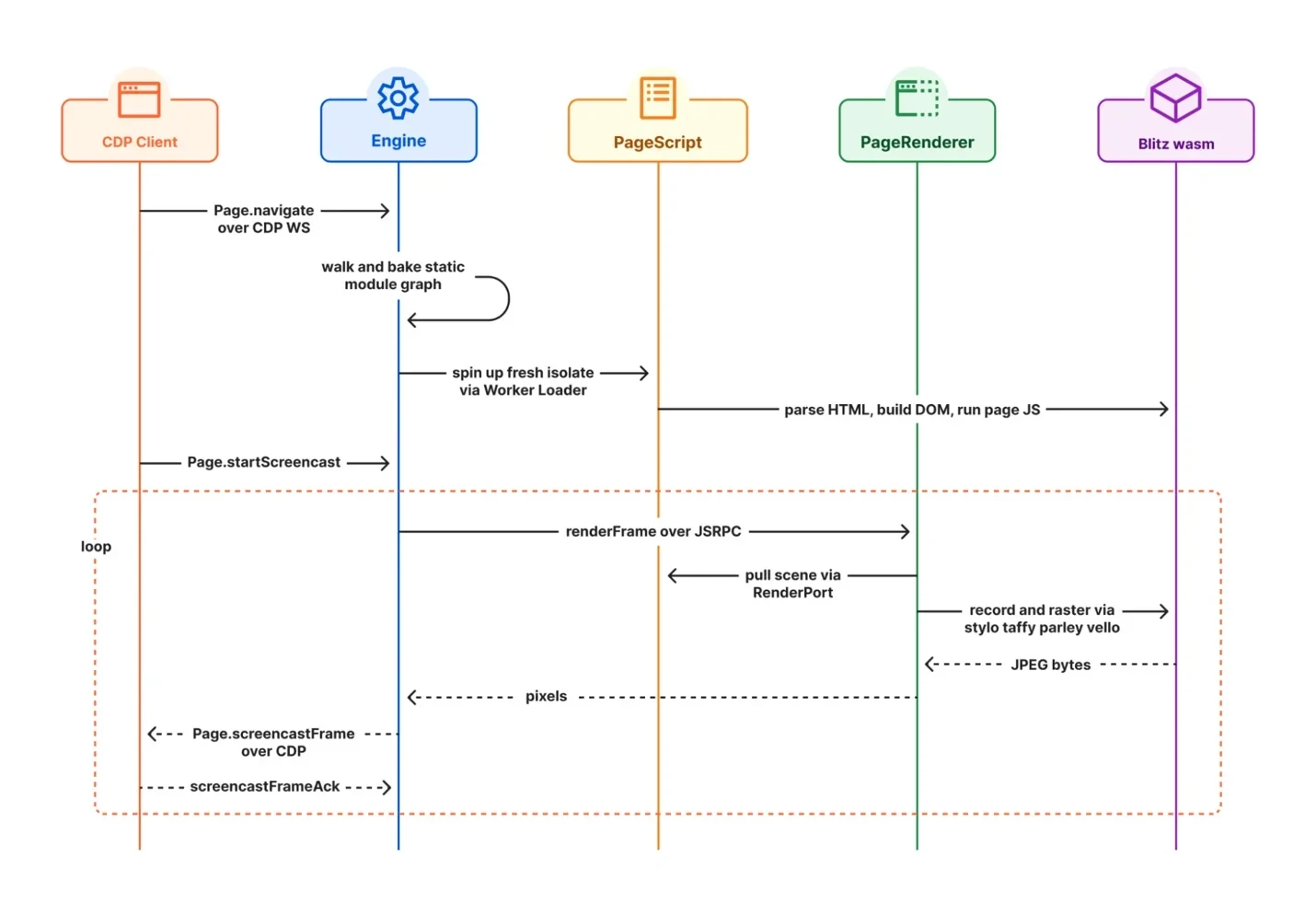
Run your own Kitesurf
To execute Kitesurf on your local system, satisfy the repository's build prerequisites, then clone the repository, install dependencies, and launch the engine:
git clone https://github.com/cloudflare/kitesurf.git
cd kitesurf
pnpm install --frozen-lockfile
pnpm run dev
The initial compilation process builds the Rust core and its dependencies, requiring additional time. Subsequent builds benefit from cached artifacts. Wrangler then starts a development server accessible at http://127.0.0.1:8787, where you can test pages using Chrome DevTools or integrate programmatically.
Integration with Puppeteer is possible through a Node.js script:
import puppeteer from "puppeteer-core";

const browser = await puppeteer.connect({
  browserWSEndpoint: "ws://127.0.0.1:8787/devtools/browser",
});

try {
  const page = await browser.newPage();
  await page.goto("https://example.com/");
  await page.screenshot({ path: "page.png" });
} finally {
  await browser.disconnect();
}
Alternatively, point your AI framework at the local CDP endpoint—agents have native support for CDP—and observe Kitesurf respond to complete automation commands.
Deploy to your Cloudflare account
Once development and testing are complete locally, the engine can be deployed to your Cloudflare account, replacing reliance on the managed Browser Run APIs. Deployment requires a Workers Paid plan, as Kitesurf utilizes Dynamic Workers to isolate page execution:
pnpm run deploy
Help us make it better
Like other Cloudflare open-source initiatives, Kitesurf resides on Github with support for forks and contributions. The project is undergoing rapid development with emphasis on improving engine compatibility, reliability, and resource efficiency.
Those interested in contributing should begin with the contribution guidelines. Prospective contributors should open an issue with a minimal reproduction case or proposed solution and obtain maintainer approval before submitting a pull request. Targeted fixes accompanied by tests, clear evidence, and well-defined scope are simpler to review than extensive rewrites or unrelated modifications, though contributions need not be limited to code—a test case demonstrating a rendering issue, a failing automation scenario, or a documentation enhancement can all advance the project.
Stay tuned
Kitesurf continues to evolve at a rapid pace. Updates will appear on the blog and in the changelog, with the official landing page providing current information on standards compatibility via Web Platform Tests and performance metrics.
The team welcomes discussion on Discord. As Cloudflare develops this browser for agents, community participation in improving the platform is encouraged.