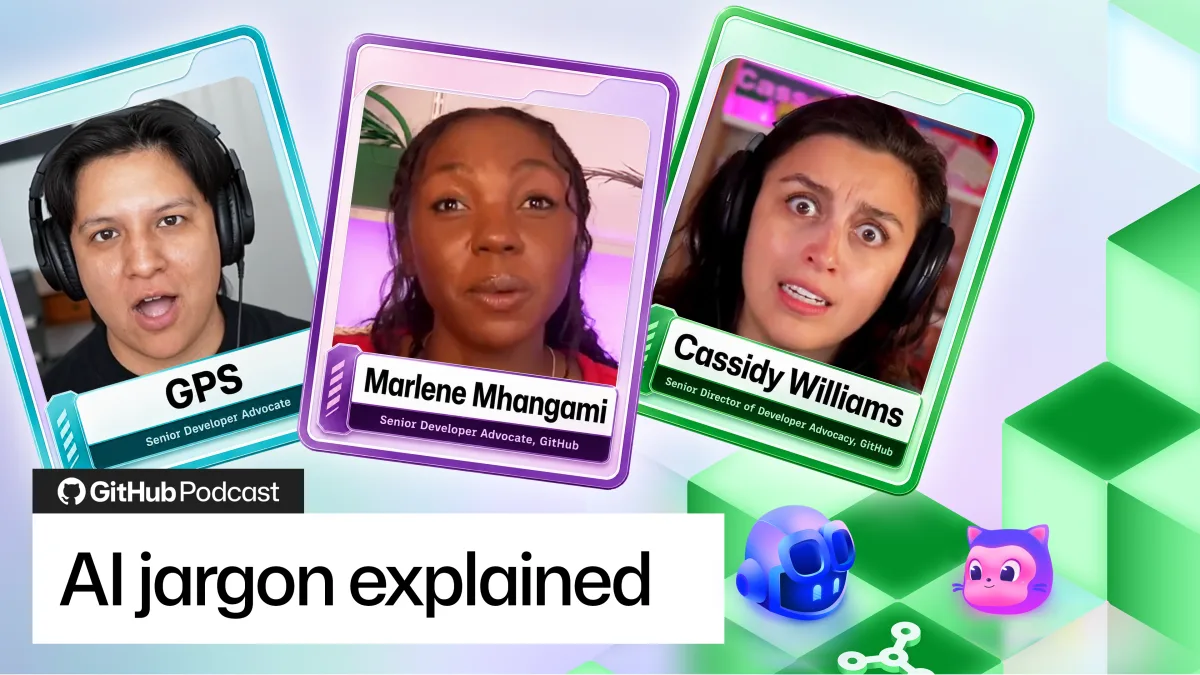
Confident one-liners about artificial intelligence dominate tech discourse, and they excel at driving engagement. Yet engagement and comprehension are not the same thing. The real value emerges only when you interrogate these claims: under what circumstances do they hold? What context disappears in the simplification? What assumptions underpin them? How do they apply to actual engineering work? The GitHub Podcast explores these tensions by examining five widespread takes and what developers can actually learn from them.
Hot take #1: "You do not need to read AI-generated code"
The answer is straightforward: you do. Responsibility for code remains yours. That said, not every line warrants identical scrutiny. A critical authentication refactor in production demands different rigor than a CSS prototype. A decade-old system you know intimately shapes your judgment differently than a codebase you encountered hours ago. Treating all changes as equally risky wastes effort rather than demonstrating thoroughness.
A practical principle: review until you can articulate and take ownership of the outcome. Sometimes this preparation happens before any code appears. You study the existing implementation, trace dependencies, spot edge cases, and establish expectations. By the time generated code arrives, you already grasp what success looks like and where failures could occur. Other times, the generated output itself demands most of your focus—examining error handling, access controls, data operations, speed, usability, and test coverage.
Artificial intelligence redistributes effort; it does not eliminate it. The genuine skill lies in recognizing where risk concentrates.
Hot take #2: "Companies will not hire you if you do not use AI"
Reality proves more complicated. Growing numbers of teams ask candidates about their approach to AI tools, which makes sense given their increasing role in development. Yet no organization expects uniform workflows, identical toolsets, or matching levels of enthusiasm across all engineers.
What matters most is discernment. Can you articulate when AI serves you and when manual work does? Can you describe your process for evaluating generated code? Can you discuss tradeoffs involving speed, reliability, protection, and long-term viability? Can you adapt as capabilities shift? If an organization builds AI-driven products or embeds AI heavily in engineering, complete avoidance might signal a poor match. Yet total reliance and total rejection are both rarely sound positions. A stronger answer describes your actual workflow, what you delegate to tools, and where you maintain control. This kind of fluency increasingly defines the craft.
Hot take #3: "Skills killed MCP"
They do not. Each addresses distinct needs. The Model Context Protocol establishes a standard for agents to connect with tools and data reliably. Agents require structured mechanisms to invoke tools, retrieve context, and execute actions. Skills function as packaged knowledge. A skill documents how a team operates, how a project should evolve, how a tool should be applied, or what conventions matter. Because skills often use Markdown, humans can read and understand them directly—and that transparency carries value.
MCP enables access. Skills illuminate how to use that access effectively. Neither requires eliminating the other. Adopt standards for shared interfaces. Adopt skills for context, workflow, and established practices. The pairing proves far richer than the false choice.
Hot take #4: "RAG is dead"
Retrieval-augmented generation persists. It simply lacks the novelty that drives social media attention. RAG supplies an AI system with relevant information beyond what the model learned during training—documentation, support records, product specifications, organizational knowledge, or repository details. Without effective retrieval, the model depends on existing knowledge or consumes extra processing to hunt for context, wasting tokens, extending latency, and increasing the odds of incomplete responses. Strong retrieval positions the model closer to correct answers, shrinks the search space, and anchors responses in information that genuinely matters.
Agents, skills, MCP, and RAG coexist productively. An agent might leverage MCP to reach a tool, follow a skill for project-specific guidance, and employ retrieval to locate pertinent supporting material. These mechanisms do not oppose one another. Framing them as competitors obscures how practitioners actually construct AI systems.
Hot take #5: "If you need to fine-tune a model for your codebase, your code is bad"
Fine-tuning carries legitimate use cases. Contemporary models have absorbed vast quantities of widespread frameworks, design patterns, naming schemes, and structural approaches. If a model struggles with your codebase, a fresh team member probably will too. AI functions as another test of maintainability, joining code review, automated testing, onboarding processes, and the engineer debugging this six months later.
Transparent organization matters. Uniform naming conventions matter. Legible tests, sound abstractions, and maintained documentation matter. These qualities help agents parse a codebase, but more critically, they help humans review, troubleshoot, and build upon it. AI-powered development favors codebases that communicate their purpose plainly. That shift benefits everyone.
Real work is more interesting than the debate
Artificial intelligence generates strong opinions because the technology evolves rapidly and workflows remain unsettled. You need not commit permanently to every argument. The superior response to a compelling claim is not another claim. Experiment. Create. Record findings. Offer others something concrete to build from.
Pollinations AI demonstrates this through a generative platform where contributors earn credits called pollen by strengthening the project. Participants can tackle issues, contribute models, and complete quests. The effort raises tangible questions about motivation, output quality, scalability, and how AI might reshape open source participation. Avian Visitors takes a wholly different path—a build journal documenting an e-ink bird-listening display that transforms balcony visitors into dynamic wall art. It combines a microphone, Raspberry Pi, e-ink screen, 3D-printed components, generated imagery, and thorough documentation.
Neither project resolves every AI disagreement. Both accomplish something more valuable: they generate evidence, surface real tradeoffs, and offer others a foundation to begin from. Read enough code to shoulder responsibility for it. Develop sufficient AI literacy to explain your process. Invoke MCP where standard interfaces create value. Invoke skills where guidance and context matter. Preserve RAG when anchored information strengthens results. If code confuses both humans and models, treat that as a structural problem. Most fundamentally, apply what you discover.