More than 2,000 Amazon staff members tested early iterations of Pizza Bot before the initiative transitioned into a community-driven endeavor outside AWS.
Amazon Web Services has unveiled Pizza Bot, a new open-source tool designed to furnish developers with an email-style inbox for supervising background-running AI agents.
The core challenge Pizza Bot tackles involves the inadequacy of chat-based interfaces for handling agents whose operations persist beyond the user's active session.
Pizza Bot adopts traditional email workflows: finished tasks surface as unread messages, while items requiring human judgment are flagged for attention. An Activity panel additionally displays work delegated to specialized agents, revealing their tool usage and advancement status.
Scheduled agents run autonomously in the background and surface updates directly into your inbox for review and triage.
Joseph Dolivo, principal technologist at AWS Startups
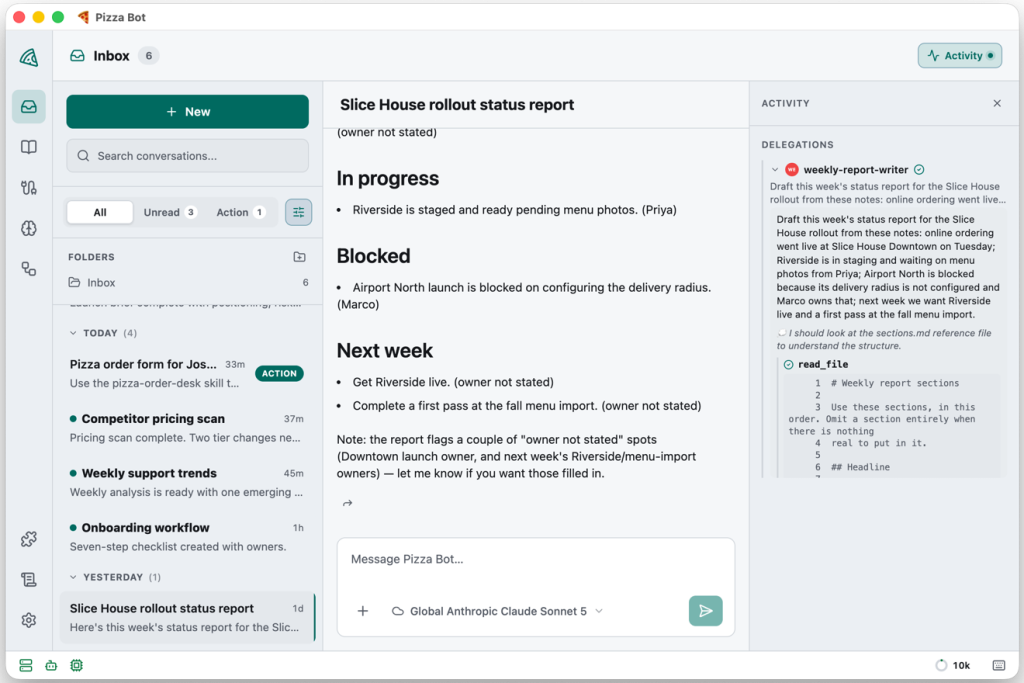
In a LinkedIn announcement on Thursday, co-creator Joseph Dolivo, principal technologist at AWS Startups, emphasized that Pizza Bot transfers responsibility for tracking agent activity away from the user. He noted that rather than requiring users to begin conversations or remain waiting for responses, agents function independently and deliver notifications to the inbox for evaluation and prioritization.
The official launch blog post reinforces this philosophy by highlighting that user unavailability constitutes a fundamental design principle.
The interface assumes you are not watching.
According to the creators, this foundational assumption distinguishes Pizza Bot from competing solutions and enables pauses extending beyond individual sessions, actionable notifications, and background work that generates message threads rather than log files.
A community project
Though originating within Amazon, Pizza Bot now operates as an independent community initiative rather than an AWS offering. The project resides in its own GitHub organization, distinct from Amazon, and carries no AWS backing or service-level guarantees — deployment and management are entirely user-managed.
Pizza Bot functions as a desktop application supporting macOS, Windows, and Linux, alongside browser and terminal-based clients. The application launches a local Pizza Bot server by default, with developers selecting their preferred underlying model from options including Anthropic, Amazon Bedrock, Google Gemini, OpenAI, OpenRouter, or a self-hosted model via Ollama.
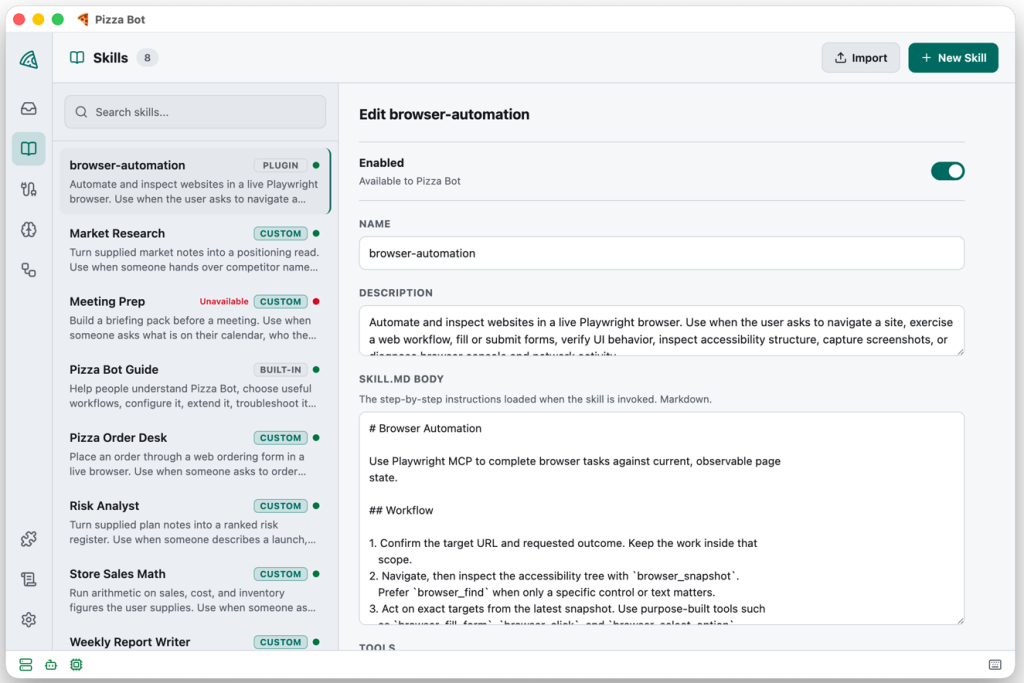
The platform supports expansion through MCP servers and Agent Skills; the included browser-automation capability leverages Playwright MCP for website navigation and interaction.
The server can operate on a continuously-running machine or within a container, enabling background agents to maintain operation when the laptop powers down and allowing users to resume threads from alternative devices later.
Under the hood: LangGraph and ambient agents
Pizza Bot's agent execution layer relies on DeepAgents, LangChain's open-source framework for extended-duration agent operations, which itself operates atop LangGraph, a runtime designed for agents with persistent state. The critical element across this architecture is state preservation: LangGraph saves agent state checkpoints during execution, permitting operations to pause for approval, withstand client disconnection, and continue from the stopping point without restarting. Pizza Bot maintains these checkpoints, conversation threads, and application information in local SQLite databases and file storage.
AWS maintains its own open-source agents framework, Strands Agents, released in May 2025 — though documentation, including sample repository content, indicates AWS positions Strands as a "lighter-weight alternative to LangGraph for agents that don't need explicit graph control flow."
When asked via LinkedIn by The New Stack whether Strands could have served Pizza Bot's needs, Dolivo acknowledged the possibility, particularly given Strands' current TypeScript and workflow capabilities. Nevertheless, the team selected LangGraph "due to the maturity of the tooling and breadth of the exosystem," Dolivo explained. He further noted that LangGraph's familiarity among developers and reduced adoption barriers made it the preferable choice for an open-source community initiative.
Pizza Bot shares conceptual similarities with an approach LangChain introduced in January 2025, when CEO Harrison Chase introduced the concept of "ambient agents" — agents capable of responding to events, executing concurrently, and engaging humans selectively. LangChain's sample implementation featured an email assistant constructed using LangGraph. The organization additionally created an "Agent Inbox": a dedicated interface modeled on email and customer-support platforms for managing ongoing interactions between users and autonomous agents.
From 'JoeBot' to Pizza Bot
Pizza Bot's origins trace to April 2025, when Dolivo launched what he describes as a "side-of-desk passion project" called "JoeBot" aimed at automating routine CRM data entry. He subsequently partnered with colleague Igor Fil to convert the initial script into Pizza Bot, an MCP server capable of executing parameterized, predictable "recipes" within internal infrastructure.
The initiative's popularity extended beyond its engineering creators into non-technical departments. As development progressed, Dolivo reports the project attracted more than 30 contributors and surpassed 2,000 internal users at Amazon, necessitating a user-facing interface for broader accessibility.
Dolivo observed that an MCP server demands an MCP client, and requiring non-engineers to operate through an IDE or command line was impractical. The team needed to provide an interface matching how people actually work and deliver a complete user experience.
The outcome was this week's Pizza Bot release: a desktop application centered on an inbox paradigm rather than terminal interaction.