
Amazon Web Services has unveiled Strands Harness, an open source general-purpose AI agent framework that developers can run on their own machines or deploy to any cloud environment. The project builds on Strands Agents, an open source Python SDK AWS introduced in May 2025 for constructing AI agents, and extends the framework with preconfigured defaults for tools, context management and memory handling.
Marc Brooker, VP and distinguished engineer at AWS, explains that Strands Harness sits above the existing Strands SDK by providing developers with a working agent that includes file, shell and web tools alongside built-in support for context, memory, persistent sessions, prompt caching and agent delegation. "An SDK like the Strands Harness SDK gives you the building blocks, but you still need to decide how to manage context, persist conversations, integrate tools, and guide the agent's behavior," Brooker says.
Architecture and flexibility
The framework's core components—agent loop, tools, context management, session handling and delegation—operate on the machine running the agent by default without requiring AWS infrastructure. The sole exception is access to the underlying language model, which AWS routes through Amazon Bedrock, its managed foundation model service. However, this default can be easily replaced.
Developers can substitute Anthropic, OpenAI or Google as their model provider, or run a locally hosted model through Ollama. "This is easily overrided to use a different model provider with one line," Brooker notes. He adds that "Different models have different strengths on reasoning, tool use, and cost. What doesn't change: context management, sessions, tools, delegation all work the same regardless of provider. No features require Bedrock."
Beyond model selection, developers can customize virtually every component: bring their own tools and skills, connect Model Context Protocol servers, adjust context handling, and specify where session state persists. "Developers can focus on their application's task and domain expertise, while customizing the components that need different behavior," Brooker explains.
Intended use and capabilities
While Strands Harness draws inspiration from coding assistants like Claude Code and Codex, AWS positions it as a general-purpose agent framework. A key differentiator is that developers can deploy it to any cloud provider, addressing what AWS describes as a common limitation of existing coding assistants.
The framework includes a command-line interface for interactive prototyping and configuration. Developers select a model, add prompts, tools and capabilities, then export the resulting agent as Python or TypeScript code using the /export command. AWS also provides an Agent Skill to help coding agents understand Strands Harness itself, including how to add MCP servers or generate deployment configuration for AWS, GCP, Azure, Cloudflare and Modal.
Performance and cost benchmarks
AWS tested Strands Harness against competing frameworks using six benchmarks: ALFWorld, ContextBench, GAIA, WebShop, τ³-bench and Terminal-Bench 2.1. The company averaged scores across these tests and compared costs per task. Against Claude Code and Codex specifically, Strands Harness achieved 45% lower cost with comparable accuracy.
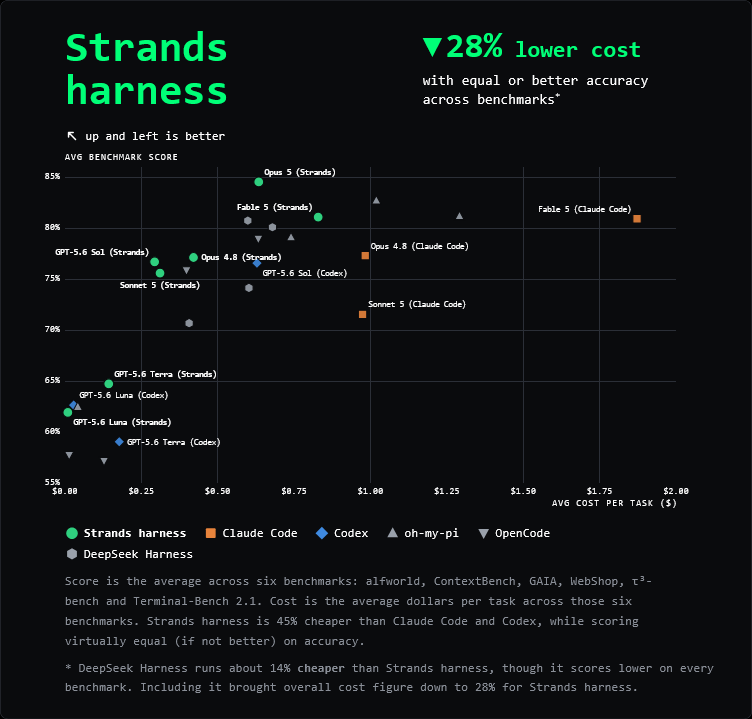
That advantage narrows when other competitors enter the picture. DeepSeek Harness ran approximately 14% cheaper than Strands Harness in matched tests, reducing the cost advantage to 28% when included in the broader comparison.
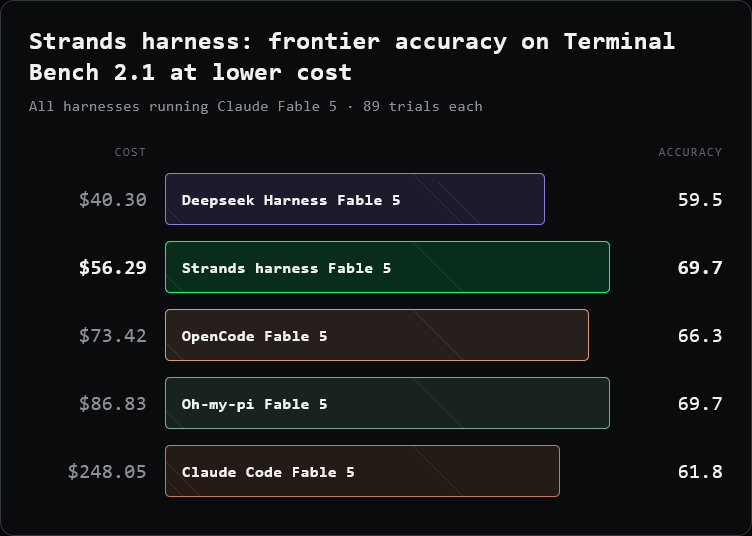
AWS attributes much of its cost efficiency to context-management defaults. Strands Harness truncates large tool outputs, compacts context once the available window exceeds a threshold, and attempts recovery within the agent loop if context overflows. On Terminal Bench 2.1 specifically, Strands Harness running Fable 5 cost $56.29 versus $248.05 for Claude Code across 89 trials, while scoring 69.7 versus 61.8. DeepSeek Harness was cheaper at $40.30 but scored lower at 59.5.
For AWS, these results justify packaging and tuning functions like context management rather than requiring each developer to make those decisions independently. "Getting a prototype working is one step; evaluating how those choices affect performance and cost is another," Brooker says. "The opportunity we saw was to package that engineering into a complete, general-purpose agent."
Commercial strategy
AWS has a clear commercial incentive: Amazon Bedrock AgentCore, a managed service for deploying and operating agents with identity controls, observability and hosting infrastructure. The open source Strands Harness and the managed AgentCore Harness were built by the same team in separate codebases, allowing improvements to flow between them.
Brooker emphasizes that Strands Harness can be deployed independently of AgentCore and outside AWS entirely. "AgentCore is an optional hosting layer for teams that want AWS to manage the infrastructure side. However, all deployment paths are open for the developer to choose." This arrangement gives AWS a natural path to revenue: developers adopt the open source framework freely, while AgentCore becomes an attractive option for teams seeking managed infrastructure.