
On Monday, AWS introduced Strands Decider v2, a suite of five open decision models that represent a significant step forward from the initial release seven weeks prior. The first Strands Decider model, developed by Strands Labs—the experimental division behind AWS's open source Strands Agents SDK—was a 2-billion-parameter system built on Alibaba's Qwen3.5.
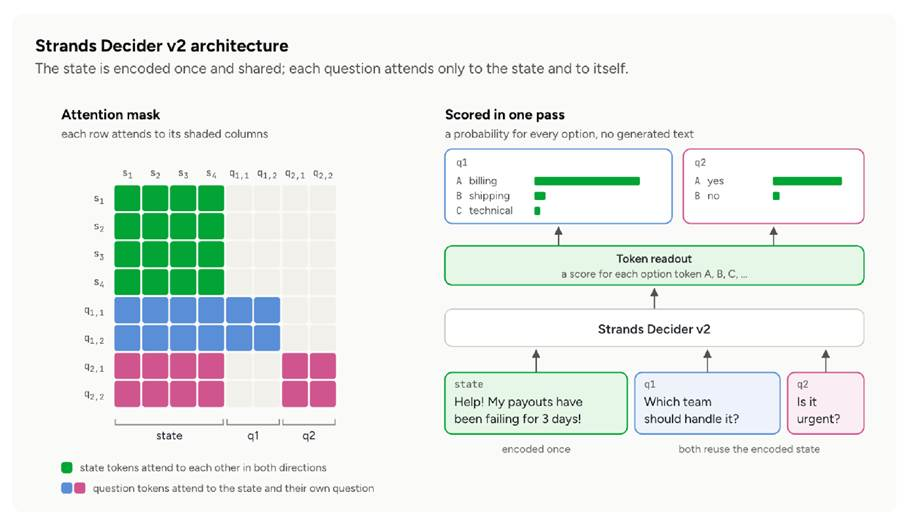
The new iteration leverages Google's Gemma 4 foundation and provides multiple size options immediately available: a 2-billion-parameter baseline, a 4-billion model, a 26-billion-parameter mixture-of-experts variant, and a 31-billion-parameter dense model. All versions are distributed under the Apache 2.0 license. Unlike text-generation models, Strands Decider accepts a state (such as a support ticket or agent trace), a question, and a predetermined set of possible answers, then outputs probability scores for each option.
According to Marc Brooker, AWS VP and Distinguished Engineer who initiated the project, "We chose better training data or larger training sets, the usual kind of ML model generation journey, and came out with a set of models with significantly better accuracy and significantly better calibration, which are the things that really matter to customers in this space."
Benchmarks
Performance improvements over v1 are substantial. Across six public text benchmarks, the 31-billion model achieves an average score of 82.1, surpassing Google's Gemini Decision 1 at 79.4 and all other tested competitors. However, the model trails some alternatives on individual benchmarks: it scores 93.1 on JevBench compared to Gemini's 92.2, but underperforms Perplexity Decider v1.3 on PubMedQA and When2Call, and falls behind vLLM Semantic Router's open d3-ultra on a New Yorker cartoon caption test.
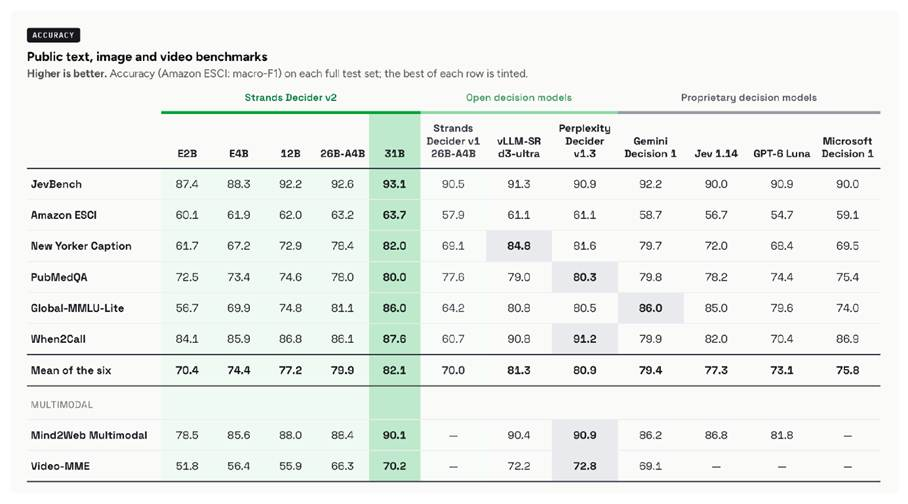
Smaller variants also demonstrate solid performance. The 26-billion-parameter mixture-of-experts model averages 79.9, marginally ahead of Gemini Decision 1, while the 4-billion model improves from 62.7 in v1 to 74.4. On image and video tasks—metrics not reported for v1—the 31-billion model scores 90.1 on Mind2Web Multimodal and 70.2 on Video-MME, slightly trailing Perplexity's offering on both measures.
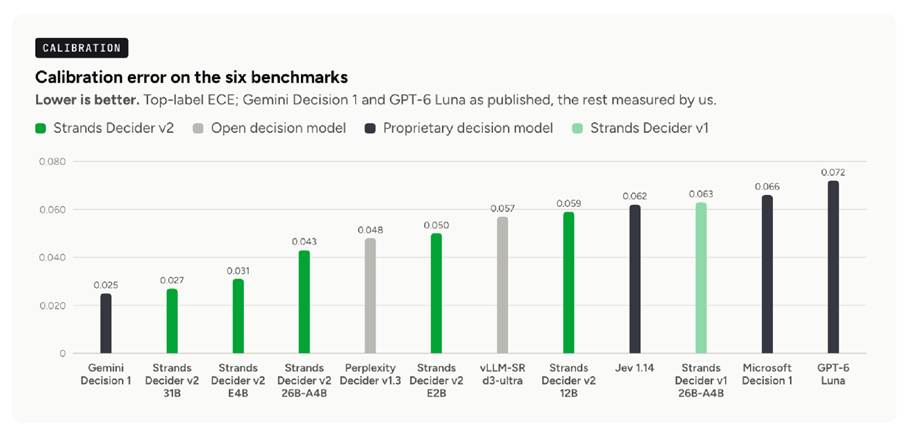
Calibration error, which reflects how closely a model's confidence aligns with actual correctness, drops to 0.027 for the 31-billion v2 model, down from 0.062 in v1. Only Gemini Decision 1 performs better at 0.025, while Jev 1.14 and Microsoft-Decision-1 register 0.062 and 0.066 respectively. Brooker notes that "I think with V1 we were benchmark leading for about eight hours," suggesting the competitive landscape is tightening. He views benchmarks as increasingly "saturated" and primarily useful for determining whether smaller models suffice for specific workloads.
Gemma 4 and bidirectional attention
AWS adopted a distinct architectural approach for Strands Decider 2. Most contemporary large language models employ causal attention, restricting each token to visibility of preceding tokens only—a necessity for text generation. Since decision models never generate text, the Strands team implemented bidirectional attention, allowing every token in the state to attend to the entire state in both directions. This design choice enables questions to reuse the encoded state, making the cost of posing 20 questions about a single agent trace negligibly higher than asking one.
When asked to explain the mechanism, Brooker acknowledges, "I have some theories, but I would say that I'm not entirely sure." The team evaluated both approaches across diverse datasets, and "one outperformed the other, and I think that is the shape of the majority of ML research." Brooker attributes some of the success to Gemma's more conventional architecture.
Using Strands Decider at Amazon
Within Amazon's operations, engineers managing an internal ticketing system replaced Claude Sonnet 4.6 with the v1 4-billion model for ticket labeling. Average latency per call decreased from 4,215 milliseconds to 897 milliseconds, and AWS estimates cost fell from approximately $22,200 to roughly $500 per million tickets at list prices, though accuracy metrics remain unpublished. The company also reports that v2 reduced expenses by routing requests between Claude Haiku 5.5 and Sonnet 5.5, shifting expenditure away from Anthropic models sold via Amazon Bedrock.
Brooker expresses particular enthusiasm for hybrid workflows: "What's really nice about these kinds of models is they're just a cool tool for us to build workflows that are mostly deterministic and then have a decider model step, or mostly agentic, but on the easy routes, we can use decider models to drive down cost and latency."
Notably, Strands Decider remains unavailable on AWS's Bedrock inference service at present. With AWS's annual re:Invent conference scheduled for one week ahead, further announcements regarding Bedrock integration are anticipated.