On Wednesday, AWS introduced AWS Emulator, a tool designed to replicate AWS services locally. The announcement stands out not merely for the product itself, but for how it came into existence: a team of agents built it from the ground up and will continue to maintain it.
Because AWS harbored uncertainty about whether it could claim copyright over work produced by agents—and preferred not to assert rights that might not legally exist—the emulator is distributed under the Creative Commons Zero license, placing the code squarely in the public domain.
Tom 'Spot' Callaway, principal open source software strategist at AWS, explained to The New Stack that while emulators for AWS have existed before, including those built by AWS itself, they suffer from a persistent problem. "The challenge is that they get out of date very quickly," he said. "They don't always reflect reality on the ground, and because of that, they're often not trusted. And we didn't even trust them internally."
The emergence of agentic coding tools created fresh motivation for a more dependable emulator. Such a tool would allow agents to test code against AWS services without requiring developers to hand over actual AWS credentials. Additionally, the team viewed the emulator as an ideal test case for building a complete project using agents—a bounded problem with measurable objectives and verifiable outcomes.
Since AWS already publishes comprehensive API models in Smithy format and generates all SDKs from those specifications, Callaway noted that "there's no reason that we can't also generate mock emulation around that same logic."
From Weekend Experiment to Production Tool
The initiative traces back to an experiment by Matt Goldberg, senior principal engineer on the AWS Developer Tools team. The team drew inspiration from Anthropic's work, where researchers had agents construct a C compiler earlier in the year.
Goldberg first directed Kiro, AWS's agentic coding tool, to build an emulator for Amazon Simple Queue Service (SQS). The initial version arrived within 15 minutes. He then tasked Kiro with expanding coverage across the rest of AWS over a single weekend. While that iteration contained gaps, Goldberg's team began testing their own software against it the following Monday.
Callaway admitted initial skepticism: "I got to admit, the first time I heard about this, I was like, 'Are we sure this is a good idea?'" However, as the team refined the system through multiple iterations, his confidence grew that agents could effectively tackle this problem.
The current version of AWS Emulator covers 438 public AWS API models spanning more than 200 services. As AWS updates and launches new services, agents will rapidly incorporate those changes into the emulator. Callaway anticipates the lag between a new AWS service release and emulator support will shrink to "days, not weeks, not months," though the team has yet to observe this timeline play out with the project now public.
Built in Rust, the emulator operates locally on Linux, macOS, and Windows without requiring a network connection or AWS account. Callaway emphasized an important clarification: "There's no AI inside of AWS Emulator. It does not do an LLM callout at all."
Three Agent Teams Working in Tandem
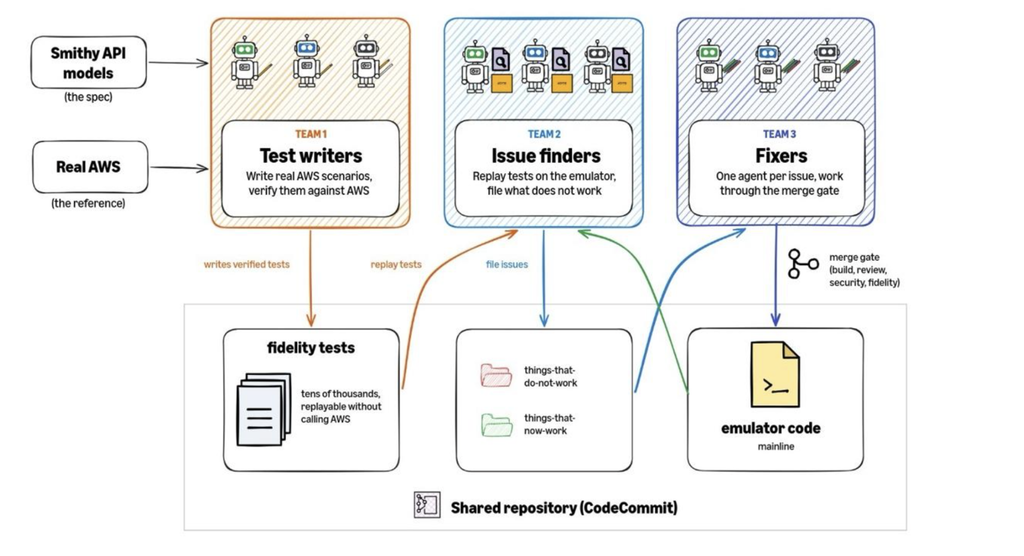
AWS organizes the maintenance work across three distinct agent teams, each with specialized responsibilities.
The first team generates test scenarios derived from the public Smithy models and executes them against actual AWS services to determine the correct behavior the emulator should replicate. These scenarios often involve multiple services interacting together rather than isolated API operations. As Callaway explained, "if the docs don't tell the truth, then the cloud becomes the source of truth."
The second team runs those same scenarios against the emulator and identifies discrepancies between its behavior and AWS's actual behavior. When failures appear to stem from a common root cause, the team documents them as issues in the code repository.
The third team addresses those issues by modifying the code. Any changes must clear build and test checks plus peer reviews from other agents examining security, code standards, and potential regressions in emulator functionality.
Human engineers concentrate on enhancing the system that directs the agents themselves. Callaway stated: "We don't edit it. We don't modify it. If we find that the code has issues, we try and trace those issues back to the agent and fix the agent so that it doesn't make bad code."
When problems arise in agent-generated code, the team adjusts how the agents operate rather than manually patching the code. Goldberg noted that in an earlier iteration, agents decided to write their own Python interpreter to support Lambda functions. The team subsequently instructed them to leverage existing libraries instead.
Callaway reflected on lessons learned: "I think we've learned a lot about sandboxing. Haven't we all in the last few months?" Early versions lacked sufficiently aggressive sandboxing, and the team initially worried agents might examine AWS's internal service source code to understand how to implement features like Aurora. AWS also spent considerable effort reassuring company executives that the framework wouldn't "go rogue."
Community Contributions and Limitations
The project maintains a strict policy regarding external contributions. Callaway stated: "We're not going to take pull requests on the project at all. The agents will be doing that. We will take issues from customers."
He characterized the agents as "their own little pull request army." If customers consistently report an API behaving incorrectly, that signals "a bug in the agent," and Callaway expects external contributions to primarily consist of scenarios the emulator doesn't yet handle properly.
AWS is publishing the benchmark used to validate the emulator, allowing others to verify results independently. Callaway said: "You can not trust us. You can run that benchmark." The benchmark can also serve as a tool for others to evaluate their own implementations.
Users should understand the emulator's scope. It does not replicate the full functionality of actual AWS services. Callaway illustrated this limitation: "I run this SQL query, and I don't get the right results. Well, guess what? There's no database." The emulator was "really built for the purposes of testing coverage."
AWS plans to provide additional details about the project at its re:Invent conference, beginning November 30.