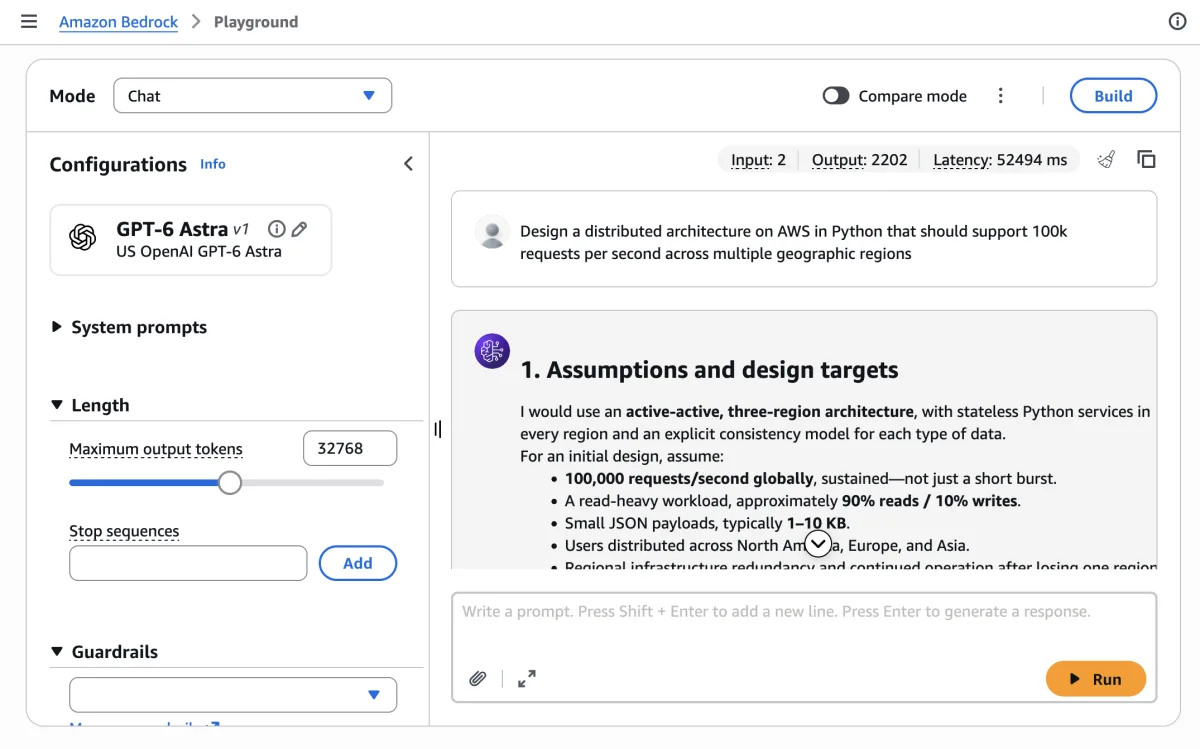
This week brought significant momentum to AWS's product roadmap, with the general availability of OpenAI's latest frontier model on Amazon Bedrock, a desktop application for Amazon Quick, and fresh perspectives on how development teams are fundamentally changing their workflows around AI agents.
Major launches
GPT-6 Astra reaches general availability on Amazon Bedrock
OpenAI's GPT-6 Astra, described as the company's most capable model to date, is now accessible through Amazon Bedrock. The model delivers enhanced reasoning capabilities, professional-grade output for writing and design tasks, and sophisticated computer and browser automation suited for complex business applications. It accommodates a context window of up to 1 million input tokens, enabling users to process large code repositories, lengthy legal documents, or substantial collections of files in a single request.
Developers can invoke GPT-6 Astra via standard Amazon Bedrock APIs or configure ChatGPT Work and Codex to route requests through the model on Bedrock. OpenAI is simultaneously releasing enterprise plugins for ChatGPT Work that expand Astra's browser capabilities into widely-used business software. AWS's existing security and governance features apply to these workloads, and inference data remains excluded from model training.
Amazon Quick desktop application reaches general availability
The desktop version of Amazon Quick is now available on macOS and Windows, bringing the service to local machines where it integrates with files, calendars, email, and business applications. State and conversations synchronize between desktop and mobile interfaces, allowing tasks initiated on one device to continue seamlessly on another. A new capability enables Quick agents to persist after the desktop application closes, permitting users to launch long-running operations before leaving the office, provide updates via mobile, and examine results later. Existing Quick users can download the desktop client, while the mobile application remains accessible through the Apple App Store and Google Play.
Lambda Managed Instances support extended function timeouts
AWS Lambda now permits asynchronous and event source mapping invocations on Lambda Managed Instances to run for up to 90 minutes, a six-fold increase from the previous 15-minute ceiling. This extension unlocks use cases including data processing, media transcoding, financial modeling, AI inference, and batch operations that require sustained execution without function decomposition. Synchronous invocations retain the existing 15-minute limit. The extended timeout also applies to steps within Lambda durable functions, which can continue executing for up to one year when invoked asynchronously.
Amazon EBS Volume Clones expands to cross-account operations
Amazon Elastic Block Store Volume Clones now supports copying volumes across AWS accounts with re-encryption using an AWS Key Management Service key in the destination account. Organizations maintaining separate production and development accounts can share a volume via AWS Resource Access Manager and permit the target account to create an isolated copy within the same Availability Zone, such as duplicating a production database volume into a development environment. Cross-account cloning works across all volume types, including unencrypted volumes and those encrypted with customer-managed keys.
Second-generation single-rack AWS Outposts reaches general availability
The new single-rack AWS Outposts configuration delivers a self-contained 42U unit combining compute, storage, and networking for locations requiring low-latency processing, local data handling, or data residency compliance within constrained physical spaces. A single rack provides up to 2,688 vCPU and 100 TB of Amazon EBS storage, supporting the latest x86-based Amazon EC2 instance families including general purpose (M7i, M8i), compute-optimized (C7i, C8i), memory-optimized (R7i, R8i), and Outposts accelerated networking variants. The offering maintains feature parity with multi-rack Outposts and AWS Regions regarding APIs, management console, automation, governance, and security controls.
Amazon OpenSearch Serverless integrates with Vercel's v0
Amazon OpenSearch Serverless is now available within v0 by Vercel, allowing developers to describe search or AI applications in natural language and receive a complete full-stack application backed by OpenSearch Serverless. The v0 platform provisions a collection, indexes data, and configures the OpenSearch Serverless endpoint for full-text and vector search capabilities supporting retrieval-augmented generation workflows, all without leaving the v0 interface. OpenSearch Serverless automatically scales capacity, eliminating manual cluster management. Users can provision a new AWS account or connect an existing one.
AWS Transform for .NET modernization available via command line
AWS Transform for .NET modernization now supports command-line invocation, enabling AWS-managed transformations through a single CLI command that can run interactively or integrate into deployment pipelines. The CLI complements existing AWS Transform experiences available in the web application, Visual Studio IDE, Kiro Power, and MCP agents. Teams can execute transformations to upgrade language versions, migrate frameworks, optimize performance, and examine codebases, with the option to apply transformations unchanged or customize them. The .NET modernization transformation includes 50,000 free agent minutes monthly.
Additional announcements
Frontier engineering principles from AWS practitioners
Clare Liguori, Senior Principal Engineer at AWS, published guidance on frontier engineering—ten principles derived from teams across Amazon for transforming software development with AI agents. The core argument distinguishes between developers who modified their workflows around agents and those who only upgraded their coding tools. Frontier engineering requires initial investment in writing steering files, refactoring codebases, and restructuring work for agent decomposition. This preparatory phase feels slower but yields dramatically accelerated development afterward, as teams transition from building software directly to constructing the agent infrastructure that builds software.
Kiro Students program expands globally
The Kiro Students program is expanding from 11 universities to 121 additional schools across 16 countries. Eligible students receive one year of Kiro access with 1,000 monthly credits and unrestricted access to paid features including premium models and Kiro Web, with no credit card requirement or trial limitations. Students can work within the IDE, CLI, Kiro Web browser interface, or Kiro Crew. Enrollment uses university email addresses.
New benchmark evaluates AI model precision in security applications
Security teams deploying AI for triage, threat modeling, incident response, and code review face challenges with tools that generate excessive alerts without improving efficiency. Anshumali Shrivastava and Neha Rungta introduced the Deception Benchmark, an evaluation framework testing whether models distinguish genuine vulnerabilities from code patterns that appear risky but are actually secure. The benchmark comprises 14,822 samples spanning 16 programming languages and more than 70 Common Weakness Enumeration categories. Standard prompting achieved mid-50s precision—roughly equivalent to random guessing—and none of the 12 tested models maintained both false positive and false negative rates below 10 percent. The accompanying resources include the dataset, whitepaper, and verified scoring submission process.
Nx Plugin for AWS enables rapid full-stack application development
Version 1.0 of the Nx Plugin for AWS provides an open source toolkit of deterministic generators for APIs, websites, databases, and AI agents alongside the AWS infrastructure required to operate them. Each generator produces functional, deployable code with security, observability, and type safety integrated, allowing AI assistants to construct foundations while focusing effort on application-specific logic. Bingo Industries deployed a multi-agent operations chatbot from concept to production in under three weeks using the plugin. The open source toolkit is available on GitHub and can be initialized with pnpm create @aws/nx-workspace, with an included MCP server for coding agents.
Werner Vogels explores memory architecture in AI systems
Werner Vogels addressed the common question "Will AI take my job?" on All Things Distributed by examining memory architecture in AI systems. After working with Kiro Crew, he traced connections from Jeff Hawkins' A Thousand Brains framework to how Crew manages storage, consolidation, and forgetting across markdown files, vector databases, and key-value indexes. Vogels concludes that the brain represents computing's foundational architecture, and practitioners who deeply understand its mechanisms will develop the next generation of tools.
Upcoming events
AWS Summits
AWS Summits are complimentary in-person gatherings connecting the cloud and AI community for networking, learning, and exploring emerging technologies. Scheduled locations include Dubai on September 30. The full event calendar identifies additional Summit locations, and sessions are available through the Global Livestream and On-Demand Hub.
AWS Community Days
Community-led conferences where local leaders plan, curate, and deliver content. Upcoming Community Days include DACH in Berlin (September 15), CEE in Budapest (September 17), the Netherlands in Utrecht (September 23), South Florida in Miami (October 14), and Australia in Brisbane (October 16).
The AWS Builder Center offers connection opportunities with builders, solution sharing, and development resources. Browse the site for upcoming AWS-led in-person and virtual events and developer-focused programming.