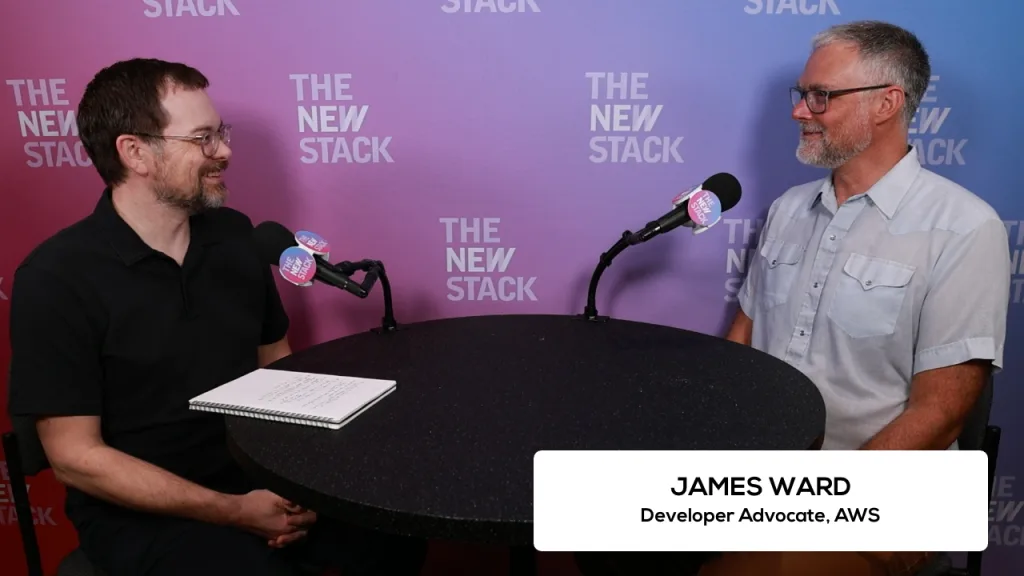
Many MCP servers function as minimal data conduits, responding to agent requests without offering direction. James Ward, a principal developer advocate at AWS and member of the Agentic AI Foundation's technical committee, contends this approach underutilizes the protocol's potential. Instead, he advocates for servers that participate more actively in the agent's decision-making process.
Ward spoke with me ahead of his presentation at AGNTCon + MCPCon in San Jose, where he and co-presenter Alexander Ioffe were scheduled to discuss evolving MCP from a basic API layer into a true agent integration interface. "Many times our MCP servers are just these APIs, like 'get me the customers,' and that is a good place to start," Ward explained. "I imagine MCP as the third person in this conversation, or a fourth or a fifth, depending on how many MCP servers you have."
Operationally, this means tool responses should bundle guidance alongside the data itself. The server communicates what action it just performed, suggests what the agent might attempt next, and indicates where additional information lives.
https://www.youtube.com/embed/RywJRuJVTUk?si=PM9ABIz3bbKEXP6G
Tracing the Agent's Path
https://player.simplecast.com/dedf4e2e-7840-4541-a137-5a2a134a6630?dark=true
The second pillar of Ward's argument centers on observability. Web developers routinely trace user interactions from the browser interface down through the database layer. "MCP by default doesn't have any way to do trace ID," Ward noted.
AWS employs a straightforward workaround: adding a session ID parameter to tools and instructing agents to include it with every call. This allows individual requests to be reassembled into a complete transaction history. A second parameter can carry the original user prompt or a distilled summary of the objective. By comparing what users requested against the actual path agents took, teams can construct evaluations, refine tool descriptions or parameters, and measure whether task completion rates improve. Ward indicated AWS has implemented much of this infrastructure for the MCP servers its own development teams rely on.
In May, AWS made its MCP Server publicly available, followed by the addition of Lambda diagnostics in September. Before the conference, Ward described in an Agentic AI Foundation profile how an agent was fetching customer records individually because the available tool only supported single-record retrieval. Observing this complete workflow revealed the inefficiency and enabled the team to build a batch retrieval tool to address it.
MCP as One Tool Among Many
Ward stopped short of positioning MCP as a universal solution. AWS also maintains a CLI and skills framework, partly because MCP's OAuth model cannot switch between AWS user profiles the way the command-line interface does. The optimal choice depends on the underlying model, how tool descriptions are written, and the mechanism by which agents discover available tools. AWS evaluates these options against each other through systematic testing.
Ward acknowledged the fundamentals are not novel. "There's nothing new under the sun," he said. The core practice remains unchanged: observe the journey, reproduce it, measure it, and improve it. What has shifted is that teams must now understand both the paths humans and agents follow together, and validate whether modifications to their tools actually enable task completion.