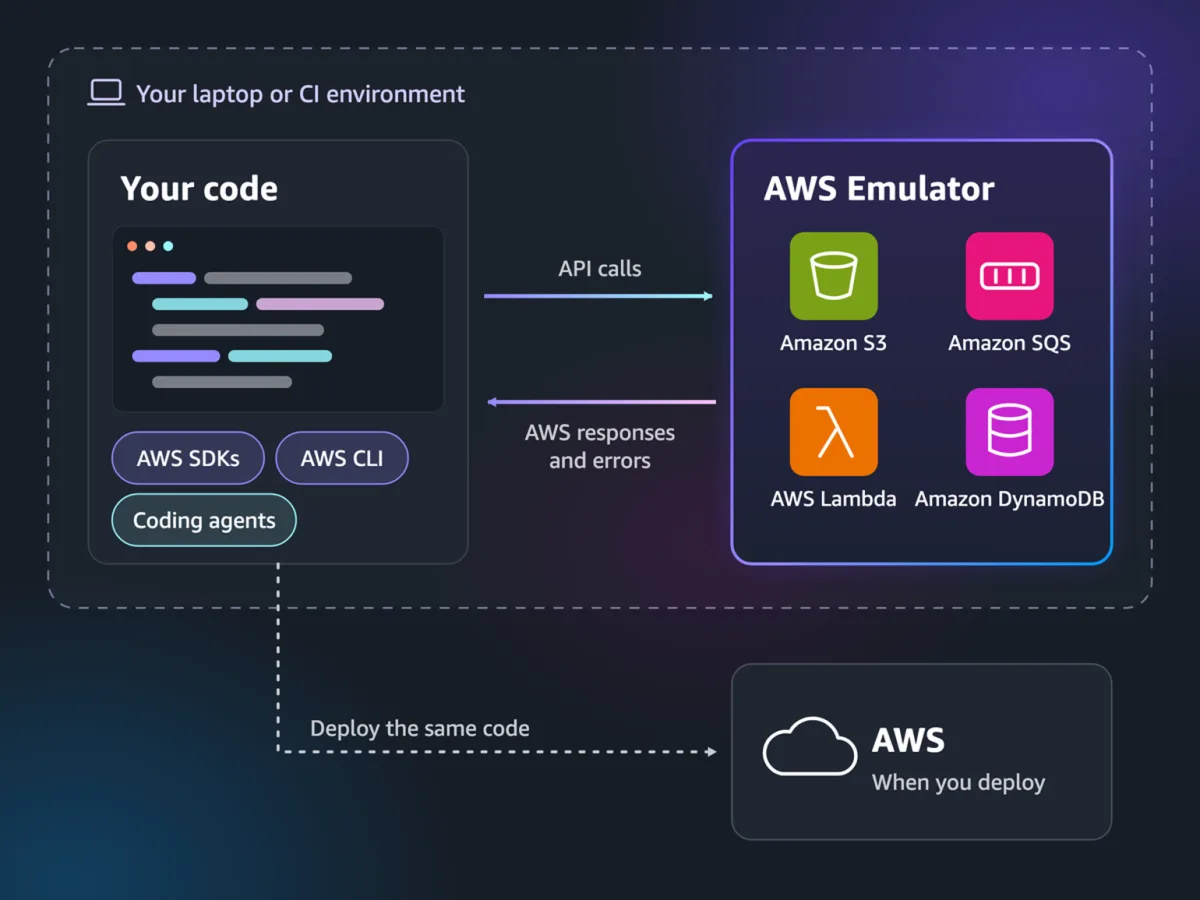
Testing applications through edge cases and failure scenarios often reveals more than standard demonstrations. Tools that enable developers to investigate problems quickly, before changes grow large, accelerate development cycles. The introduction of AWS Emulator last week shifts some of this testing work to local machines, allowing both developers and AI agents to interact with AWS APIs, examine responses, and iterate without spinning up cloud infrastructure for each attempt.
This week's AWS announcements include new isolation mechanisms for containerized workloads, narrower permission scoping for delegated access, and preparation tools for regional outages. Here are the highlights from the past seven days.
Key launches
AWS Emulator for local API testing
AWS Emulator provides a generally available local environment for testing AWS API calls. Developers point the AWS CLI or AWS SDKs to its HTTPS endpoint, and applications continue using standard SDK calls without modification. A demonstration shows a coding agent provisioning an Amazon DynamoDB table, inserting an item, and retrieving it—all without an AWS account or additional fees. Setup guides cover Linux packages, Docker containers for macOS and Windows, and agent-assisted configuration, with source code available on GitHub.
The value lies in rapid feedback loops: agents execute calls, inspect results, and refine code in real time. Coverage varies across operations, with unimplemented calls returning HTTP 501 responses. The emulator does not enforce IAM policies, resource policies, cross-account access, or cross-Region behavior, so comprehensive testing and security validation on AWS infrastructure remains necessary before production deployment.
AWS Nitro Sandboxes for workload isolation
AWS Nitro Sandboxes introduce hardware-level isolation for individual pods, tasks, and virtual machines sharing an Amazon EC2 instance. Each Amazon EKS pod or Amazon ECS task receives its own VM boundary, useful for multi-tenant deployments, build processes, and agents running generated code. Isolated mode prevents workloads from interfering with neighbors; confidential mode extends protection to include node operators and provides cryptographic attestation. No additional charges apply on supported instances, though standard EC2 and applicable EKS Auto Mode or ECS Managed Instances fees continue.
Amazon Cognito OAuth 2.0 token exchange
Amazon Cognito now supports OAuth 2.0 token exchange, allowing users' tokens to be converted into scoped credentials for downstream services. Derived tokens carry narrower permissions, single audience designation, and no refresh token. An actor token parameter identifies the intermediary through an act claim, making delegation transparent without exposing the original token. The capability is available on Essentials and Plus plans across all Cognito Regions.
Claude Fable 5.2 on Amazon Bedrock
Claude Fable 5.2, Anthropic's most capable generally available model for technical tasks, is now accessible through Amazon Bedrock or Claude Platform on AWS. The model targets extended engineering work, scientific research, and quantitative finance applications. Bedrock retains Fable 5.2 traffic for up to 30 days for abuse detection, with a temporary zero-retention option available for eligible internal use.
Amazon ElastiCache Serverless search capabilities
Amazon ElastiCache Serverless for Valkey now combines vector, full-text, and hybrid search with server-side aggregations. This addition supports product discovery, recommendations, and agent memory retrieval on frequently updated datasets. The feature requires Valkey 9; existing caches must be upgraded or replaced with compatible versions. Availability spans commercial Regions, AWS GovCloud (US), and the AWS European Sovereign Cloud.
Amazon OpenSearch Service cross-Region disaster recovery
Amazon OpenSearch Service now supports managed cross-Region disaster recovery by pairing domains running version 3.7 or later across two Regions within a single account. AWS guarantees recovery objectives of under one minute for data loss and under 20 minutes for recovery time. Planned switchovers preserve all writes; unplanned failovers may lose unreplicated data. Implementation requires keeping configuration synchronized, redirecting application writes after role changes, and accounting for secondary-domain and data-transfer charges.
Amazon CloudWatch Logs account-level retention
Amazon CloudWatch now supports account-level retention policies across all log groups or groups matching a name prefix. Policies can apply to existing groups or new groups only. When multiple policies overlap, the longest retention period takes precedence. Platform teams can establish baseline retention while extending security log retention without modifying individual group settings. The feature carries no additional charge and is available in commercial Regions except Middle East (Bahrain) and Middle East (UAE).
Next-generation Bedrock AgentCore runtime
Amazon Bedrock AgentCore now defaults to its next-generation runtime. New agent sessions initialize in under 2 seconds, scale to 8 vCPU and 32 GB, scale down to zero when idle, and reduce memory billing by up to 68%. Each session runs in its own isolated microVM.
Additional resources
- Cost optimization and ROI measurement for Amazon Bedrock agents, including task-level cost tracking, reasoning expenses, caching benefits, and human review workflows
- Zillow's architecture for 100 million daily notifications using AWS Step Functions Express Workflows, featuring reusable modules, configuration-driven design, idempotent operations, batching, campaign isolation, and TestState API validation
Upcoming events
- AWS re:Invent in Las Vegas, November 30 to December 4, featuring over 2,200 sessions including workshops and deep dives, with free livestream access to keynotes and selected talks
- AWS Community Days offering community-led technical talks, workshops, and hands-on learning; check individual organizer pages for dates and registration
- AWS Builder Center for connecting with developers, sharing solutions, and accessing development resources, plus upcoming AWS-led in-person and virtual events