Anthropic unveiled Claude Fable 5.2 and Mythos 5.2 on Monday, bringing pricing reductions and performance gains to its specialized model lineup. The new Fable 5.2 cuts input and output token costs from $10/$50 to $8/$40 per million tokens—a 20 percent reduction that positions the model 20 percent below OpenAI's GPT-6 Astra at standard rates.
Fable 5.2 rolls out across all major cloud platforms including Amazon Web Services, Google Cloud, and Microsoft Azure, while Mythos 5.2 access remains restricted to organizations enrolled in Anthropic's Cyber and Life Sciences verification programs. Both models share the same underlying architecture, though Fable applies stricter safeguards for cybersecurity and biology use cases.
The company continues to recommend Opus 5.5 for general coding and knowledge work, positioning Fable 5.2 instead as a tool for tackling demanding technical problems. Anthropic notes that improvements span coding, reasoning, and vision capabilities, with baseline generation speed up 30 percent compared to the prior 5.1 versions.
Speed enhancements and Fast mode
A new Fast mode option accelerates token generation by up to 2.5 times for users prioritizing response speed. This mode is accessible through Claude Code, the Claude Platform, Google Cloud's Claude Models, and Anthropic-hosted Microsoft Foundry. Fast mode pricing runs $16 per million input tokens and $80 per million output tokens—double the standard rates.
Coding benchmark results
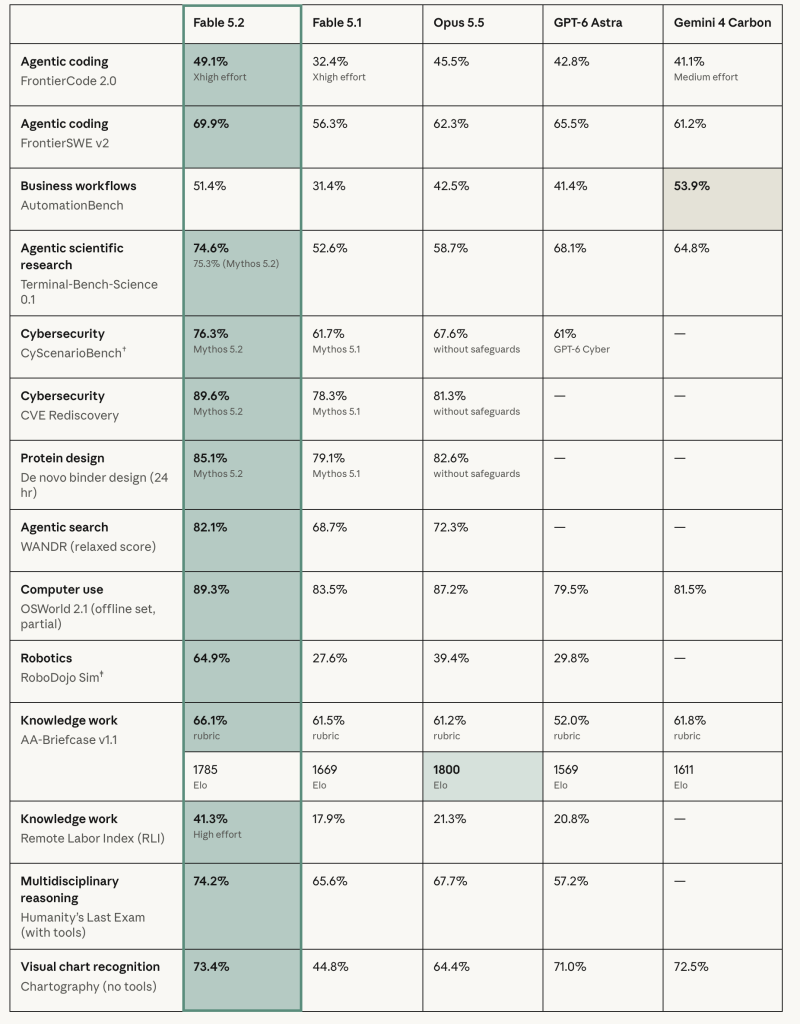
Fable 5.2 demonstrates significant gains on complex coding evaluations. On FrontierCode 2.0, the model scored 49.1 percent, substantially ahead of Fable 5.1's 32.4 percent, Opus 5.5's 45.5 percent, and GPT-6 Astra's 42.8 percent. The FrontierSWE v2 benchmark shows Fable 5.2 at 69.9 percent, outpacing Astra's 65.5 percent and Opus's 62.3 percent.
Cost-per-task comparisons reveal additional advantages. In early FrontierCode 2.0 testing, Fable 5.2 operating at High effort matched Opus 5.5's performance at Max effort for roughly half the cost per task. Medium effort is now the default setting for Fable 5.2 in Claude applications and Claude Code.
Results are not uniformly dominant across all benchmarks. Google's Gemini 4 Carbon leads on AutomationBench, which evaluates business workflows, with 53.9 percent versus Fable's 51.4 percent. Opus 5.5 maintains a narrow advantage on the Elo measure of AA-Briefcase v1.1, a knowledge-work assessment.
Agentic capabilities and orchestration
Anthropic positions Fable 5.2 as capable of functioning either as an adviser that smaller models consult on difficult problems or as an orchestrator delegating simpler tasks downstream. In one internal experiment, an engineer tasked Fable 5.2 with building a prototype operating system from an empty folder. The model coordinated over 1,000 subagents across eight days to produce a bootable OS featuring drivers, persistent storage, a graphical interface, and an installer.
Safety blocks and guardrails
Anthropic maintains that Fable 5.2's cybersecurity and biology safeguards remain as stringent as those in version 5.1. Early testing across Claude.ai, Claude Code, and Cowork showed approximately 55 percent fewer overall blocks, including roughly 60 percent fewer cybersecurity blocks and 40 percent fewer biology blocks. This reduction aims to minimize interruptions to legitimate work without broadening permissions.
High-risk activities remain blocked, including penetration testing, exploit generation, and most research biology tasks. When a query encounters a block, users receive a fallback response from Opus 4.8 for cybersecurity matters or Opus 5 for biology. Claude Enterprise customers now gain access to Claude Security, which includes Mythos 5.2, even without Cyber Verification Program membership.
Anthropic deliberately constrained certain AI-development capabilities during training, including accelerator kernel optimization and large language model architecture work. Performance in these areas matches Opus 5.5 levels. The company states these limitations do not affect agentic coding, hardware development, or traditional machine learning research.
For API developers, preserved thinking expands to all accounts, restricting context modifications that could extract reasoning for distillation purposes.
Enterprise safeguards in private beta
Enterprise Frontier Safeguards, initially announced in September, enters private beta with early customers including Bridgewater, Salesforce, and Stripe. The system runs automated safety monitoring on prompts and responses within customers' own infrastructure, supporting zero data retention policies. Eligible customers can continue using Fable 5.2 and Mythos 5.2 with zero data retention prior to implementation. Other customers see data retained for 30 days for safety monitoring.
Scientific and mathematical applications
Anthropic argues that Fable 5.2's coding strengths extend to scientific research, where software underpins much of the work—from data analysis and molecular modeling to component design and instrument control. The company reports that Fable 5.2 solved two open theoretical-physics problems: one involving black-hole formation transitions in quantum descriptions proposed in 2003, and another establishing limits on a technique used to eliminate candidate quantum gravity theories in simplified universes.
On Fermat's Last Theorem, a team of 1,000 Fable 5.2 agents fully formalized the proof in Lean within 30 hours using minimal human intervention. Formalization translates a proof into computer-verifiable language, distinct from discovering new proofs. The agents received intermediate theorem statements for progress measurement but no mathematical references. An earlier Claude research version required 11 days with a purpose-built harness and human guidance. Anthropic's comparison ran single instances per model, with Opus 5.5 reaching 26 percent after 18 hours and showing minimal progress by 30 hours.
Hardware design testing partnered Fable 5.2 with circuit-board company Diode to develop a voice-assistant hub, USB speakerphone, and handheld virtual pet. Claude selected components, designed boards and enclosures, and wrote software, while Diode built and tested the devices with Claude's guidance. All three prototypes functioned without electrical modifications.