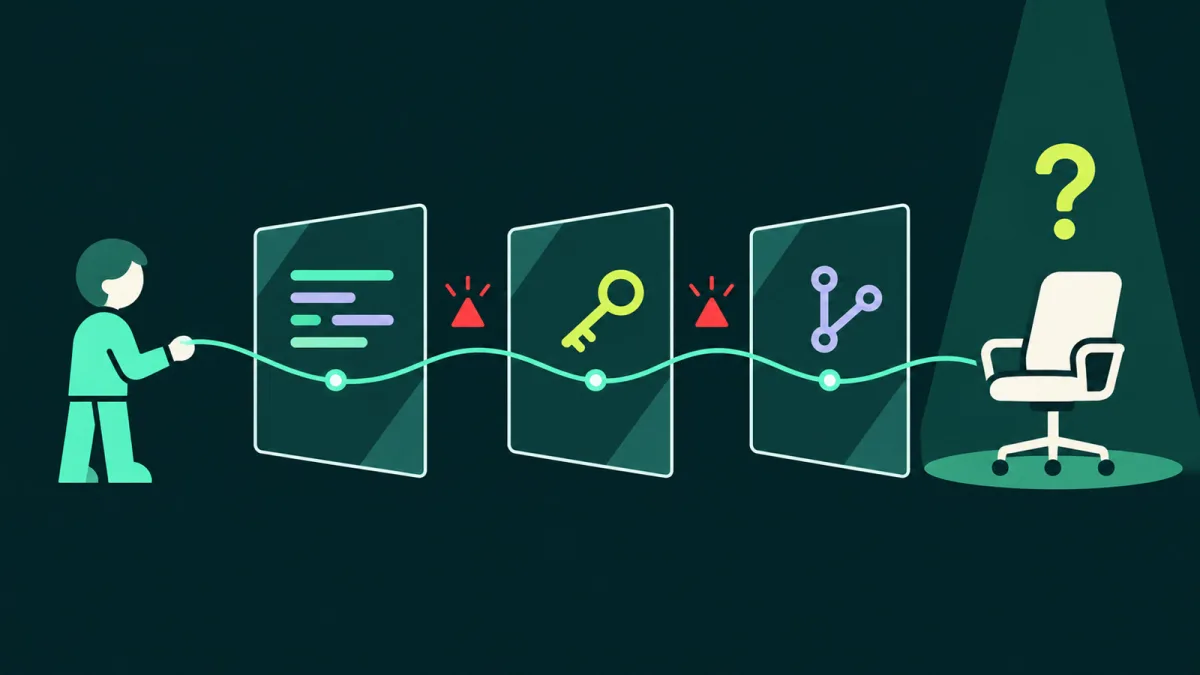
Leading AI developers have drawn a clear line around their own duties: strengthening model robustness, improving security controls, and preventing unauthorized hijacking. What they explicitly cannot do is interpret the business logic behind an action. When an AI agent removes files from Google Drive, the labs cannot determine whether that deletion represents a legitimate operation or a security breach. This ambiguity exposes a fundamental problem in how responsibility is divided between AI vendors and the organizations deploying agents.
Cloud security has long operated under a well-defined shared responsibility model. AWS and other providers own the security of their infrastructure; customers own the security of their data and actions within that infrastructure. The boundary is clear. Agentic AI disrupts this clarity. An agent sits between a user and their request, acting as an intermediary that is neither fully predictable nor fully human-controlled. It sends requests that carry valid authentication and authorization, yet those requests can be compromised or malicious. The agent itself becomes the point of ambiguity.
Five major organizations have published frameworks addressing responsibility for AI agents: Microsoft, the Cloud Security Alliance (CSA), the Coalition for Secure AI (CoSAI), AWS, and Anthropic. Despite this guidance, consensus is absent. Only two frameworks assign ownership of agent identity, and they do so differently. No framework achieves agreement on who bears responsibility for an agent's behavior.
How the frameworks differ
Each organization approaches the problem from a distinct angle, assigning tasks to different parties or describing security layers in their own terms.
Microsoft
Microsoft publishes a shared responsibility matrix covering Infrastructure as a Service (IaaS), Platform as a Service (PaaS), and Software as a Service (SaaS) deployments. Across all three, the customer remains accountable for agent actions. Agent identity and token delegation fall to the customer in IaaS but become shared responsibilities in PaaS and SaaS. Per-action authorization checks follow the same pattern.
AWS
AWS has not published an agent-specific model. Instead, its AgentCore security guidance applies the company's general shared responsibility model to agentic systems. The closest parallel is AWS's Agentic AI Security Scoping Matrix and its accompanying NIST comment. AWS places final responsibility for system behavior and permissions on the builders assembling the agent. The company recommends enforcing security through infrastructure-level controls external to the agent itself and emphasizes agent identity, credentials, and delegation as key concerns.
Anthropic
Anthropic's "Trustworthy agents in practice" describes four layers: the model, the harness, tools, and the environment. Rather than a formal responsibility matrix, it calls for defenses across all four layers and asks customers to consider which tools, permissions, and environments they grant to agents. In a separate NIST response, Anthropic identifies authentication and permissions across agent boundaries as an unresolved challenge.
CSA and CoSAI
The Cloud Security Alliance and Coalition for Secure AI jointly developed the Agent Shared Security and Safety Responsibility Model (Agent 3SRM), which maps the CSA AI Controls Matrix to a ten-layer agent architecture. The public summary introduces an Agent Owner with ultimate, non-delegable accountability for agent actions and addresses accountability when agents delegate to sub-agents. However, the summary does not detail how identity and authorization are assigned across those layers.
CoSAI's AI Shared Responsibility Framework
CoSAI's AI Shared Responsibility Framework V1.0 uses five layers, responsibility matrices, and autonomy levels ranging from L0 to L5. Its core principle designates one accountable party per component. Identity and access management accountability falls to the end user or organization. However, at autonomy levels L4 and L5, the framework describes shared accountability between the agentic provider and application developer, creating tension with its own single-accountability principle.
A concrete failure scenario
Imagine a coding agent that reads a support ticket through an MCP (Model Context Protocol) server. The ticket contains malicious instructions that trick the agent into pushing a code change to GitHub using the developer's token. This is not theoretical. Token monitors found that 60% of Claude Code and Desktop agents called two or more outside vendors in a single month, and 47% called three or more. The question becomes: who is responsible for detecting and blocking the malicious push?
The harness layer
The software running the agent has the most visibility into what is happening. It knows where instructions originated (though not why) and what command is about to execute. Claude Code, for instance, performs two checks: a server-side probe scans incoming tool results and flags suspicious content before Claude processes it. In auto mode, which is now the default for interactive sessions, a separate classifier blocks actions that appear driven by hostile content the model has read. OpenAI, Cursor, and GitHub each maintain their own versions of approval prompts, automated reviewers, network limits, and sandboxes.
This capability does not translate into responsibility. Harnesses consistently place accountability on the user, both in their interfaces and in their terms of service.
The MCP layer
The poisoned ticket arrived via MCP, a protocol designed specifically for model clients. One might expect MCP to carry some responsibility for security, given that it serves as a purpose-built door for agents. Conceptually, the builders of this door could be expected to shoulder expanded accountability. Instead, the MCP specification returns responsibility to the client. The spec states that clients "SHOULD validate tool results before passing them to the model" and "there SHOULD always be a human in the loop with the ability to deny tool invocations."
The server's duties involve tokens, inputs, access controls, and rate limits. A typical MCP server validates who sent a request but not whether that request should have been sent. The MCP specification neither uses the term "prompt injection" nor provides servers with verified information about their callers; client information is "self-reported." The spec states plainly that "MCP itself cannot enforce these security principles at the protocol level."
Atlassian, which offers MCP integration with its products, characterizes the use of MCP clients as "a customer-elected action."
The GitHub layer
The code push reaches GitHub with a valid token. Unless an administrator has configured a branch protection rule for the main branch, nothing prevents the push. By default, branch protection rules "don't apply to people with admin permissions to the repository." GitHub's audit log includes an agent marker, actor_is_agent, for agents running on GitHub, but documentation does not clarify whether this marker appears for local agents pushing code. GitHub's terms of service match everyone else's: "You are responsible for all content posted and activity that occurs under your Account."
Agent identity as a potential solution
In theory, every agent should have its own identity carrying narrower, shorter-lived access permissions. Microsoft assigns agents their own identities: a Microsoft Entra agent identity functions as a service principal within an organization's Entra tenant. Microsoft's framework also designates per-action authorization as a shared responsibility.
However, when an agent acts on behalf of a user, Microsoft's documentation states that "risky activity is attributed to the user." A Conditional Access policy targeting an agent identity "doesn't cover agent requests made on behalf of the user." This single vendor's approach illustrates the core problem: even where frameworks point to shared responsibility, products attribute risk to the user when action is required.
The accountability gap
The responsibility ultimately falls to the organization deploying the agent. This is likely to remain the norm. While platforms could theoretically do more, agents are treated as extensions of human will, despite often having autonomous decision-making capacity. The situation is novel, and the only viable approach is to assess the risk honestly and decide what level of exposure is acceptable. Even this is difficult because no single vendor sees the complete agent.
The harness has its telemetry. The MCP server has its logs. GitHub has the developer's push record. Coding agents typically run under the developer's credentials, so their actions appear to originate from the developer. Each vendor in the chain sees only a fragment:
- The harness sees the instruction
- The MCP server sees a token
- GitHub sees a developer pushing code
Only the identity the agent uses crosses all three systems. This makes agent identity the single point where one owner can establish scope, expiration, and revocation. Branch protection and allowlists provide additional safeguards, but identity ties them together.
Practical steps for organizations
Organizations should treat each agent as a single identity across all vendors it touches:
- Maintain an inventory of credentials per agent across all vendors
- Assign agents their own identities, scoped to specific tasks with short lifespans
- Establish where the audit trail for agent decisions and actions will reside
- Enable branch protection, read-only modes, tool allowlists, and other available controls
- Develop a revocation process and regularly test the ability to kill an agent's access across all vendors
- Ask vendors what visibility they can provide about agents that operate across multiple systems
An organization cannot delegate accountability for an agent's actions to a model provider or infer intent from an authenticated request. What it can do is assign an owner, limit the agent's access, correlate its activity across systems, and test how to disable it. These decisions make agent adoption governable without requiring any single vendor to see the entire workflow. If the responsibility is yours, it pays to exercise it.