
Researchers at ESET have documented a cyber-espionage campaign in which the Russian state-backed group Turla deployed a sophisticated malware framework called Cereal to extract emails from Microsoft Exchange servers operated by government organizations. The attacks came to light in late 2025, when ESET initially detected modular .NET malware targeting Exchange infrastructure at a Kazakhstani government entity.
Within a month, ESET identified the identical toolset deployed against a Romanian government agency. At that target, the attackers focused on harvesting email messages exchanged with officials from NATO and the European Union. "After fine-tuning our detections, we found the same toolset at a governmental organization in Romania - compromised on December 23rd, 2025," ESET researchers stated in their report.

Turla, which operates under multiple aliases including Snake, Secret Blizzard, and Waterbug, has conducted cyber-espionage operations for more than two decades and maintains ties to Russia's Federal Security Service (FSB).
Technical architecture and capabilities
The Cereal framework employs a modular design centered on several interconnected components. A key element named CerealBox injects into the Exchange process EdgeTransport.exe and takes control of existing transport agent handlers. This approach allows the malware to monitor and intercept email traffic while executing operations entirely in memory, avoiding the need to register new transport agents or disrupt normal email flow through the server.
The attackers configured the malware to apply selective filtering, targeting only messages that meet specific criteria: those containing attachments in formats such as .DOC, .DOCX, and .PDF, combined with matching patterns for sender addresses, recipient addresses, and subject lines.
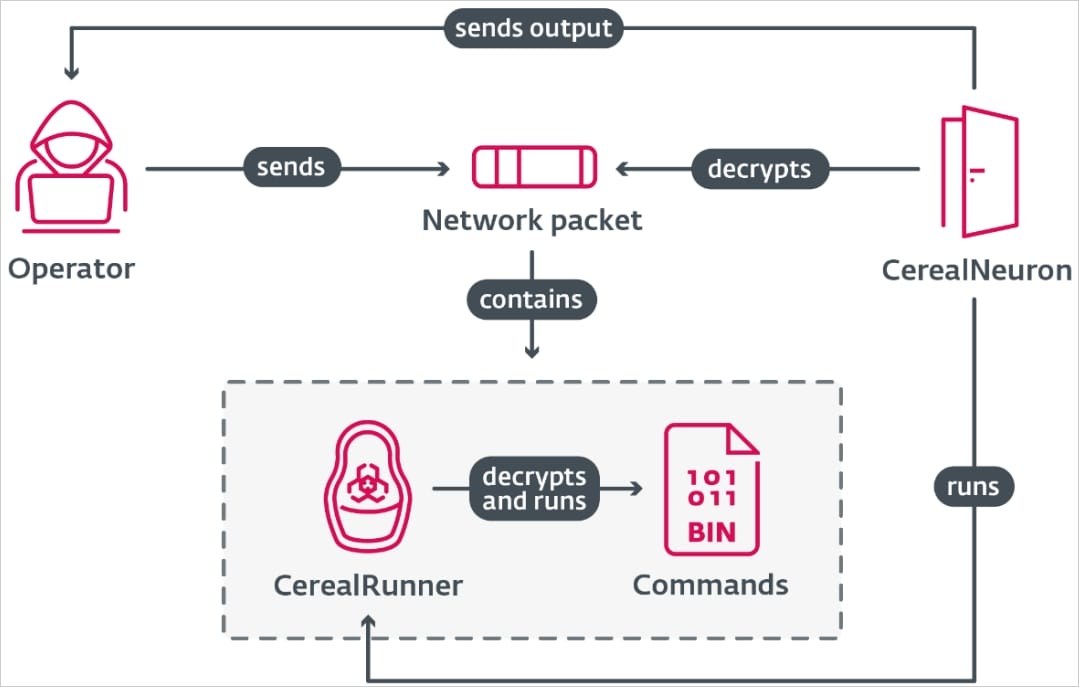
A second component, CerealNeuron, listens for encrypted web traffic arriving on paths that mimic legitimate Exchange services. Upon receiving a request, CerealNeuron decrypts it and launches CerealRunner, a wrapper program that carries the attacker-supplied code. The CerealRunner instances execute in memory and relay their output back to CerealNeuron, which encrypts the results and transmits them to the operators.
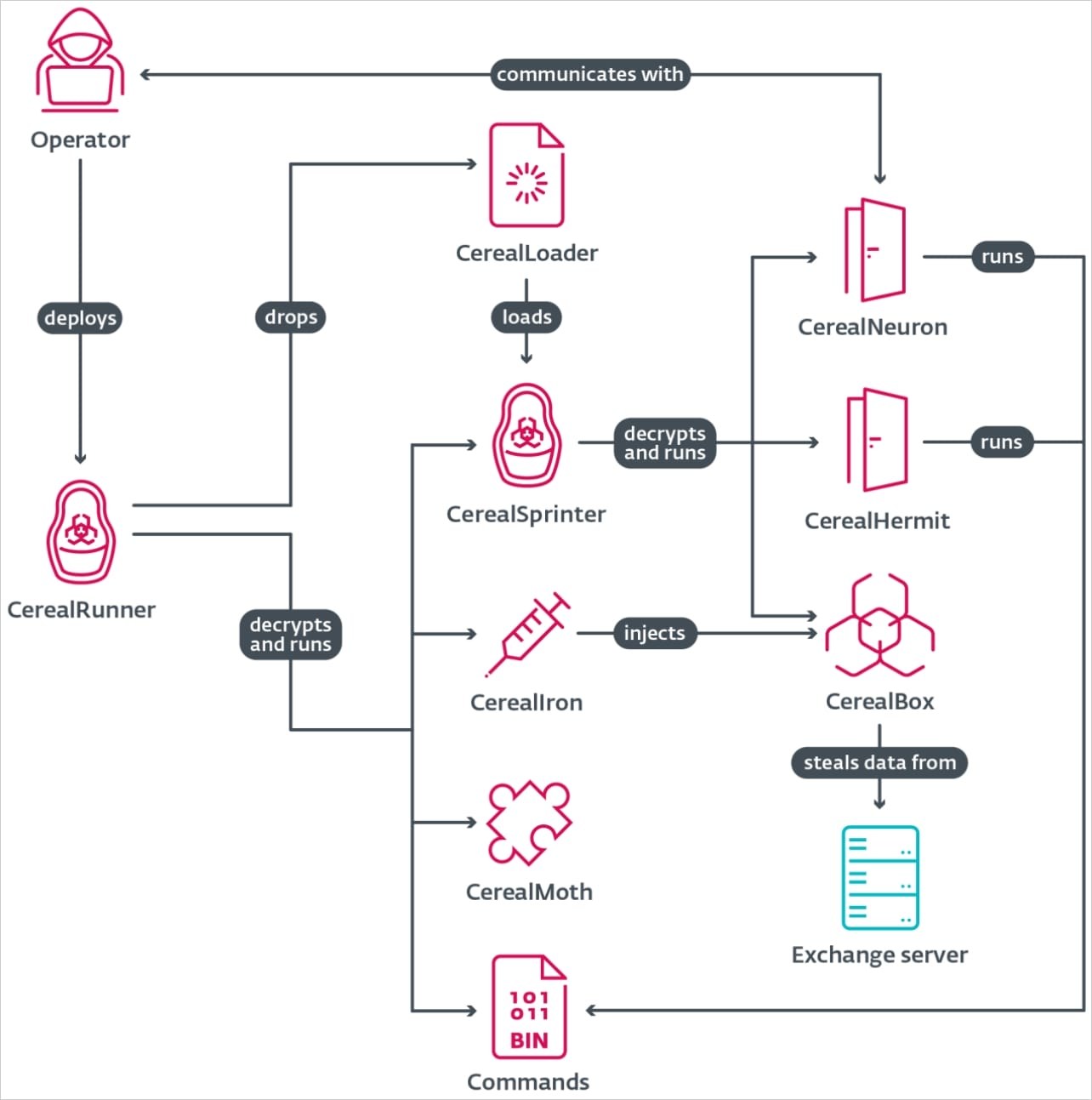
The command set available through CerealRunner encompasses a broad range of post-exploitation tasks, including email retrieval from Exchange, querying Active Directory for user and group information, DNS record enumeration, credential extraction, file reading, and file deletion.
ESET observed that the attackers generated a large number of nearly identical binaries, each compiled for a specific operation. "The sheer volume of near-identical binaries, each compiled for a specific task, strongly suggests that the operators have an internal framework that automates the compilation and packaging of commands," the researchers noted. "Combined with a codebase built around modular, interchangeable components, the impression is one of a mature, well-engineered platform – rather than a loose collection of scripts."
Command and control infrastructure
Notably, ESET found no evidence of external command-and-control servers in these attacks. Instead, the compromised Exchange server itself functioned as the sole control point, reducing the external infrastructure footprint and lowering detection risk.
The researchers also identified a variant called CerealHermit that operates without network capabilities, instead reading commands from encrypted files stored on disk. This component likely serves as a backup mechanism should the web-based CerealNeuron channel become unavailable or blocked. ESET did not detail how attackers place or retrieve command files through CerealHermit.
Evasion and operational design
The Cereal toolset demonstrates Turla's sophisticated understanding of .NET execution techniques, including abuse of the .NET native image cache to run code within legitimate processes. The framework prioritizes stealth through a minimal disk footprint and reliance on infrastructure less likely to trigger detection and blocking mechanisms.
ESET characterized the toolset as purpose-built for "long-term, stealthy cyberespionage," reflecting the group's operational objectives. The company has published a comprehensive list of indicators of compromise on its GitHub repository.