Researcher Abdelhamid Naceri, known online as Nightmare Eclipse, has unveiled SignDrop, a Windows zero-day that leverages a flaw in Microsoft's own defensive measures to grant attackers SYSTEM-level access. The exploit targets protections that Microsoft rolled out in October 2025 to counter authentication-based attacks on the Common Log File System (CLFS) driver. Naceri observed that while the mitigation successfully reduced CLFS-based attacks, the defensive mechanism itself opened a new attack surface.
The vulnerability stems from how CLFS manages authentication file creation when initializing a new log. Naceri explained that although CLFS performs access validation correctly during initial file creation, the process becomes exploitable when a privileged application—such as Windows Defender—subsequently accesses the log file. Once a privileged process opens the file, CLFS generates the authentication file with SYSTEM privileges while applying the original file's access controls, creating the conditions for privilege escalation.

Naceri emphasized that Microsoft implemented the mitigation correctly but noted that "the logic allows abuse." The technique proves particularly potent against antimalware and endpoint detection and response (EDR) solutions because the file-creation request originates from the security software's own legitimate process, bypassing kernel-level validation checks.
If everything is chained correctly, funnily, this legit security mitigation can be used against itself and allow an elevation of privileges. Everything is done properly by Microsoft here but the logic allows abuse.
Abdelhamid Naceri
What makes it funnier is the fact that it can be used against any antimalware engine to bypass their self defense (or tamper protection) mechanism, as you can trigger arbitrary file creation in the context of their own antimalware process so from the perspective of their kernel drivers, the file creation request is coming from their own legit process so it passes, this makes this vulnerability unique as it can be used to turn off any antivirus/EDR.
Abdelhamid Naceri
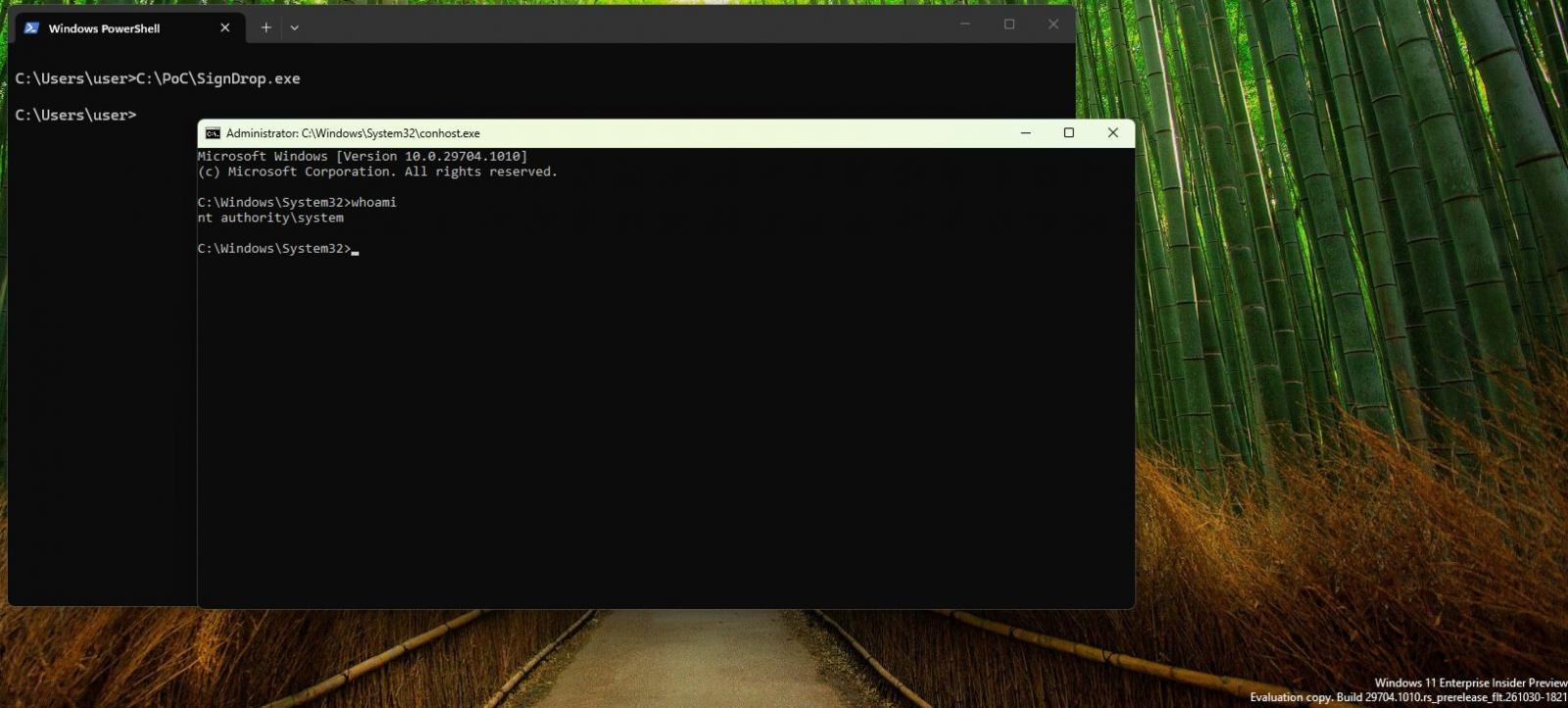
Testing on Windows 11 26H2, Windows 11 26H2 Experimental, and Windows Server 2025 Experimental revealed broad exposure; Naceri estimates approximately 80% of Windows deployments face vulnerability to SignDrop attacks.
To determine if a system is vulnerable, Naceri recommends executing the proof-of-concept exploit or checking the CLFS authentication configuration. Running the PoC that spawns a SYSTEM shell confirms vulnerability. Alternatively, checking the registry value at HKEY_LOCAL_MACHINE\SYSTEM\CurrentControlSet\Services\CLFS\Authentication\Mode will show vulnerability if the value is 0 (learning mode) or 1 (enforcement mode).
Currently, no remediation exists beyond awaiting a Microsoft patch. Disabling the CLFS mitigation would leave systems exposed to memory corruption exploits targeting the underlying driver vulnerabilities, creating an untenable tradeoff.
Naceri, who identifies as a former Microsoft employee, has disclosed numerous zero-day vulnerabilities across Microsoft's security stack since April. His disclosures include BigDiskBuster, ShieldCrash, ShieldBreak, LegacyHive, RoguePlanet, BlueHammer, RedSun, YellowKey, GreenPlasma, MiniPlasma, and UnDefend affecting Microsoft Defender, BitLocker, and other Windows components. He previously released privilege escalation exploits targeting multiple Windows versions five years ago.
Naceri disclosed these flaws publicly without prior private reporting to Microsoft, prompting the company to issue warnings of legal action against anyone conducting "malicious activity causing real harm" to its customers. The infosec community widely interpreted Microsoft's response as a direct warning to the researcher.
Microsoft has patched some of Naceri's disclosed vulnerabilities, including ShieldBreak, RoguePlanet, YellowKey, GreenPlasma, and MiniPlasma. However, the remaining zero-days, including SignDrop, remain unpatched.