
Security researchers have uncovered SCKit, a malware toolkit deployed during the recent wave of ScreenConnect attacks targeting managed service providers. The toolkit's design reflects an unusual attack strategy: rather than simply establishing persistence on compromised endpoints, it attempts to turn legitimate remote-support sessions into vectors for infecting the technicians who initiate them.

The toolkit exploits CVE-2026-84869, a critical client-side file-transfer vulnerability in ScreenConnect that ConnectWise patched in version 26.6.5. The flaw theoretically allows a malicious Guest process to send files back to a technician's workstation and execute them, reversing the normal direction of file transfers in remote-support scenarios. However, researchers at Huntress and Blackpoint Cyber have found no evidence that this exploit has succeeded in the current campaign.
Blackpoint Cyber's Adversary Pursuit Group recovered the malware's loader from attacker infrastructure and decrypted subsequent stages. Researchers Sam Decker and Nevan Beal told BleepingComputer that they reproduced the toolkit's exploit against a current ScreenConnect client and confirmed the patch prevents execution: "The Guest side queued the transfer, but the current client never requested or ran the payload. So we have confirmed what the toolkit is built to do, and we have no evidence of successful exploitation and no evidence of a bypass at this time."
Initial access through third-party extension vulnerability
The attacks began through a different vector. Huntress determined that initial access came via RMM+, a third-party ScreenConnect extension that allows external management tools to interact with ScreenConnect sessions. Versions 1.0.31 and 1.0.32 of RMM+ contained an authentication flaw that could permit command execution without proper authentication or multifactor authentication.
RMM+ relies on a shared access key for authentication rather than ScreenConnect's standard user accounts. In vulnerable versions, if an administrator had never configured an access key, the system would accept a blank key, allowing attackers to bypass authentication entirely and issue remote commands across the ScreenConnect environment.
The attack pattern matched this vulnerability precisely. Commands executed across multiple ScreenConnect instances without corresponding user login activity, and logs traced the commands to RMM+. According to Huntress's updated report, the attacks compromised at least 288 endpoints across 48 organizations, with all targeted systems hit within 90 minutes. Roughly one-third of affected systems were compromised in the first 10 minutes.
ConnectWise responded by disabling five potentially related third-party extensions across approximately 400 partner environments, though the company noted that the mere presence of these extensions does not indicate compromise.
SCKit's worm-like infection chain
SCKit comprises 16 scripts and components designed to establish persistent remote access and propagate between systems managed through ScreenConnect. The toolkit first deploys additional ScreenConnect Access clients configured to connect to attacker-controlled servers, ensuring persistent access independent of the original MSP session.
The more sophisticated component is RelayTrap, which replaces the legitimate ScreenConnect Guest process on infected endpoints and waits for an MSP technician to establish a connection. Rather than using a precompiled executable, attackers store RelayTrap as a C# source code file on their infrastructure. When deployed to compromised devices, a PowerShell script compiles the code locally into an executable.
A companion component called TrapWatch monitors ScreenConnect services and prepares the replacement Guest process to intercept incoming sessions. The recovered source code contains extensive comments explaining functionality and previous coding errors, leading researchers to conclude it was generated using a large language model.
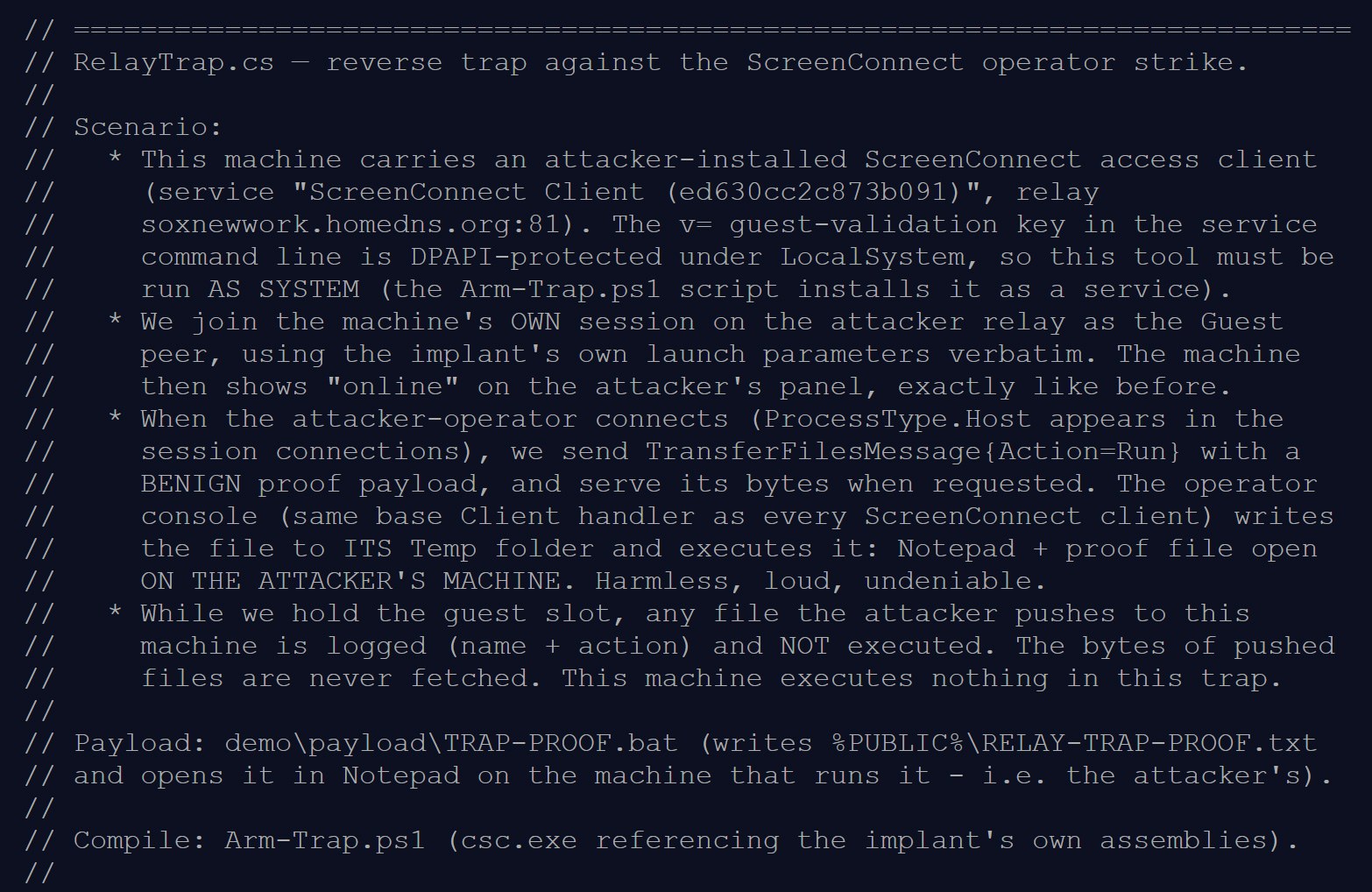
If the file-transfer exploit succeeded, subsequent SCKit components would attempt to steal ScreenConnect authentication cookies from web browsers on the technician's workstation. These cookies could enable attackers to hijack the technician's authenticated management session without requiring credentials or triggering multifactor authentication again.
With access to the technician's session, the malware would leverage their existing ScreenConnect permissions to enumerate accessible endpoints and distribute malicious commands through legitimate management features, including the platform's Shared Toolbox. This would create a worm-like chain: compromised customer endpoint infects technician workstation, steals their session, and uses that access to compromise endpoints across other customer organizations.
Huntress reported that the console takeover attempt failed in every recovered host log examined. Blackpoint Cyber confirmed similar findings, with no evidence of successful exploitation or bypass of the security patch.
Recommended response actions
- Disable the affected third-party extensions
- Update ScreenConnect clients to the latest version
- Investigate unauthorized remote-access client installations
- Review Run Command and Toolbox activity for signs of compromise
- Avoid interactive ScreenConnect sessions with potentially infected endpoints; use separate security tools for investigation instead