
A destructive malware campaign has compelled Russian cloud and hosting provider Beget to undertake a complete rebuild of its infrastructure. The intrusion occurred during the evening of November 1st, when threat actors obtained credentials to the firm's management layer and deployed scripts designed to wipe data across the entire system.
Beget identified the attack immediately after the malware executed and moved to isolate all servers from its network, preventing further propagation of the destructive code. The company operates as a major provider of web hosting, cloud services, and domain registration for more than 200,000 clients spanning e-commerce platforms, news outlets, and educational institutions.
Recovery progress has been incremental. As of the company's latest update, restoration efforts have recovered 60 percent of shared hosting infrastructure and 40 percent of dedicated server capacity, though work continues across the platform.

Scope of data loss
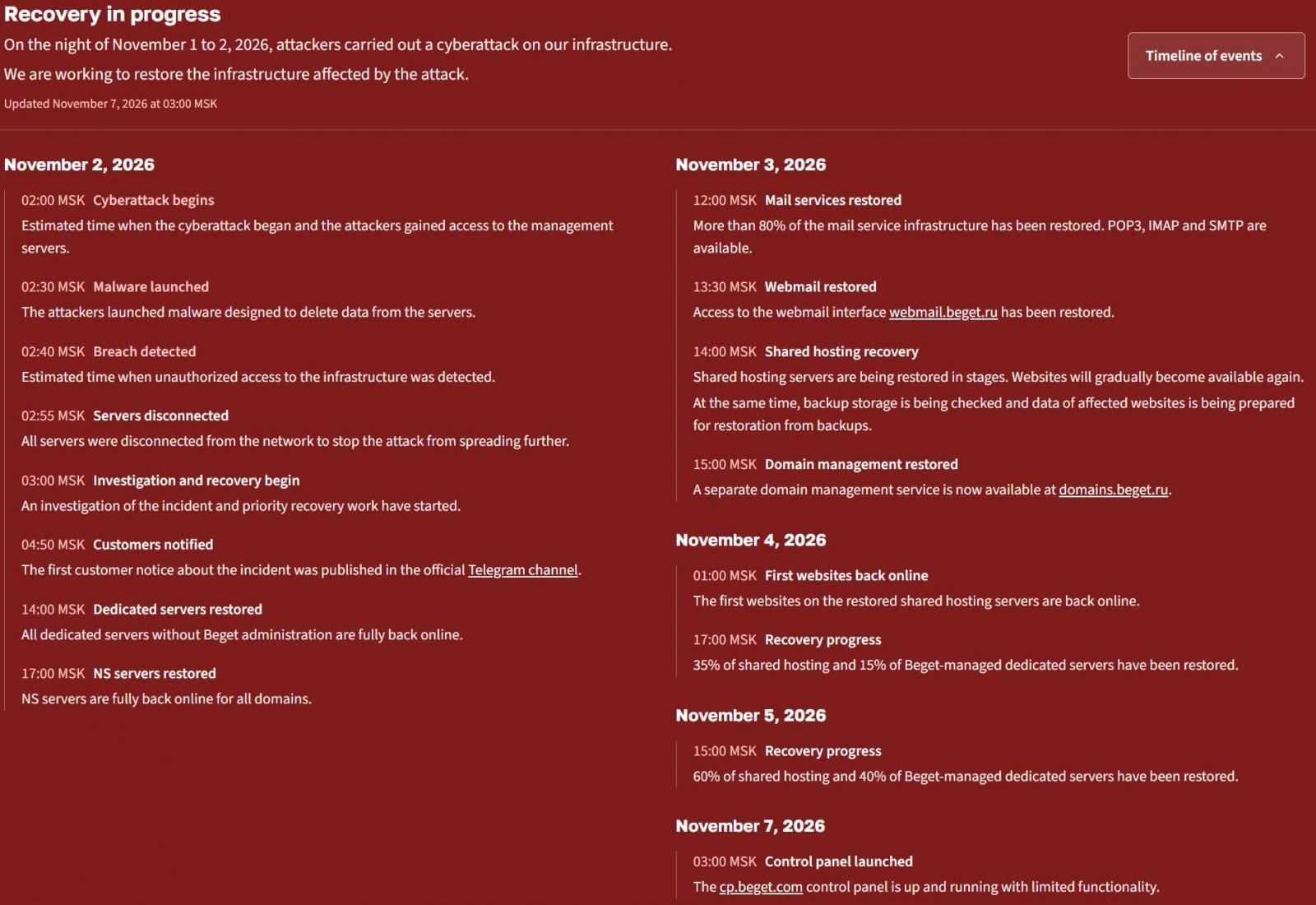
In a detailed statement released on November 3rd, Beget disclosed that attackers executed data-zeroing routines after gaining control of the management layer. The assault resulted in total loss of all data residing in the company's cloud infrastructure, encompassing VPS instances, S3 object storage, and Kubernetes deployments, along with CDN configurations and IP address assignments.
The damage to backup systems was severe. Binary backups for VPS services were entirely destroyed, while file-based backups sustained partial damage. A reassessment completed on November 6th indicated that file backups would be retrievable for approximately half of VPS customers.
Unfortunately, it is impossible to recover all data
Beget
Beget elaborated on the VPS recovery challenge, noting that even where backups exist, the process of matching them to individual users presents substantial technical hurdles. The company stated it had exhausted available recovery options and determined that file backups would be accessible to only half of its VPS user base.
Recovery and remediation efforts
The restoration operation is resource-intensive, requiring approximately 1,000 servers to undergo manual inspection for security flaws and malicious code before returning to service. Beget has adopted a defensive posture, assuming all infrastructure components may harbor threats.
We are therefore cleaning out everything we can and reworking every potentially vulnerable point, including those that previously did not appear to pose a risk.
Beget
Investigation findings indicate the attacker showed no interest in exfiltrating or altering data on the compromised systems. The assault was purely destructive in nature, focused exclusively on erasing information rather than theft or modification.
Beget has filed reports with law enforcement and relevant government bodies and is collaborating with external cybersecurity specialists to contain the incident and accelerate infrastructure restoration.