
OVHcloud has alerted customers that its open-source CLI tool was compromised to distribute credential-harvesting malware. The attack involved unauthorized access to a developer's GitHub account, which was then used to tamper with versions 0.11.0 through 0.15.0 of the utility.
The CLI provides administrators and developers with terminal-based management of OVHcloud's cloud and hosting infrastructure, including task automation capabilities. OVHcloud CEO Octave Klaba disclosed the breach and advised anyone who downloaded the latest version on October 19 to immediately update or uninstall the tool.
The malicious release appeared at 14:47 UTC on October 19 and was identified and removed at 16:21 after a customer flagged the issue. Klaba confirmed that versions 0.10.0 and 0.16.0 remained uncompromised.
The compromised versions are v0.11.0 v0.12.0 v0.13.0 v0.14.0 v0.15.0
Octave Klaba, OVHcloud CEO
The malware's primary function was to extract stored credentials from infected systems. Although Klaba characterized the malware quality as substandard, he emphasized the severity of the threat.
The quality of the binary is poor but it can go all the way. If you are affected, please change all the secrets on your disk.
Octave Klaba
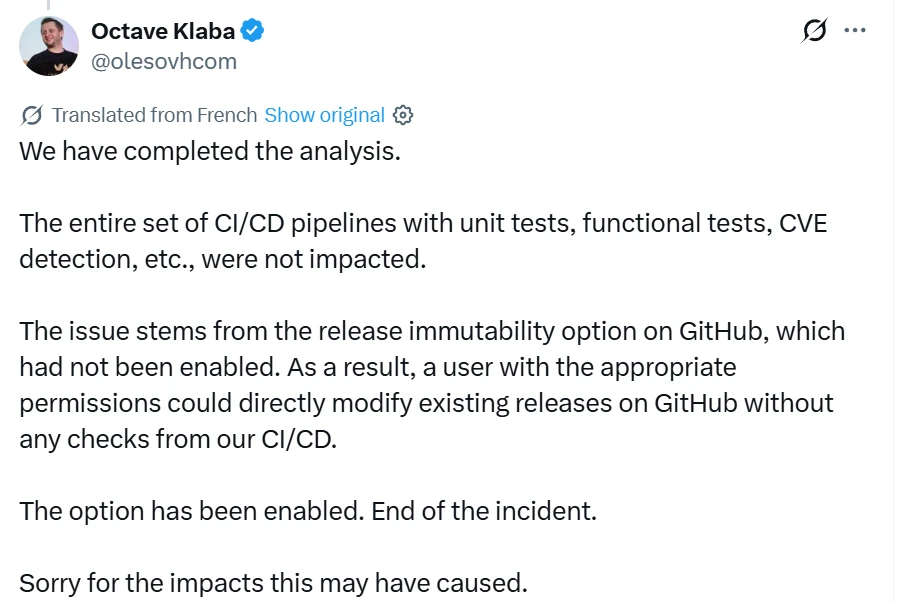
Investigation revealed that GitHub's release immutability setting had been disabled on the repository, permitting the compromised account to alter existing releases without triggering CI/CD validation. Klaba noted that the build pipelines themselves—including unit tests, functional tests, and vulnerability scanning—remained intact and unmodified.
OVHcloud has now activated GitHub's release immutability protection and considers the incident contained. The company recommends that all users who executed a compromised binary perform thorough system cleanup and rotate all credentials.
GlassWorm Connection
OpenSourceMalware, a community-operated threat intelligence resource, linked the attack to GlassWorm, a threat actor behind campaigns since late 2025 targeting the VSCode, OpenVSX, GitHub, and npm ecosystems.
Researchers determined that the attacker did not compromise the CI/CD infrastructure but instead built and uploaded malware-laden packages locally. The GitHub account involved in the attack had been under attacker control for over six months.
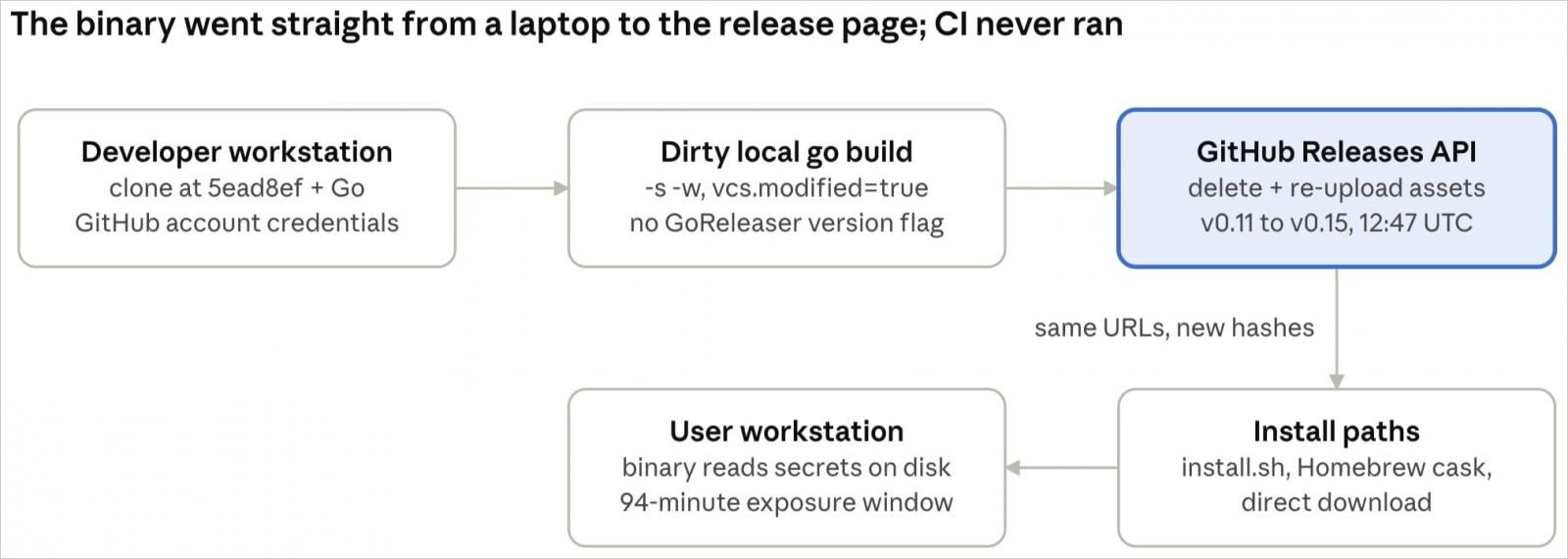
Analysis of the compromised account's public repositories uncovered a scripted history rewrite on March 5, 2026, and a concealed preinstall.js loader that decodes a secondary payload using a Solana memo dead drop mechanism. The associated cryptocurrency wallet matches known GlassWorm infrastructure, though researchers did not examine the final malicious payload delivered through the trojanized CLI.
The backdoored binaries affected macOS systems running Intel and ARM processors, Linux distributions on x86_64 and ARM64 architectures, and Windows x86-64 platforms. Source code builds and Docker container images were not compromised.
Anyone who executed an affected binary should assume all secrets stored on that machine have been exposed to attackers.