
Developers using OpenAI's API can now activate watermarking for generated text, marking an expansion of the company's content provenance initiatives to address identification challenges with AI-produced language. The rollout comes as OpenAI prepares mandatory watermarking for certain EU-based outputs under the AI Act's transparency rules.
The underlying technology, called textGrain, embeds a detectable pattern by subtly steering model word selection—choosing one fitting term over another when both would work contextually. Across sufficient text length, these choices accumulate into a recognizable signal that OpenAI's detection system can identify.
Starting immediately, API customers worldwide can activate watermarking on eligible models. OpenAI will begin automatically watermarking supported ChatGPT and Codex output in the European Union in the coming weeks to meet regulatory requirements.
Starting today, API customers globally will be able to opt in to text watermarking for select models. Text watermarking will remain off by default in the API. This lets customers decide how watermarking fits their transparency obligations and the experiences they provide to users.
OpenAI
OpenAI and Anthropic take divergent paths
OpenAI's voluntary approach stands apart from Anthropic's strategy announced in August when the company introduced watermarking for Claude. Anthropic implemented watermarking globally across supported Claude models, citing technical constraints in applying region-specific restrictions. The watermark applies uniformly to Claude API usage and other product surfaces, with no documented opt-out mechanism for developers.
Anthropic's documentation states: "Watermarking will be applied at the model level, which means it will be present no matter which Claude product or surface the text comes from." This gives API developers less discretion than OpenAI's offering.
For OpenAI customers choosing to enable watermarking, activation occurs at the project or organization level, with granular selection of which supported models apply the feature. No modifications to individual API calls are necessary once enabled.
OpenAI's broader content provenance efforts
OpenAI has deployed multiple provenance technologies for different content types. In 2024, the company began embedding Content Credentials into generated images using the C2PA standard to document file origin and history. Google's SynthID watermarks were added to supported images in May 2026 and audio in July. OpenAI now operates a Content Provenance API for verifying these signals in images and audio.
Rather than adopting existing text watermarking solutions like SynthID or Meta's TextSeal, OpenAI developed textGrain internally. The company explains this choice on its FAQ: it wanted "more control….over the balance between watermark detectability and the variety of responses generated from the same prompt." Testing showed textGrain matched or exceeded SynthID's detection performance. OpenAI intends to open-source the technology to enable broader improvement efforts.
Detection limitations and code challenges
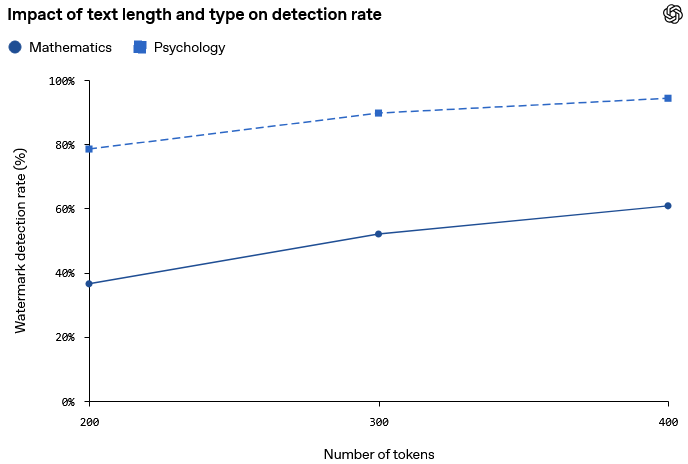
The watermarking method faces inherent constraints. Since textGrain operates through word-choice preferences, detection weakens in contexts with fewer viable alternatives. OpenAI reports its detector identifies roughly 80% of watermarked 200-token passages and 95% of 400-token passages in fields like psychology, maintaining a 1% false-positive target. Detection rates drop for constrained domains such as mathematics.
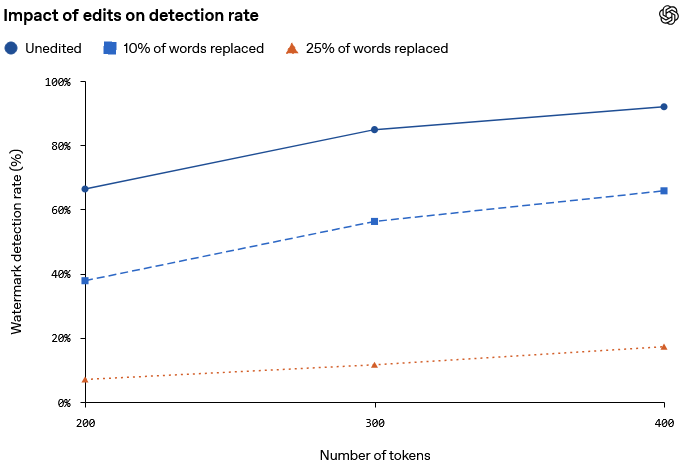
Editing poses another challenge. When OpenAI tested replacing 10% of words in a 400-token passage with synonyms, detection fell from approximately 92% to 66%. Increasing substitutions to 25% dropped the rate to just 17%. Short passages may lack sufficient material for reliable watermark identification.
Code presents particular difficulties. OpenAI notes that "Code is also harder to watermark because there are fewer plausible choices for what comes next than in ordinary prose." This limitation carries weight given OpenAI's plan to automatically watermark eligible Codex output in the EU. The company has not yet clarified what "eligible" means for code or whether the watermark applies to generated code itself.
Anthropic has encountered comparable obstacles with Claude. Code offers fewer opportunities to embed signals without risking program behavior changes, though natural-language elements like comments watermark more readily.
OpenAI tested its Astra model with and without watermarking across coding and agent benchmarks including DeepSWE, AutomationBench and Terminal-Bench, finding no meaningful performance degradation. This suggests textGrain can operate without substantially compromising code quality, though it does not address how reliably watermarked code can be subsequently detected.
Detector access remains restricted
API customers activating textGrain do not automatically gain watermark detection capabilities. OpenAI is initially restricting detector access to approved research and academic institutions investigating text provenance and detection reliability. This arrangement permits researchers to assess watermark resilience through editing and transformations, or to study false-positive and false-negative rates under various conditions.