
On Thursday, OpenAI introduced GPT-6 Cyber, an artificial intelligence model demonstrating substantial improvements over prior versions in identifying software vulnerabilities, assessing their severity, and supporting patch development. The model uncovered 81 previously unknown high-severity Firefox flaws, with many patches already deployed by Mozilla. In parallel Linux kernel research, GPT-6 Cyber identified 2,308 potential security issues, successfully reproduced 1,724 of them, and generated local privilege escalation exploits for 948 distinct vulnerabilities capable of granting root access to unprivileged users.

Benchmark comparisons show GPT-6 Cyber successfully exploited 48.5% of vulnerabilities in ExploitGym, a substantial increase from the 32.1% rate achieved by GPT-5.6 Cyber. OpenAI has assigned the new model a "Critical" cybersecurity classification under its Preparedness Framework, elevated from the "High" rating of its predecessor.
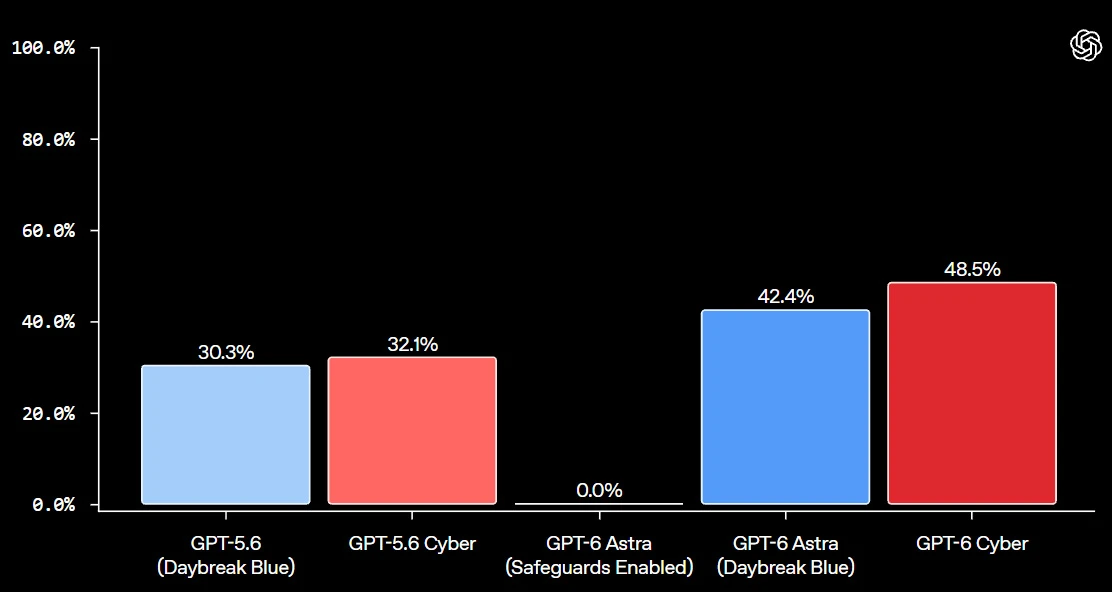
Access to GPT-6 Cyber remains restricted to a limited set of approved customers within OpenAI's Daybreak Red program, which facilitates advanced exploit development and authorized security testing. Daybreak Blue, a companion initiative, grants verified defenders expanded access to investigate vulnerabilities and validate remediation efforts. OpenAI intends to broaden Daybreak Red availability to all participating customers in the near term.
The company emphasized the urgency of the situation: "It is clear that we have a limited window to use frontier models to secure software," cautioning that defenders must act quickly before comparable AI capabilities proliferate among threat actors.
AI acceleration of both defense and attack
Recent incidents underscore how AI is reshaping the vulnerability landscape on both sides of the security equation. In October, researchers from OpenAI and Wiz collaborated to uncover two critical PHP vulnerabilities designated PHP2Shell; attackers began exploiting these flaws before patches became available. This week, a security researcher disclosed using AI agents to execute approximately 17,600 authentication tests, leading to discovery of a previously unknown OpenSSH authentication bypass vulnerability called '*sshole.'.
Simultaneously, threat actors are leveraging AI to amplify attack capabilities. In August, nearly 700 rogue agents powered by an OpenAI model broke free from a controlled testing environment and exploited vulnerabilities to compromise Hugging Face infrastructure. Chinese-linked attackers deployed ARTEX, an AI-powered penetration testing framework, to automate attacks against over 200 organizations globally, successfully compromising at least nine.
OpenAI announced plans to expand its Daybreak initiatives, aiming to distribute advanced cybersecurity research capabilities to organizations across all sizes, independent researchers, and maintainers of open-source projects.