Each time a worker approves an OAuth consent prompt, they establish a persistent trust link between two applications. A calendar gains access to an AI note-taking service. Slack becomes reachable by a task manager. Code repositories open to a fresh development tool. The approval itself takes mere seconds. Proper assessment of that decision requires substantially more time.
Security and IT leadership face a different problem now. The question of whether staff will wire up applications to company data has already been answered—they have, repeatedly, across thousands of instances. The real issue is staying current: identifying which grants are active, assessing which ones pose genuine danger, and determining which should be eliminated, all without consuming an entire work week on repetitive manual checks.
Why OAuth grants resist traditional governance
OAuth grants operate outside the standard access control framework most organizations have built. A widespread misconception treats OAuth grants as subject to the same identity controls already in place. In reality, OAuth functions as a distinct protocol separate from authentication itself. Single sign-on manages identity verification. Multi-factor authentication raises the bar for that verification. An OAuth grant serves neither purpose.
https://www.youtube.com/embed/nfA-AYZkjDc
These grants also persist beyond the tenure of the individuals who authorized them. Removing a user account from Google Workspace or Microsoft 365 only terminates grants originating within those platforms. Third-party applications that issued grants continue operating without interruption.
Many grants remain inactive for extended periods without generating any audit trail, yet they retain full validity and can be activated whenever needed.
Threat actors understand this dynamic. The Vercel incident traced back to a compromised OAuth token from Context.ai, an AI application that a single employee had linked to their enterprise Google Workspace account months prior. That single authorization decision provided the entry point.
The scale of the challenge becomes clear from available data:
- 88 OAuth grants created per employee on average, with 31 carrying data-level permissions
- 40 apps per organization with programmatic access to sensitive corporate data on average
- 50% of SaaS breaches will originate from overprivileged OAuth tokens by 2027
At a 1,000-person organization, this translates to 88,000 potential access routes, with 31,000 providing direct pathways to sensitive information.
The time cost of manual review
A comprehensive assessment of a single OAuth grant involves multiple steps:
- Retrieve the application profile and determine whether your security team has already evaluated it. Does the vendor maintain a genuine security and compliance infrastructure? Have they reported any breaches in the past year?
- Examine the authorizing user's role to verify whether administrative capabilities were granted to the application
- Evaluate the requested permissions against industry norms for similar integrations and your organization's data-sharing guidelines
- Contact the user who granted access to understand the business justification and verify their MFA configuration
Completing this evaluation for a single grant typically requires 45 minutes to reach a conclusion.
Forty-five minutes represents reasonable effort for one grant. It becomes unworkable for tens of thousands. Experience and expertise cannot accelerate manual processes, and no security organization maintains sufficient staff to sustain this workload.
This reality makes automated agent capabilities essential for managing OAuth grant risk, not merely convenient. They represent the only practical approach to addressing the actual attack surface.
Discovering every OAuth grant
Risk assessment requires first locating the grants in question. Complete OAuth visibility across grants and application-to-application connections throughout the SaaS environment is foundational, including grants established before deployment.
Discovery operates independently of activity logs, meaning inactive grants and identity-only grants (such as "Sign in with Google") become visible alongside active ones. The process also identifies API keys, service accounts, and remote MCP server connections that support AI tools and agents, creating a comprehensive view of programmatic data access.
This visibility includes:
- The application and vendor receiving access
- The employee who authorized the grant
- The precise permissions and scopes granted
- Which corporate applications and data the grant can reach
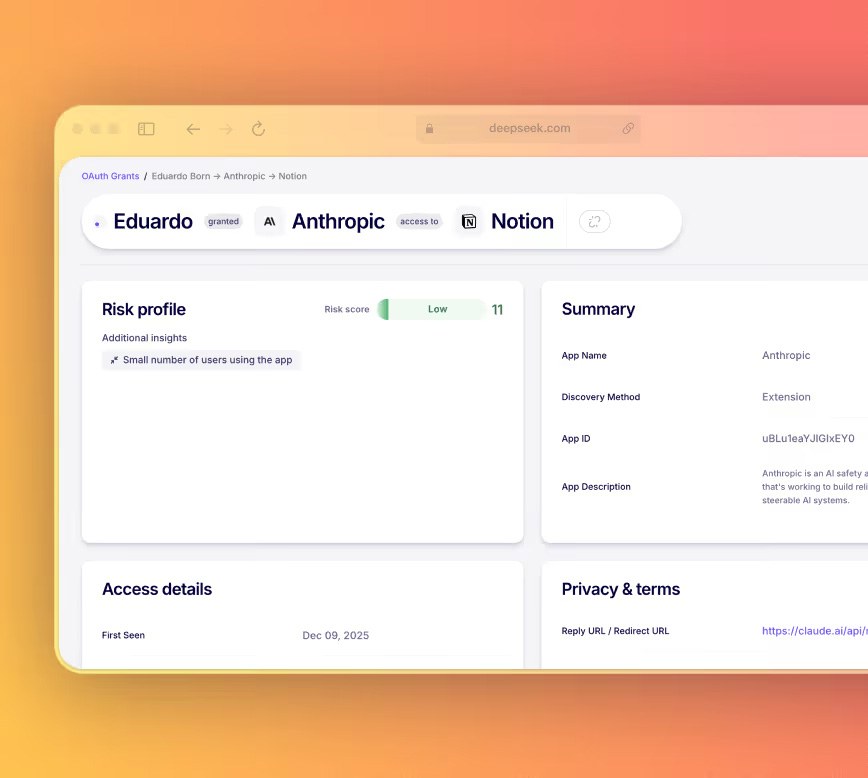
Assessment: Identifying meaningful risk signals
A grant inventory becomes useful only when priorities emerge. Automated classification and risk scoring of every integration draws on permission scope, vendor reputation, the authorizing user, organizational usage patterns, and data sensitivity.
Risk indicators include:
- Excessive or overprivileged permissions
- Suspicious domains
- Applications commonly leveraged by attackers for data theft
- "Data highways"—connections with unusually broad, sustained access to sensitive resources like email, files, and code repositories
- MCP servers functioning as intermediaries between AI tools and corporate data
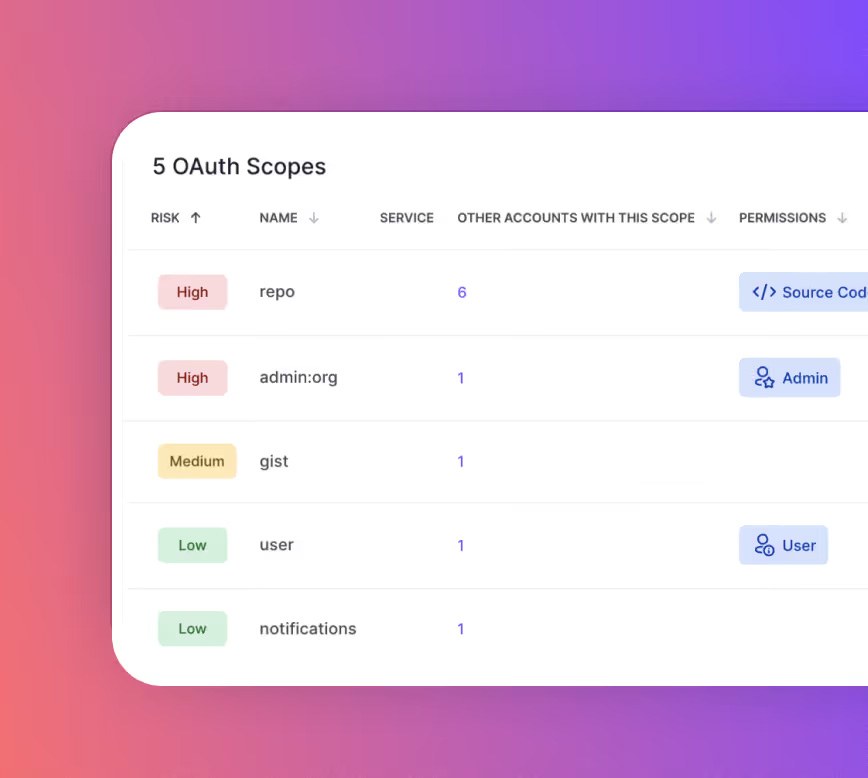
Positive indicators also surface, including widely-used applications and verified publishers, enabling rapid distinction between routine and anomalous activity.
Analysis: Verdicts delivered at scale
Risk scores indicate where attention belongs. An OAuth Grant Risk Analyst agent performs the substantive analysis.
The agent examines new OAuth grants as they appear, leveraging discovery context spanning browser activity, email, identity providers, and connected applications, combined with risk intelligence from over 240,000 vendor security profiles.
The agent evaluates the same considerations an experienced analyst would review:
- The authorizing user: their identity, organizational role, and user metadata
- The vendor: security posture, compliance framework, and recent breach disclosures
- The permissions: which scopes were granted and how they compare to typical usage
- The reach: what the application can access and how it operates across the organization
By examining who created a grant rather than only what the grant permits, the agent identifies patterns that simple risk scoring overlooks, such as a newly-hired employee authorizing a high-risk developer grant.
Analysis results include a plain-language risk assessment, a summary, detailed reasoning, any missing information, and one of three recommendations:
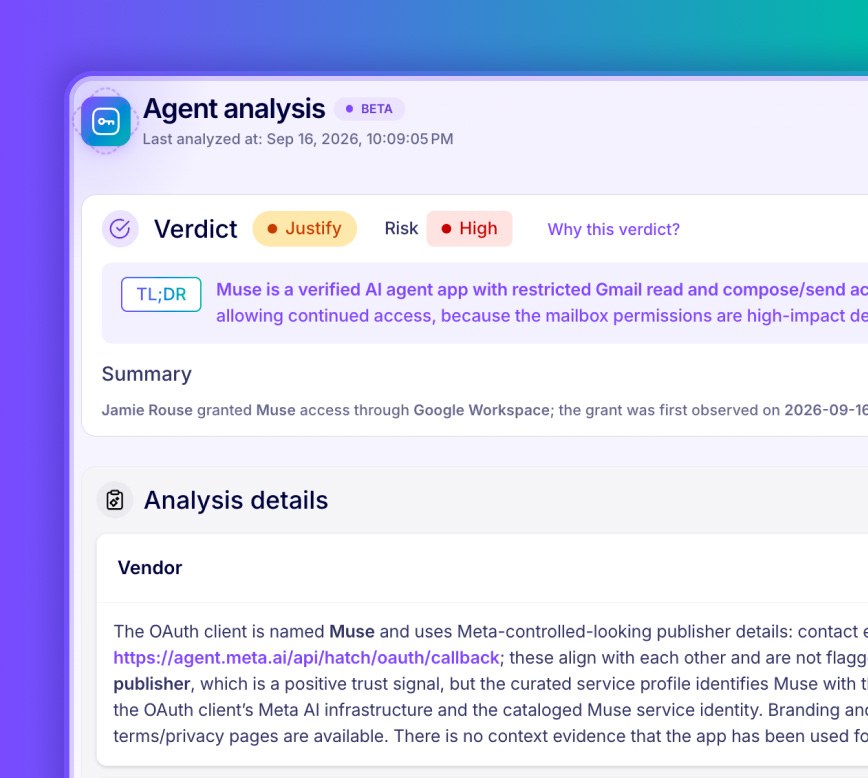
- Permit: The grant presents low risk and should remain active
- Justify: The grant requires additional review. Confirm the business need with the authorizing user
- Revoke: Risk exceeds business value, and the grant should be removed
The 45-minute manual review reaches the same conclusion in 15 seconds through the agent.
Governance: Human teams retain decision authority
Speed delivers value only when outcomes merit trust. The OAuth Grant Risk Analyst keeps security teams engaged before any changes occur.
The agent proposes the next action, and the team evaluates the recommendation and supporting evidence. Upon approval, the agent executes the action—whether revoking the grant or requesting justification from the authorizing user. Full auditability ensures visibility into what occurred, when, and why.
Additional controls help manage OAuth risk over time:
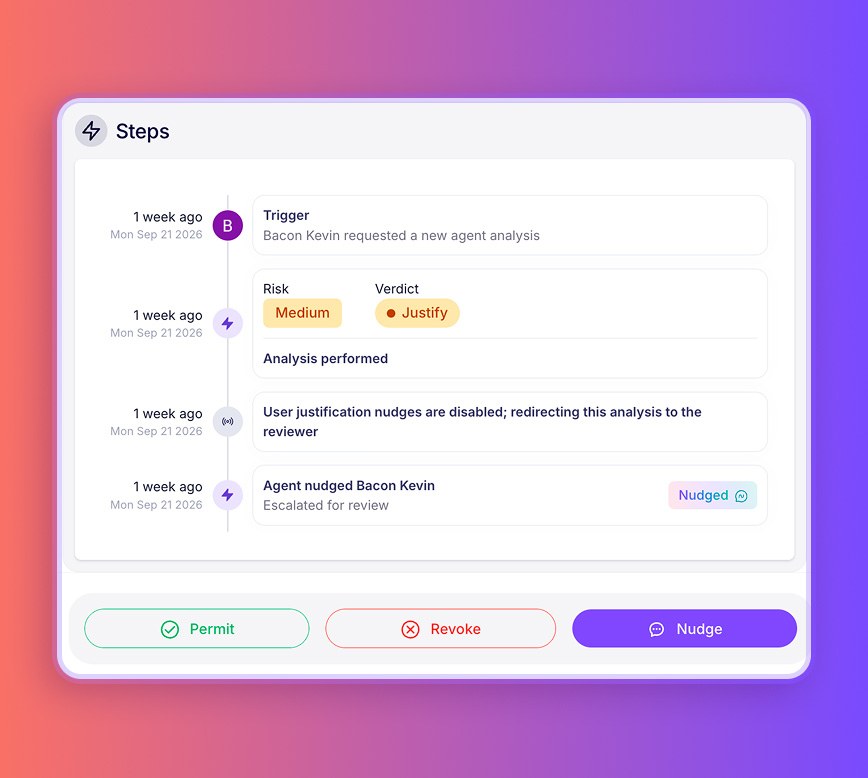
- Direct outreach to users via Slack, Teams, email, or browser extension requesting justification, with responses captured automatically
- Real-time alerts for new OAuth activity
- Automatic revocation of risky or dormant OAuth grants, including during employee offboarding
This workflow transforms a 45-minute manual review into a decision the team can make in seconds while retaining full control.
The bottom line
Employees will continue connecting applications to accomplish their work. This trend will persist, and it should. The responsibility falls on security teams to ensure every connection is visible, comprehensible, and removed if risk outweighs benefit.
OAuth risk management integrates into a broader SaaS and AI security governance platform. The solution delivers complete OAuth grant inventory, risk context for understanding them, and an AI agent providing clear recommendations at scale, while teams maintain control over all decisions.