
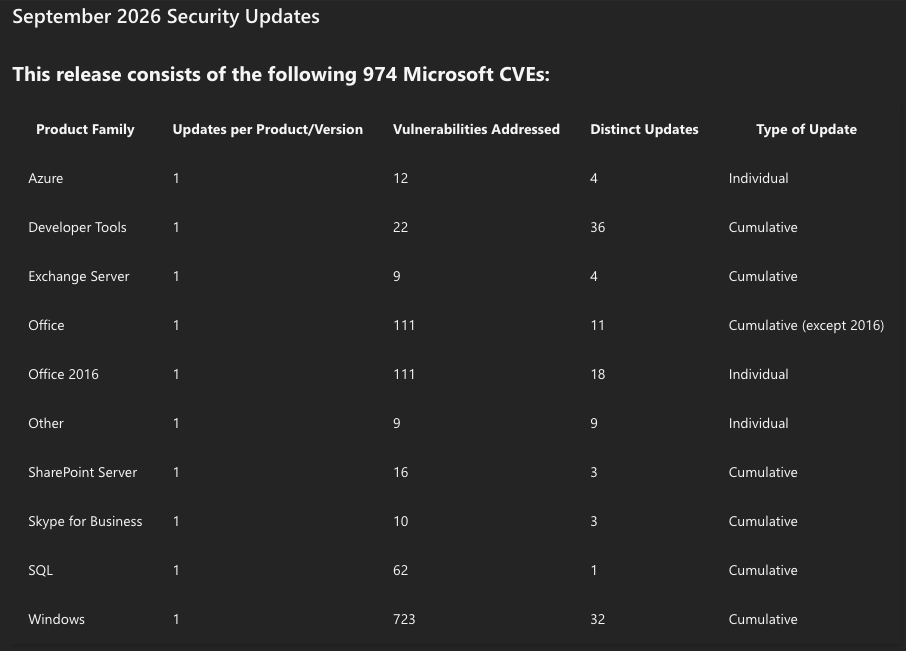
A record-breaking security update from Microsoft Corp. today addressed at least 974 vulnerabilities across its Windows operating systems and broader software portfolio. The company attributes the acceleration to artificial intelligence tools that speed vulnerability identification, yet security professionals caution that deployment remains a bottleneck for many enterprises struggling to validate and roll out such massive monthly patch sets.
The September release far exceeds Microsoft's previous high-water mark from July, when the company patched a minimum of 570 flaws. Through September alone, Microsoft has now issued fixes for more than 2,600 vulnerabilities this year—more than double the 1,245 patched during 2020, the company's previous record year, with a quarter of the calendar still remaining.
Two zero-day vulnerabilities receiving fixes this month are already under active attack. Both CVE-2026-81963 and CVE-2026-85880 permit attackers to escalate privileges on Windows systems.
Among this month's fixes, 113 vulnerabilities received Microsoft's "critical" designation, indicating potential for malware or attackers to commandeer vulnerable Windows machines with minimal or no user involvement.
CVE-2026-69730 stands out as a particularly severe critical flaw—a DNS weakness affecting Windows Server 2012 and later versions alongside Windows 10. According to Microsoft, an unauthenticated adversary could trigger exploitation by transmitting a malformed packet to a susceptible system, and the company expects active exploitation.
Equally concerning is CVE-2026-69829, a critical remote code execution vulnerability residing in the Windows Shell component. Carrying a CVSS base score of 9.8 out of 10, this flaw demands minimal attack complexity, requires no prior access, and necessitates zero user action for successful exploitation.
Microsoft is far from unique in releasing expansive patch collections. Vendors including Adobe, Cisco, Google, Mozilla, and Oracle have similarly attributed their rising patch volumes and frequency to AI-powered vulnerability research. Google announced today that it will transition to biweekly security update cycles.
Testing and Deployment Challenges
Tyler Reguly, associate director of security research and development at Fortra, highlighted a fundamental obstacle: Windows patches require validation before enterprise deployment since third-party applications may not function correctly following operating system modifications.
It's time to put our CISOs and CSOs on notice. How are you helping your teams through these difficult times? Do you have your teams deploy after hours and on weekends to avoid disruption to the business environment? Do you reward them for that effort? Time to dig into your budget and buy dinner for your teams that are working on Saturday to get patches rolled out before users return to work on Monday.
Tyler Reguly, Fortra
Satnam Narang, senior staff research engineer at Tenable, emphasized that while Microsoft's patched vulnerability count continues climbing, the subset actually impacting most organizations remains comparatively modest.
AI-assisted vulnerability discovery in 2026 is creating larger haystacks, but it isn't finding more needles. It's critical that organizations understand which vulnerabilities actually apply to them, whether they pose a threat by being reachable and exploitable, and prioritize remediation based on this risk context.
Satnam Narang, Tenable
Guidance for Users and Administrators
Consumer Windows users lack the testing requirement that enterprises face, though they must still access Windows Update regularly or respond to system notifications about available patches. Given the accelerating scale of monthly releases, deferring updates indefinitely poses increasing risk.
Enterprise administrators should monitor askwoody.com for reports of problematic updates. The SANS Internet Storm Center continues offering granular patch analysis sorted by severity and urgency.
Source: Krebs on Security