
The traditional vulnerability management workflow—manual code analysis, proof-of-concept development, coordinated disclosure, CVSS evaluation, sprint scheduling, and eventual deployment—operated at human pace for decades. That era has ended.
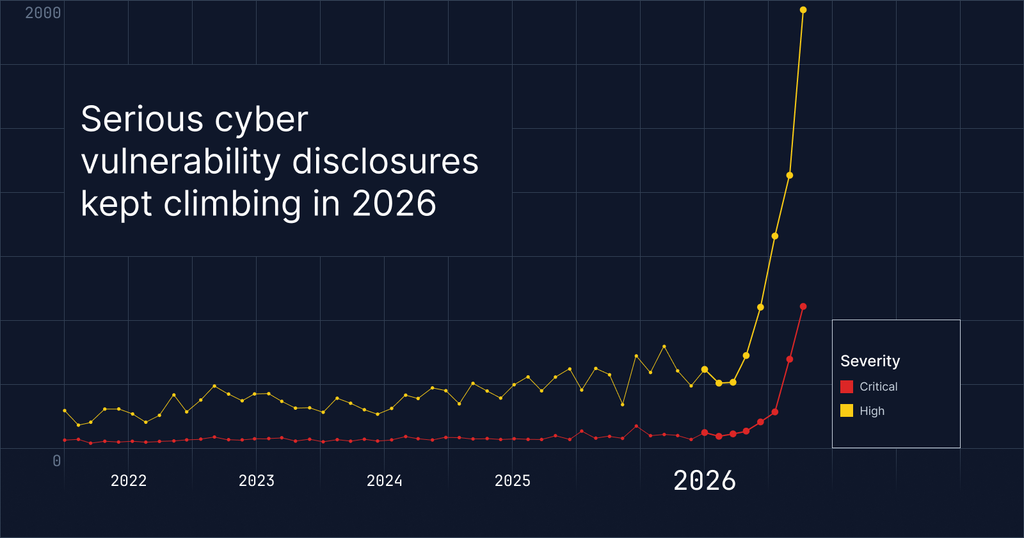
In the first nine months of 2026, publishers recorded 75,242 CVEs, representing roughly 20% of all vulnerabilities published since the CVE program was established in 1999. The acceleration is intensifying: according to the Cyber Strategy Institute, nearly 38,000 of those flaws emerged in Q3 alone.
The pace of vulnerability discovery has outpaced the human capacity to remediate it. Engineering organizations face a stark operational reality: the traditional two-week patch cycle is dead.
Why vulnerabilities exploded in 2026
The explosion stems not from degraded code quality but from vulnerability discovery evolving from manual craftsmanship into automated, distributed computation.
- Autonomous codebase traversal: Contemporary agentic security systems perform full-context semantic analysis—cloning repositories, tracing asynchronous data flows across microservices, constructing dynamic exploit payloads in sandboxes, and validating exploitability before generating alerts. This replaces legacy SAST tools that produced noisy pattern-matching dashboards.
- Exhaustive compute at scale: Automated agent swarms continuously scan open-source package registries and public repositories, decompiling transitive dependencies, examining legacy C/C++ utilities, and testing modern Go, Rust, and Node.js runtimes for concurrency bugs, deserialization flaws, and memory leaks.
- Focus on foundational infrastructure: Autonomous discovery concentrates on high-impact software targets including identity layers, reverse proxies, parsers, and container runtimes.
When machines exhaustively search across the entire public software graph, they discover every reachable flaw.
The operational cascade
Machine-discovered CVEs create severe structural friction across risk management, engineering velocity, and compliance:
- The exposure gap becomes unmanageable: The critical risk is elapsed time between public exploit discovery and downstream production deployment. When agentic frameworks generate working zero-day or N-day exploits within hours of a code push, a multi-day patching window represents an open door.
- Alert paralysis and triage debt: Engineering teams navigate between CVSS scores (which measure theoretical severity) and EPSS metrics (which predict real-world exploitation likelihood). Distinguishing whether an alert represents an unreachable helper function or an active, weaponizable zero-click flaw has transformed routine triage into continuous crisis management.
- Compliance and audit deadlock: Frameworks like NIST SP 800-53 (Control SI-2), PCI-DSS 4.0, and DORA enforce strict timelines for critical and high-severity issues. When 9.0+ CVSS scores arrive in weekly batches, security and platform leads spend more time writing risk-acceptance waivers than hardening production architecture.
Can internal IT teams keep up with patching and push innovation?
The short answer is no.
Enterprise development focuses on delivering business value: shipping differentiated features, enhancing platform reliability, and expanding market share. Yet contemporary software supply chains depend on thousands of dependencies. When a critical flaw surfaces in foundational infrastructure—an authentication engine, an API gateway, or a database driver—feature roadmaps freeze. Development teams enter fire-drill mode:
- Halt active sprint work.
- Trace internal dependencies to determine real exploitability.
- Reconcile dependency breaks, merge conflicts, and integration regressions.
- Execute emergency deployments across multi-region production clusters.
Defending against automated, machine-speed discovery using manual human labor is an economic dead end.
The architectural shift: Decoupling architecture from maintenance
Open-source software remains central to enterprise computing, but self-hosting foundational components imposes an unsustainable operational burden: your organization becomes the de facto maintainer of every layer you operate.
To withstand automated, machine-speed vulnerability discovery, forward-thinking engineering teams are restructuring their operating model: maintain open standards and architectures while outsourcing the patching burden.
1. Managed platform tiers for critical edge and identity
Foundational edge components—identity and authorization planes (such as Ory Kratos/Hydra) or ingress proxies (such as Envoy)—form an organization's perimeter. When implementation flaws or protocol vulnerabilities strike these layers, maintaining self-hosted community forks requires constant emergency rebuilds. Shifting these layers to managed vendor clouds transfers zero-day mitigation, regression testing, and upstream backporting to teams dedicated entirely to that software layer.
2. Commercial subscriptions with contractual backporting SLAs
Organizations constrained by strict data sovereignty, air-gapped data centers, or zero-trust VPC policies cannot always adopt public SaaS. However, relying solely on raw community repositories exposes internal teams to unpredictable release cycles and breaking updates.
A viable hybrid approach involves adopting commercial open-source enterprise subscriptions backed by formal CVE remediation SLAs (such as Red Hat Enterprise Linux, enterprise distributions of Kubernetes, or commercial licenses like the Ory Enterprise License). Organizations retain full control over their data plane while outsourcing patch engineering:
- Predictable remediation SLAs: Contractual response windows for High and Critical vulnerabilities replace upstream community best-effort timelines.
- Non-breaking LTS backports: Vendors backport security fixes directly to long-term support branches, eliminating the breaking schema changes and API refactors that accompany major upstream updates.
- Verified distribution streams: Access to signed SBOMs and hardened enterprise container images reduces internal triage friction in CI/CD pipelines.
3. Continuous delivery automation and runtime shielding
For internally maintained services, teams must automate the path from patch to production. This requires pairing automated GitOps workflows (such as ArgoCD, Renovate) with progressive deployment controllers (like Flagger or Argo Rollouts) and eBPF-based runtime shielding (such as Cilium Tetragon). Automated canary verification and kernel-level network enforcement isolate vulnerabilities in flight, buying engineers time to test and deploy updates without emergency rollouts.
Fighting automation with automation
The volume of vulnerability disclosures will not return to human scale. As autonomous models and agentic fuzzing advance, exploit discovery and weaponization will accelerate further.
The volume of vulnerability disclosures will not return to human scale. The sustainable path forward requires matching automation with automation: modernize the stack so upstream infrastructure partners absorb the patching burden.
Attempting to absorb this deluge with manual Jira tickets and emergency weekend deployments guarantees developer burnout and security breaches. The sustainable path forward requires matching automation with automation: modernize the stack so upstream infrastructure partners absorb the patching burden, allowing internal engineering teams to focus on what matters—shipping product.