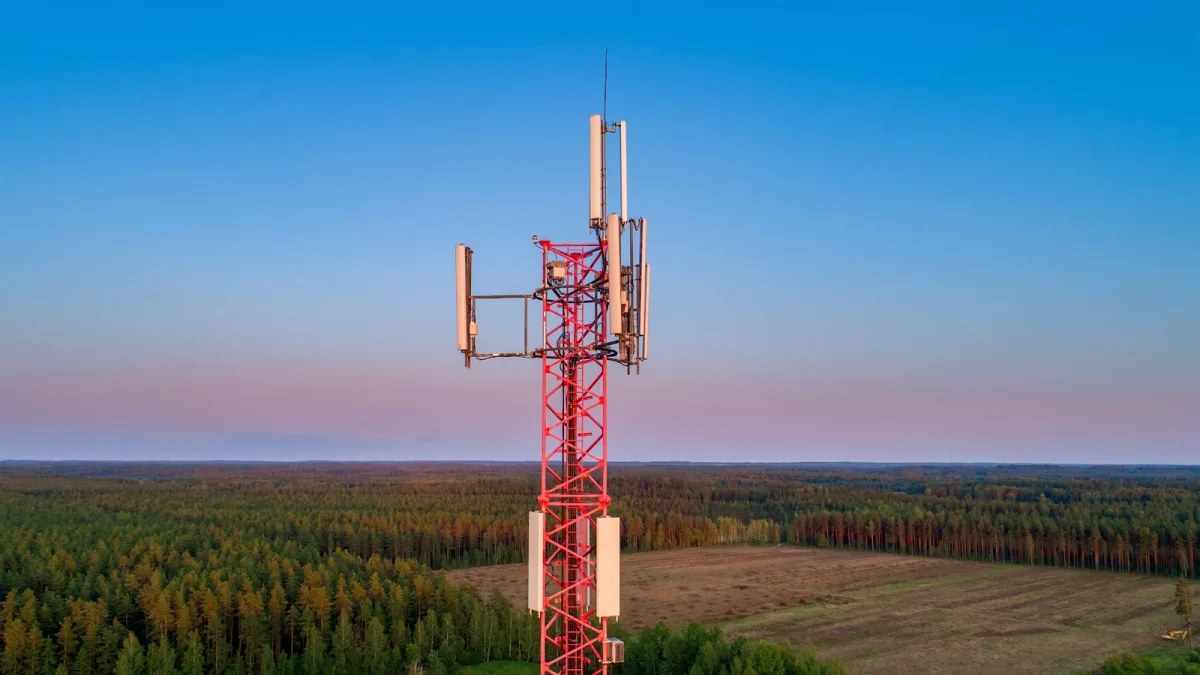
In April 2026, Canadian law enforcement arrested three individuals operating an "SMS blaster"—equipment that mimics a legitimate cell tower to deliver phishing messages to nearby devices. This technique shares fundamental similarities with IMSI catchers, surveillance tools that exploit fake base stations. Both attack methods succeed by convincing phones to connect to the strongest available signal and transmit sensitive data before any authentication occurs.
Your phone continuously broadcasts identifiers through its cellular radio. The most critical of these are the IMSI (tied to your SIM card) and the IMEI (tied to your physical handset). Attackers using fake towers or other techniques can intercept these identifiers to track location, intercept communications, or build detailed movement histories.
What information does your phone actually broadcast?
Multiple radios within your phone connect to different networks and expose varying amounts of information. Wi-Fi and Bluetooth radios transmit hardware addresses, though modern devices randomize or rotate these to limit tracking exposure.
The cellular radio reveals two identifiers that typically remain static throughout the device's lifetime: the IMSI, which corresponds to your SIM card, and the IMEI, which corresponds to your handset itself.
IMSI vs IMEI
The IMSI (International Mobile Subscriber Identity) is a permanent number assigned by your mobile carrier upon account creation. Stored on your SIM card, it enables the network to identify and authenticate your subscription. In most circumstances, your IMSI remains unchanged for years.
The IMEI (International Mobile Equipment Identity) is a permanent number assigned to your physical phone. Unlike the IMSI, the network does not authenticate this identifier; it simply identifies the device without verification.
Protection levels for each identifier vary based on the cellular generation deployed. The 3GPP standards body establishes mobile network specifications, with newer generations offering stronger safeguards. However, phones often revert to older network standards when necessary, creating vulnerabilities that fake towers exploit.
How your IMSI can be leaked
- IMSI catchers and fake base stations: In 4G networks, phones transmit the IMSI in unencrypted form to towers that have not authenticated themselves—the exact vulnerability IMSI catchers target. Although 5G introduces SUCI encryption to address this weakness, incomplete 5G coverage allows attackers to force devices back to 4G or earlier standards.
- Paging attacks: Idle phones conserve battery by entering sleep mode and awakening only at specific intervals, called paging occasions, to check for incoming calls, messages, or notifications. In 4G, the paging slot is derived from the IMSI using a publicly available formula, meaning the slot never changes as long as the IMSI remains constant. (5G uses a temporary identifier instead.)
Researchers published a 2019 paper demonstrating how to exploit paging vulnerabilities. An attacker possessing your phone number can initiate "silent calls" (calls terminated before your phone rings), send messages, or trigger app notifications. Using a nearby radio receiver, the attacker observes which paging slot becomes active. After approximately eight attempts on average, the pattern confirms your presence in the area—without requiring a fake tower. This attack succeeded against all tested US carriers.
Paging attacks serve as a foundation for more dangerous attacks. Using a fake tower, an attacker can directly correlate your phone number with your IMSI. Certain carriers revert to broadcasting the raw IMSI in paging messages when normal pages to a phone's temporary identifier fail. An attacker who knows your paging slot can trigger this fallback behavior.
A fake tower can intercept your paging channel to block legitimate network pages. A single silent call then causes the carrier to transmit your IMSI over the air, where the attacker captures it. Researchers validated this attack against one major US carrier.
Once an attacker obtains your IMSI, they can track your location or intercept your calls and text messages through signaling attacks.
What about the IMEI?
An IMSI catcher functions similarly to a license plate reader for phones: the IMSI resembles the license plate, following your SIM card, while the IMEI resembles the vehicle identification number, remaining with your device. In 4G and 5G networks, a basic fake tower captures the IMSI but not the IMEI, because phones transmit the IMEI only after authenticating with the network.
Attackers typically must either downgrade the phone to an older network standard or use authentication credentials obtained previously through SS7 or Diameter attacks, which themselves begin with harvesting an IMSI. Signaling systems use the IMSI rather than the IMEI to route calls or determine your location.
If your mobile carrier becomes compromised, however, anyone with access to carrier systems could track you using your IMEI.
Why rotating the IMSI helps
Cape's Identifier Rotation changes your IMSI every 24 hours or on demand, cycling through seven IMSIs per week drawn from a shared pool continuously reassigned among customers. This means each IMSI carries a complex history involving many users' activities.
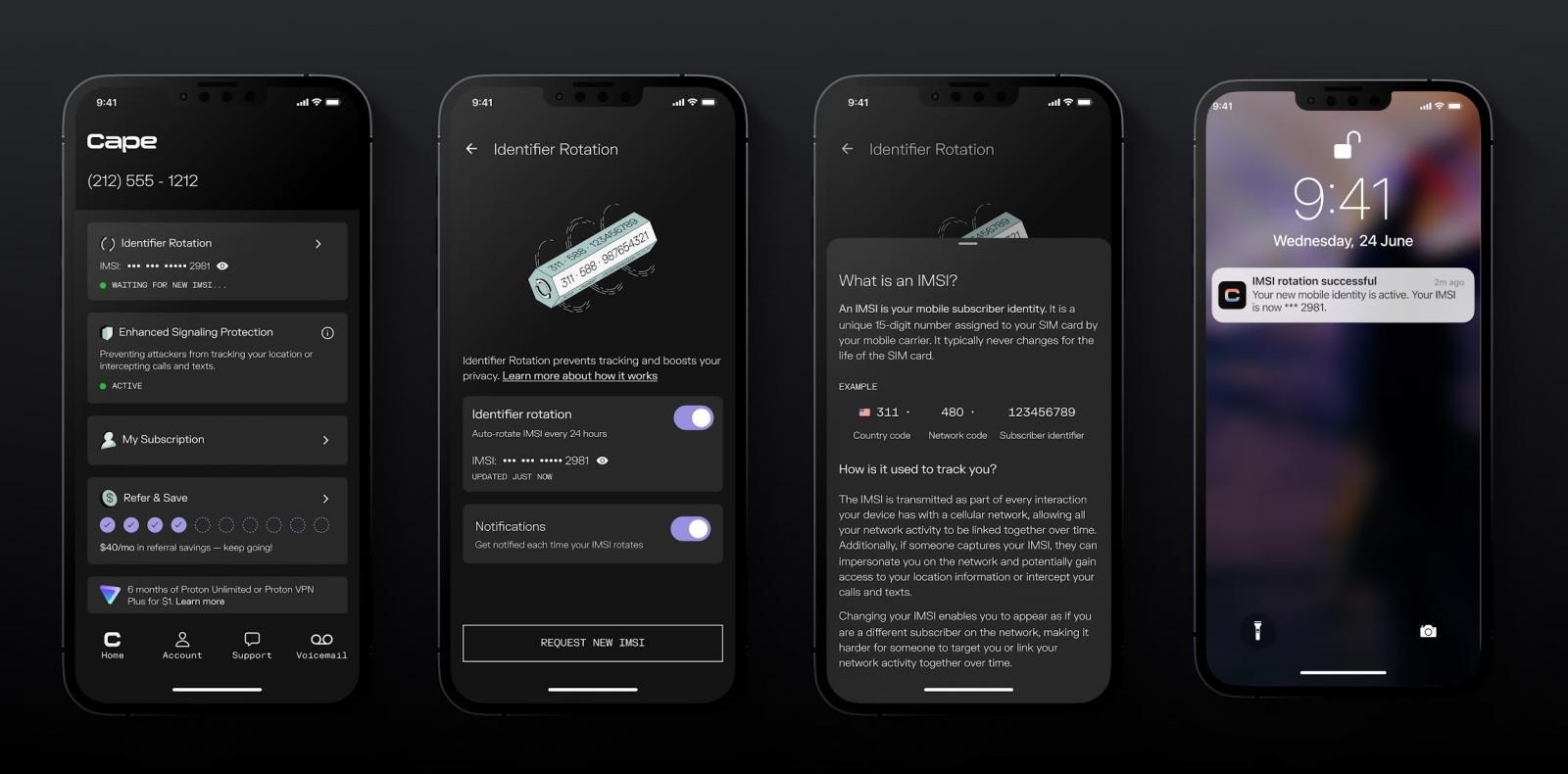
- Harvested IMSIs become outdated. Signaling attacks begin by harvesting a target's IMSI, which on a standard carrier remains valid for years. A rotated IMSI stops identifying you within a day. An attacker can still request your current IMSI in real time, which is why rotation works alongside additional signaling protections.
- The paging fingerprint changes. In 4G, a new IMSI generates a new paging slot, so any pattern an attacker previously established no longer applies.
- IMSI catchers lose continuity. A catcher can still capture today's IMSI, but cannot match it to yesterday's, preventing attackers from building a movement history or confirming your presence using an IMSI learned previously. Cape combined with GrapheneOS adds LTE-only mode to prevent downgrades.
For most users, the tracking threat that matters involves long-term patterns built on stable identifiers—precisely what rotation disrupts.